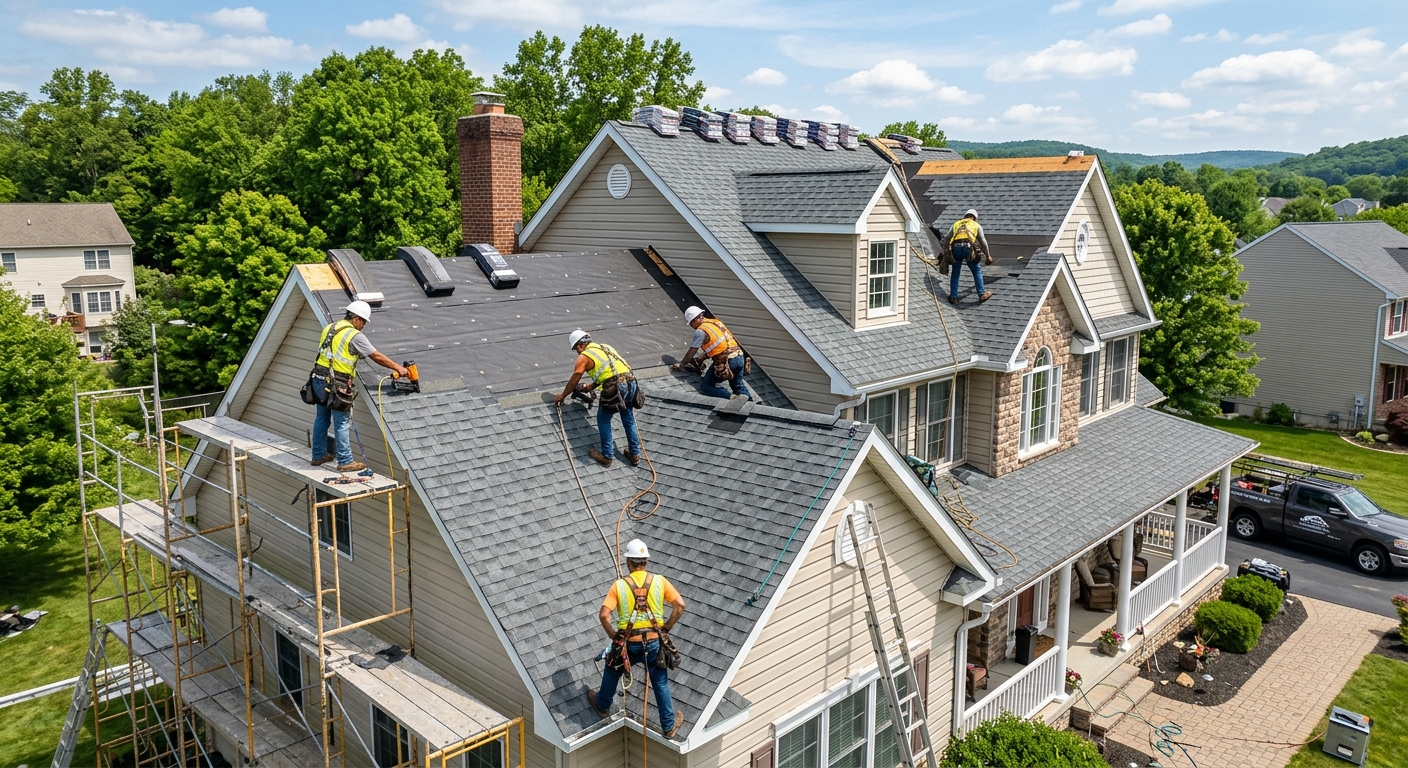
West Deer roofing prices by material and scope — 2026
In West Deer, most homes date from before 1980, with more than half predating 1980 (U.S. Census Bureau, ACS 2024), which means roof replacements here often uncover old decking, hidden layers, or poorly vented attics behind the shingles. With a homeownership rate above 85%, and a strong preference for single-family houses, West Deer’s roofing needs center on full tear-offs and long-term durability, not quick patch jobs or surface recovers.
A high percentage of the area’s housing stock comes from the 1900–1950 era—a time when roof sheathing was often plank rather than plywood, and flashing details didn’t meet today’s practices. In these homes, roof replacement often involves more than a shingle swap: expect deck repairs and ventilation upgrades to add cost and time. Many projects run into unforeseen decking rot, out-of-date venting, or troublesome chimneys—all common in West Deer because of age and hard winters.
Most West Deer roofs are covered with architectural asphalt shingles, which balance price and reliability in the face of freeze-thaw cycles and frequent Ohio Valley storms. Metal is less common but increasingly chosen by owners wanting the longest service life. Flat roofs on additions require specialty membranes (not shingles), and leak repairs can be worthwhile if the roof's age justifies it.
| Material / Scope |
Lifespan |
Best for |
Price range (installed) |
| Asphalt shingles — architectural (30-yr) |
25–30 yrs |
Standard pitched roofs in West Deer |
$9,600–$20,000 |
| Asphalt shingles — impact-resistant (Class 4) |
30+ yrs |
Storm-prone sites, maximizing insurance premium credit |
$15,500–$20,000 |
| Metal standing seam |
40–70 yrs |
Owners seeking maximum longevity or minimal maintenance |
$23,500–$41,500 |
| Flat roof — TPO or EPDM |
15–25 yrs |
Porches, low-slope additions, and flat sections |
$12,000–$24,500 |
| Roof repair — leak or isolated section |
n/a |
Troubleshooting single leaks or preventive maintenance |
$500–$1,900 |
Prices are estimates for a typical West Deer home and vary with roof size, pitch, decking condition and material selection.
Decking, ventilation and flashing — the hidden roof costs
The bid you get for your West Deer roof rarely includes all the costs a 40-, 60-, or even 100-year-old house can spring on replacement day. Old decking covered by two or three shingle layers may be soft or rotted underneath, and you can't spot it until everything comes off. Replacing a few sheets of decking can add $600–$1,500 depending on how much needs replacing.
Attic ventilation is another line-item that’s overlooked or “thrown in” at estimation—but in this freeze-thaw Allegheny County climate, poor airflow leads to ice dams, deck rot, and premature shingle failure. Upgrading vents or adding intake/exhaust can cost $400–$1,200, but can mean the difference between a shingle warranty standing or being denied after the first rough winter.
Flashing around chimneys, walls, and valleys is a chronic weak spot in older West Deer homes, especially with outmoded tar or aluminum (common on pre-1980 housing). Installing new step and counter-flashing with the roof should cost $350–$900 on an average house, and about the same to replace all vent boots or add a continuous drip edge. Ridge vent installs—vital for long roofs—usually add $300–$700 to the bill, but can prevent attic mold and extend roof life considerably.
Most of these numbers aren’t optional: in Allegheny County, covering up old code violations or skipping vent upgrades simply leads to callbacks and denied claims. A realistic roof quote in West Deer should budget for at least a few of these contingencies.
When to book roofing work in West Deer
Roofing in West Deer follows a seasonal rhythm set by southwestern Pennsylvania’s freeze-thaw climate. April through mid-November is the main window for roof replacement, as architectural shingles need ambient warmth to self-seal properly—a struggle once night lows dip below 45°F. Early spring and late fall bring rain delays, but major installations normally pause December through March, when ice, snow, and regular 8°F winter lows (FACTS block) make safe, quality work impossible.
Thanks to the competitive Greater Pittsburgh roofing market, reputable crews book out quickly from May through September, especially with the frequent storm damage and high volume of older homes needing full tear-offs. If you want your West Deer roof replaced in the optimal dry, warm stretch (June–August), expect to get on the books two months ahead. September is popular for scheduling—weather is still workable, and you beat the late autumn rush of emergency calls.
Emergency leaks in winter—when snow is melting and refreezing, backed up by clogged gutters—cost more for the same repair. Crews face shorter daylight, cold-weather handling issues, and challenging access, which bumps labor costs. A leak in February might cost $1,500 to patch when the same fix could be $800 in late spring. Plan ahead if you can, but if not, expect a premium for safe, competent winter roof work.
Pennsylvania code and Allegheny County permit rules for roofing
All residential roofing projects in West Deer are governed by the Pennsylvania Uniform Construction Code (UCC), based on the IRC. Within Allegheny County, Pittsburgh’s Department of Permits, Licenses, and Inspections oversees building and roofing code enforcement countywide, following the state’s framework.
In the city of Pittsburgh, replacing more than 50% of your roof area at once typically requires a building permit. Smaller repairs—like-for-like minor shingle work on a single side—usually don’t, as long as the affected area stays below the city’s small area threshold. Always check your job’s scope against these guidelines before starting, especially for older homes needing a full tear-off.
Pennsylvania requires all contractors doing home improvement work over $500 to be registered as a Home Improvement Contractor (HIC) with the Office of Attorney General. You can verify a roofer’s registration at hic.attorneygeneral.gov. For workers’ compensation, you should ask for proof and verify coverage via WCAIS (wcais.pa.gov), as insurance is mandatory for all employers in this state.
Don’t settle for a handshake: Pennsylvania’s Home Improvement Consumer Protection Act (HICPA) means you must have a written contract for work over $500, and you have a three-business-day right of cancellation. Never work with a roofer who says otherwise. Roofing work here has no special trade license, just HIC registration—so verification is your best consumer tool.
Flat roof sections: the part most quotes get wrong
Many West Deer homes—especially those with additions or old porch enclosures—include at least one low-slope or flat roof section. These areas can’t be reliably roofed with shingles, even if they “look” sloped: anything with a 2/12 pitch or less needs a membrane system like TPO or EPDM. Attempting shingles will guarantee leaks within a few years, particularly with southwestern Pennsylvania’s heavy freeze-thaw and wind-driven rain.
Membrane roofs handle ponding water, which flat sections inevitably face in our climate, and last about 15–25 years—shorter than a well-vented shingle roof, but far outlasting any shortcut with architectural shingles on a low slope. Proper flat roofing includes upturned edges, welded seams, and integrated drainage; skipping these steps is why many flat roofs fail early in West Deer.
Costs for membrane replacement in this market run $12,000–$24,500 for a typical addition or rear porch roof, depending on size and details. A roofer who tries to quote shingles for a low-pitch surface is cutting corners or doesn’t understand Pittsburgh-area building science—either way, it’s a sign to look elsewhere. If you hear “we can just shingle over that porch,” get another bid and ask for a real membrane system.
Checking out a roofer in West Deer: what to verify
With the crowded Greater Pittsburgh roofing market serving West Deer, proper vetting becomes self-defense. Start by looking up HIC registration at hic.attorneygeneral.gov—the law requires it for any job above $500, and it’s your first line against fly-by-nights. Next, verify workers’ comp insurance via WCAIS (wcais.pa.gov). Any roofer who hesitates isn’t someone to trust on a steep roof. Require a written contract and check every line: Pennsylvania demands a contract under HICPA for any substantial work. For pre-1978 homes, ask directly if the crew is EPA Lead RRP Rule certified—especially important in West Deer’s older housing stock. Good roofers never object to showing proof or documentation.
- Check HIC registration number at hic.attorneygeneral.gov
- Verify workers’ comp coverage at wcais.pa.gov
- Get a written contract (not just an estimate)
- Demand detailed scope and materials—no “shingles and nails” language
- Request proof of liability insurance
- Ask for references from recent West Deer projects
- Ask about cleanup, debris handling, and property protection measures
- For homes built before 1978, verify EPA Lead RRP certification
- Insist on start and completion dates in the contract
- Confirm permit process for the job's scope
- Check for any unresolved complaints at the PA Attorney General’s site
- Never pay cash up front or agree to waiving your insurance deductible
Red flags to watch for in West Deer include: aggressive door-to-door solicitation after storms, refusal to provide a HIC number, “no insurance needed” pitches, using out-of-area addresses, or offering to eat your insurance deductible (prohibited by law). In a saturated metro, take your time and follow the paper trail—good contractors expect that level of due diligence here.
Patching vs full replacement in West Deer
West Deer’s housing stock and climate mean patching makes sense only under specific conditions. If your roof is under 15 years old and otherwise sound, a focused repair ($500–$1,900) for a single leak can coast you through another decade. But for most homes built pre-1980, with roofs already 20–30 years old, multiple leaks or visible wear signal that replacement is overdue. In our freeze-thaw climate, what starts as spot repairs on an aging shingle roof can spiral into thousands spent over a couple years.
Take this scenario: Two repairs in two years at $1,200 apiece total $2,400. Patch again after the next storm, and suddenly you’ve sunk $3,500 into a failing roof—still facing a full tear-off at $15,500. For roofs past 20–25 years (very likely in West Deer, given the housing era), replacement is a better investment and often the only way to stop chronic leaks, mold, and hidden deck rot.
| Situation |
Recommendation |
Typical cost |
Reasoning |
| Under 15 years, one isolated leak |
Repair |
$500–$1,900 |
Short lifespan used; repair holds if roof is otherwise sound |
| 15–25 years, several leak points |
Replace |
$9,600–$20,000 |
Underlay, decking, and shingle life likely ending |
| 25+ years, any active leak |
Replace now |
$9,600–$20,000 |
Out of warranty—repairs will multiply |
| Storm damage, wind or hail |
Document, claim, replace |
$9,600–$20,000 |
Housing insurer expects replacement, not patching, for major events |
| Flat roof ponding or blistering |
Replace membrane |
$12,000–$24,500 |
Repairs will not fix systemic drainage failures |
| Active leak entering winter |
Emergency repair, schedule replacement |
$500–$1,900 |
Must stem water before freeze-thaw rises |
Frequently asked questions — roofing in West Deer
How much deposit should I pay a roofer upfront?
In West Deer and across Pennsylvania, most reputable roofing contractors request a deposit that covers material ordering and secures your place on the schedule. State law sets a maximum upfront payment of one-third the contract price or $1,000, whichever is less, for projects covered by the Home Improvement Consumer Protection Act. For a typical architectural shingle replacement ranging from $9,600–$20,000, an initial payment should not exceed several thousand dollars. If any contractor asks for half or full payment upfront, consider it a red flag. Legitimate roofers will specify the exact deposit and payment schedule in your written contract, required by law for jobs over $500. Always pay by check or credit—not cash—and get a receipt; this not only protects you but ensures compliance with the HICPA statute in Pennsylvania.
Will filing a roof claim raise my premium?
In Pennsylvania—including here in West Deer—filing an insurance claim for roof damage doesn’t always trigger a premium increase, but it can depending on your insurer and claims history. If your roof needs replacement after a wind or hail storm (which are increasingly common in Allegheny County), the typical claim could involve $9,600–$20,000 in work—substantial enough to be noticed by insurers. While one weather-related claim in 10–20 years rarely bumps your rate, multiple claims or claims for preventable maintenance issues might. For that reason, repair small leaks (often $500–$1,900) out of pocket unless the problem is widespread or clearly storm-related. Always document the damage before repairs. Insurance companies view large, sudden losses more favorably than a string of minor preventable problems.
Do I need to leave my house during a roof replacement?
Most West Deer homeowners can safely remain in their homes during a typical roof replacement, even for a major job running $9,600–$20,000. Roofing creates noise, knocks dust down through light fixtures, and may block driveways or access for a day or two. If you have pets, very young children, or anyone sensitive to noise or fumes (especially during flat roof membrane installation in the $12,000–$24,500 range), consider being out for a few hours during active installation. Professional crews in West Deer lay tarps, protect landscaping, and coordinate with owners on schedules. If your attic holds valuables or exposed insulation, cover them. Replacement is usually wrapped up in 1–2 days for standard single-family homes. Only in rare cases—such as asbestos abatement or significant structural replacement—might a temporary move-out be wise.
How long should a roof last in West Deer?
In West Deer's climate, a properly installed architectural asphalt shingle roof lasts 25–30 years, provided attic ventilation and flashing details meet current standards. With freeze-thaw cycles and exposure to strong wind storms, roofs here often wear faster than the “30-year” mark advertised elsewhere. Metal roofs, running $23,500–$41,500 to install, typically stretch to 40–70 years, making them increasingly popular with homeowners planning to stay decades. Flat roofs, common on porches, last 15–25 years if properly drained and kept clear of debris. If your home is pre-1980—over half in West Deer fall in this bracket—expect to see decking or chimney issues when the second or third roof comes due. Lifespan is often determined as much by what’s under the shingles as the shingles themselves.
Why is my West Deer roofing quote higher than the online average?
Many national roofing sites publish price ranges that don’t reflect the realities faced by West Deer homeowners. First, much of our local housing stock predates 1980, which means roofs are rarely simple layovers—hidden rot, multiple layers, or outdated ventilation often need correction. Labor costs and code enforcement in Allegheny County are higher than rural areas, especially with full tear-offs (most West Deer jobs fall in the $9,600–$20,000 shingle replacement band). Flat roof sections push costs up, and insurance, permitting, and written contracts are non-negotiable. If your neighbor’s recent quote was high, compare the scope of deck, venting, and flashing work included; those factors separate West Deer pricing from “national averages,” which overlook older homes and local code standards.
Does attic ventilation matter in West Deer's climate?
Attic ventilation is crucial for West Deer roofs. With our cold winters (8°F design lows) and high heating demand, trapped attic moisture leads directly to ice damming—a major cause of shingle, deck, and even ceiling failures. Poor ventilation voids manufacturer warranties and sharply reduces effective roof life. Upgrading or correcting attic venting during replacement usually adds $400–$1,200 to your bill, but it’s an investment in longevity and warranty protection. In this part of Allegheny County, skipping vents isn’t just an energy waste—it’s a recipe for expensive water damage that’s slow to reveal itself. Any good contractor serving West Deer will evaluate your attic insulation and venting before installing new roofing.
How do I verify a roofing contractor is registered in Pennsylvania?
In West Deer and all of Pennsylvania, verifying your roofer’s Home Improvement Contractor (HIC) registration is simple and free: go to hic.attorneygeneral.gov, enter the contractor’s name or number, and check their active status and history. If the company can’t be found there, they aren’t authorized for projects over $500—which includes nearly all roof jobs (even most repairs run $500–$1,900). Ask for proof of workers’ compensation insurance and check coverage using WCAIS (wcais.pa.gov). Don’t just trust a business card or branded vehicle—these registries are your protection under the Home Improvement Consumer Protection Act. Refusing to provide documentation is a dealbreaker in Allegheny County’s competitive market.
Are impact-resistant shingles worth it in West Deer?
Impact-resistant (Class 4) shingles cost more upfront—roof replacements typically run $15,500–$20,000 compared to standard architectural shingle installs at the lower end of the scale. In West Deer, where roofs are exposed to strong wind and occasional hail from the Ohio Valley storm track, they provide extra security and can sometimes lower insurance premiums. They also tend to resist roof pitting and storm damage, which means fewer repair calls after harsh weather. If you plan to stay in your home for decades or have experienced repeat storm claims, impact-rated shingles are worth considering. For homes with trees overhead or visible hail marks after past storms, they’re an even better investment. For newer, well-sheltered roofs, standard architectural shingles are very reliable for the price.
Does roof pitch affect the price in West Deer?
Absolutely. Steep or complex roofs cost more to replace in West Deer—the labor is slower and safety risks rise with the angle. Roofing over a moderate 6/12 pitch is easier and less costly than tackling an old farmhouse at 12/12, or replacing low-slope porch sections that require membranes ($12,000–$24,500). Crews often bring extra safety staging, insurance, and specialized labor for difficult pitches, and removal of multiple old layers is harder on steep roofs. Insurance claims for wind or storm damage also factor pitch into payout schedules. Be suspicious of a price that seems too low for a steep or multi-level roof; a thorough contractor in West Deer will walk every slope, measure, and quote accordingly.