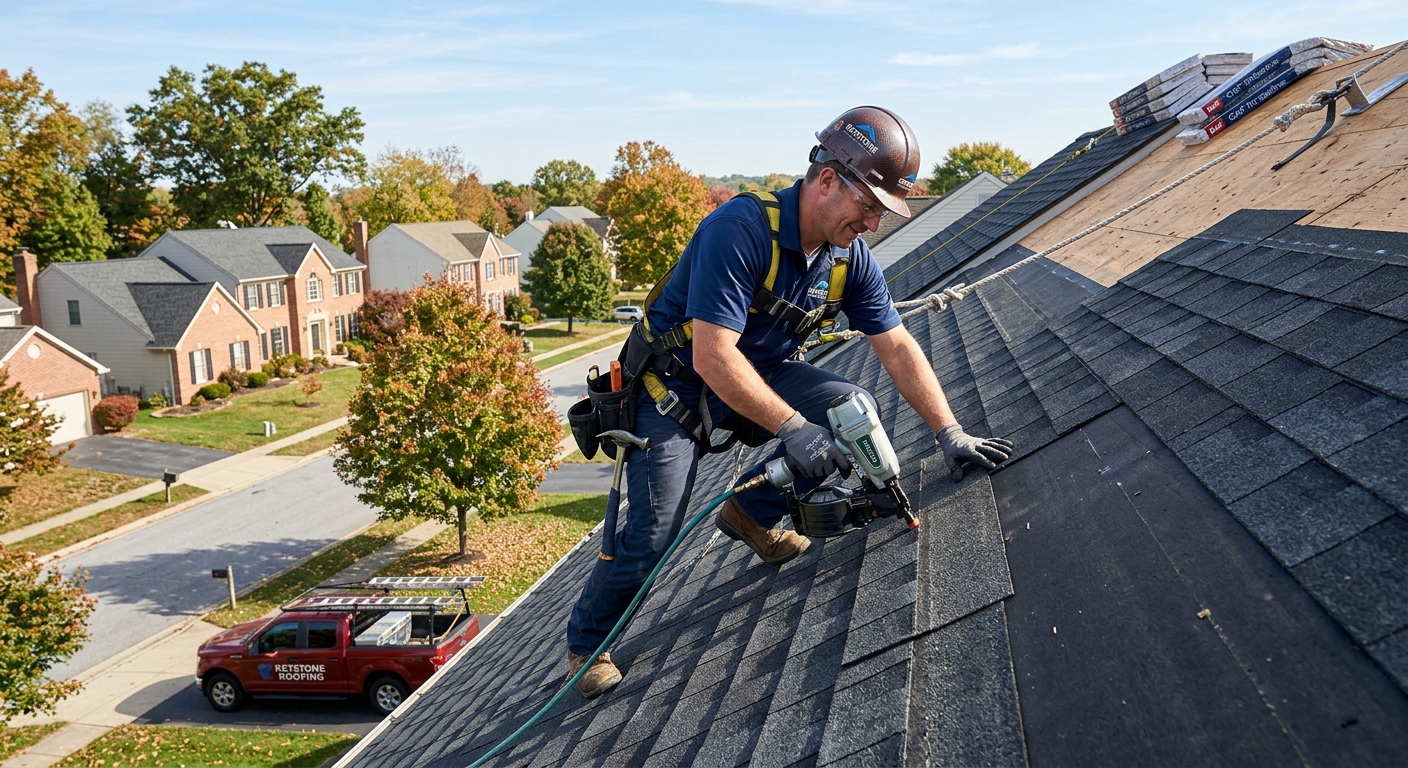
Northampton roofing prices by material and scope — 2026
Roofing in Northampton reflects not just the climate, but the history and character of homes here. With 74.8% of homes built before 1980 and a homeownership rate near 70% (U.S. Census Bureau, ACS 2024), many roofs in the county are reaching the age where replacement becomes critical, not optional. Post‑World War II subdivisions in Palmer Township mean much of Northampton’s asphalt roofing stock gets replaced all at once, typically in batches as neighborhoods age together. This generates high demand for full roof replacements, especially architectural shingles, which are compatible with the steep, mid-century rooflines common across Bethlehem and Easton.
This heavy replacement cycle is amplified after storm events, with wind-damaged rooftops in Lower Saucon and Forks regularly swelling the repair market. Homeowners here don’t just choose between repair and replacement — they contend with a landscape where architectural shingles are the baseline. Estimates below are specific to Northampton’s homes, factoring in typical roof sizes and features seen in our area’s subdivisions, add-on flatter roofs, and frequent code-driven upgrades.
| Material / Scope |
Lifespan |
Best for |
Price range (installed) |
| Asphalt shingles — architectural (30-yr) |
25–30 yrs |
Most Northampton homes built after 1945 |
$9,400–$20,000 |
| Asphalt shingles — impact-resistant (Class 4) |
30+ yrs |
Ridge-line homes, frequent storm exposure |
$15,500–$20,000 |
| Metal standing seam |
40–70 yrs |
Owners planning to stay, low pitch valleys |
$23,000–$40,500 |
| Flat roof — TPO or EPDM |
15–25 yrs |
Rowhouse, addition, or porch roofs |
$12,000–$24,000 |
| Roof repair — leak or isolated section |
n/a |
Spot leaks on sound roofs under 15–20 years |
$500–$1,900 |
Prices are estimates for a typical Northampton home and vary with roof size, pitch, decking condition and material selection.
Roofing permits in Northampton: what you need before work starts
For Northampton homeowners, roofing work usually falls under the Pennsylvania Uniform Construction Code (UCC), overseen by the PA Department of Labor & Industry and enforced locally by each municipality. In Bethlehem, any full roof replacement that includes new sheathing almost always requires a building permit, issued by the City of Bethlehem Department of Community & Economic Development. However, minor shingle repairs in Easton often happen without a permit, especially if you're just patching and not tearing off large areas.
Before hiring a contractor for any roofing job over $500, the contractor must hold a Home Improvement Contractor (HIC) registration issued by the Pennsylvania Office of Attorney General. To ensure your roofer is properly registered, you can verify them at hic.attorneygeneral.gov. Workers' compensation is mandatory for all roofing employers in Pennsylvania; you can confirm current insurance coverage using the WCAIS system at wcais.pa.gov. If your home was built before 1978, any disturbance of painted surfaces requires an EPA Lead RRP-certified firm—check credentials using the EPA's certified renovator search.
For roof replacements and more significant repairs, check with your municipality’s code office for the most current permit requirements. You should never proceed based on a contractor’s word alone—ask to see their HIC registration, workers' comp proof, and any required municipal permits before any contract is signed.
Choosing a roofer in Northampton County
With Northampton’s roofing contractors competing in a saturated Lehigh Valley market, due diligence is essential. Always verify your contractor’s Home Improvement Contractor (HIC) registration with the Pennsylvania Attorney General’s database at hic.attorneygeneral.gov and check their workers’ compensation insurance through WCAIS (wcais.pa.gov). For homes predating 1978, be certain your contractor can produce Lead RRP credentials from the EPA’s certified renovator list. Insist on seeing these documents and don’t accept promises—plenty of contractors here will tell you what you want to hear if you don’t check.
- Verify HIC registration at hic.attorneygeneral.gov
- Check active workers’ comp in WCAIS
- Ask for a written contract under HICPA, required over $500
- Ensure a 3-day right of cancellation is stated in writing
- Demand a proof of permit (if applicable in your municipality)
- Review manufacturer certification for materials if claimed
- Confirm EPA Lead RRP status for homes pre-1978
- Ask who will be onsite—direct employees or subcontractors?
- Get a copy of the warranty terms for labor and materials
- Request references for recent Northampton County jobs
- Make sure all project details are in the written contract
- Demand a copy of liability insurance
Red flags in Northampton include door-knockers flooding in after a wind or hail storm, any company without a local history, vague or “handshake” estimates, requests for large cash deposits, or hesitation to pull the needed permit. The Lehigh Valley’s crowded contractor market means scammers chase quick jobs—don’t skip verification.
Decking, ventilation and flashing — the hidden roof costs
It’s often what you don’t see that adds up on Northampton roofing projects. On homes built before 1980—most in this county—hidden costs start with rotted decking. Plywood or plank boards under the shingles may be decayed, especially where leaks or condensation lingered. Plan for an extra $950–$2,200 if more than just a sheet or two needs replacement.
Ventilation is even more critical in Northampton's winters—ice dams are common along our escarpments and attic condensation can be mistaken for boot leaks. Failure to upgrade to continuous ridge vent or correct intake airflow will accelerate shingle failure and void manufacturer warranties. Fixing attic ventilation or adding a ridge vent to older homes typically adds $700–$1,800.
Flashing around chimneys, walls, or vent stacks is another underestimated expense. On old masonry chimneys or where siding meets rooflines, replacing step and counterflashing typically runs $550–$1,400. Worn vent boots, missing or unpainted drip edge, and even the humble ice and water shield at eaves all add up in a climate where snow and freeze-thaw cycles exploit every unsealed seam.
When comparing quotes, ask specifically for line items covering these risks. If you hear "we won't know until we tear off," get a per-sheet decking rate and preparedness for common attic upgrades. In Northampton, these extras are the rule, not the exception.
Reading a roofing estimate line by line
Northampton homeowners should demand detail in every roofing estimate. The first number to find is the roof’s area, stated in “squares” (one square equals 100 sq ft) and with the roof pitch specified—without these, you can't compare bids. Tear-off and disposal of old shingles must be listed as a separate line, with the dumpster fee included. Underlayment and ice/water shield should be identified by product type (“synthetic underlayment” or “Grace Ice & Water Shield”), not just by generic descriptions.
Decking replacement is best shown as a contingency price per sheet—older homes in the Lehigh Valley often need replacement of at least a few. Chimney and wall flashing need to be itemized. Warranties should be divided by type: workmanship (from the roofer) vs manufacturer (from the shingle company). Any deposit should be modest—under 15% upfront, with the balance at completion. If your quote bundles labor, materials, and all extras into one sum, or never mentions the roof measurement, expect problems and hidden fees when the job starts.
| Line item |
What to look for |
Red flag if… |
| Roof area |
stated in squares, with pitch |
no measurement given |
| Tear-off and disposal |
number of layers, dumpster included |
bundled into one figure |
| Underlayment |
product type and coverage |
listed only as 'felt' |
| Ice and water shield |
coverage height at eaves |
omitted entirely |
| Decking |
per-sheet contingency price |
no allowance at all |
| Warranty |
workmanship years stated separately |
only the shingle warranty |
| Payment |
deposit under 15%, balance on completion |
large upfront cash |
Patching vs full replacement in Northampton
In Northampton, quick patching is only a good decision when the roof is relatively young and you have a single, isolated leak. With more than 74% of homes built before 1980, most asphalt shingle roofs approaching 20 years are due for full replacement rather than repeated repairs. If you have several leaks, curling or brittle shingles, or signs of granule loss, spending on repairs is almost always wasted—two or three rounds of $1,200 repairs will quickly surpass half the cost of a new roof, leaving you with piecemeal patches and no warranty. Storm damage is another case where repairs don't get you ahead—if wind tears off shingles in Lower Saucon, replacement is typically the best financial move, especially if insurance is available. For flat roofs, ponding or recurring blisters indicate a full membrane replacement is due.
| Situation |
Recommendation |
Typical cost |
Reasoning |
| Under 15 years, one isolated leak |
Repair |
$500–$1,900 |
Rest of roof still serviceable, warranty may remain |
| 15–25 years, several leak points |
Replace |
$9,400–$20,000 |
Labor and repeated repairs will exceed replacement value |
| 25+ years, any active leak |
Replace now |
$9,400–$20,000 |
End of service life, patching is wasted money |
| Storm damage, wind or hail |
Document, claim, replace |
$9,400–$20,000 |
Insurer will usually cover full replacement if claim is approved |
| Flat roof ponding or blistering |
Replace membrane |
$12,000–$24,000 |
Patching will not fix underlying drainage problem |
| Active leak entering winter |
Emergency repair, schedule replacement |
$500–$1,900 |
Prevent snow/ice intrusion first, then plan full reroof |
Flat roof sections: the part most quotes get wrong
Many Northampton homes have add-on flat roof sections—often over porches, room additions, or across the back of a rowhouse. These low-slope or flat areas demand a membrane roofing system like TPO or EPDM; if your roofer suggests standard shingles for a 2/12 pitch or lower, their work won’t last through our winters. Shingles on low slopes in this region simply can’t drain fast enough, and melting snow or ice dams quickly lead to leaks and rot.
Proper flat roof installation runs $12,000–$24,000 for most membrane replacements in Northampton. The lifespan is 15–25 years—shorter than a pitched shingle or metal system, but much more reliable than constantly patching. Insist on a real membrane system, with proper edge metal and drainage plan; ponding for more than 48 hours signals the wrong slope or clogged outlets. If your quote covers the whole house with only shingle labor and no breakdown for membranes, you’re not really covered on flat sections. That’s a mistake you’ll pay for every thaw cycle here.
Frequently asked questions — roofing in Northampton
Do I need a permit to replace a roof in Northampton?
Roofing permit requirements depend on where you live in Northampton County. In Bethlehem, any full roof replacement—especially if it includes new sheathing—almost always requires a building permit from the City of Bethlehem Department of Community & Economic Development. If you are in Easton or other parts of the county, minor shingle repairs often proceed without a permit, but anything beyond patching typically does need one. Always check with your local municipal code office; relying on a contractor’s word isn’t enough. Remember, skipping a permit can hold up resales or insurance later on. A proper replacement contract should specify permit costs—figure them into your budget along with roof replacement, which typically runs between $9,400–$20,000 for architectural shingles in Northampton.
What if my insurer denies my roof claim?
If your insurer denies a claim for roof replacement or repair, start by requesting a written explanation. In Northampton, wind and storm damage are frequent—roof problems after storms in Forks or Lower Saucon are well documented, so clear documentation helps. Ask your roofer for a written inspection report, with photos and explicit details right down to the number of damaged shingles or missing flashing. Sometimes a denial is the result of insufficient proof of storm damage or missed deadlines. Appeals require persistence, and you may need a second, independently written estimate (typically $500–$1,900 for a documented assessment). Don’t authorize further repairs until your insurance status is sorted, unless you face an active leak entering winter—then temporary emergency patching is advisable while your claim is re-examined.
What does roof replacement cost per square in Northampton?
The total price of a new roof here depends on roof size, pitch, and complexity, but a ballpark figure for Northampton is typically between $470–$700 per square (100 sq. ft.) for architectural asphalt shingles. On a 28-square ranch or colonial, expect a full install to fall within $13,000–$19,600. Higher-end impact-resistant shingles or more cut-up roofs in Palmer Township subdivisions can push that band to the top end. Always look for a written roof measurement in your estimate—the per-square price only means something if the size and scope are clearly stated, not just assumed from the ground.
How do I know if my Northampton roof needs replacing?
Take a close look if your home was built before 1980—as most in Northampton were—and you haven’t replaced the roof in the last 20 years. Watch for missing shingles, curling tabs, heavy granule loss in gutters, leaks after rain or thaw, and daylight in the attic around vent boots or chimney flashing. If you’re seeing repeated leaks or shingle brittleness, repair costs will soon stack up. At that point, investing in a replacement ($9,400–$20,000 for architectural shingles) is almost always more cost-effective than constant patching. Don’t wait for a spring thaw to find out your decking is rotted—a leak in February does twice the damage here due to snow load and freezing.
Why do roofs fail faster in northeastern Pennsylvania?
Northampton sits in a region with a ground snow load of 40 psf and winter lows below 10 degrees. This leads to severe ice dam exposure, especially along ridge-lines and in older homes lacking ridge vent or adequate attic air flow. The freeze-thaw cycle, snow accumulation, and wind-driven rain all mean roofing materials—especially asphalt—break down more rapidly here than elsewhere. Add in the high number of pre-1980 homes in Northampton and you have many roofs aging out at the same time. Replacement runs $9,400–$20,000 for asphalt, but investing in attic ventilation or better flashing during re-roofing extends lifespan and keeps you ahead of leaks in this demanding climate.
What's the cheapest way to replace a roof in Northampton?
The lowest-cost route is a straightforward architectural asphalt shingle roof with minimal wood replacement and no major upgrades—expect on the very low end around $9,400 for a smaller home with basic features. But if your attic is under-ventilated or the decking reveals damage, skipping fixes is a false economy; small savings now can lead to rapid, expensive leaks. Never agree to a “layover” (a second layer over old shingles) in Northampton—this method is not allowed under code whenever decking or underlayment are suspect, and it cuts roof life considerably. A detailed estimate that separates all labor and materials is your friend. Chasing the bottom dollar here usually backfires, so insist on clear scope and code compliance even on a tight budget.
How far ahead should I book a roofer in Northampton?
In Northampton’s busy market, especially during spring and late summer, reputable roofing contractors may book jobs 4–8 weeks in advance. After major storms, the wait can stretch longer as door-knockers from outside the region flood in, but you’re better off waiting for a proven local crew than grabbing the first available hand. For emergency repairs (leaks just before winter) you can usually get tarping or short-term fixes done for $500–$1,900 within days, but for full replacements expect to sign a contract at least a month before your desired completion date. If you have an urgent need after hail or wind, insist your chosen company documents the damage for insurance and gets on your schedule quickly after paperwork clears.
Are impact-resistant shingles worth it in Northampton?
For homeowners in wind-prone or ridge exposed areas like Lower Saucon or Forks, Class 4 impact-resistant (IR) shingles make good sense. While they run slightly higher—in the $15,500–$20,000 range for a typical install—their lifespan and damage resistance save money long-term, especially with repeated hail or ice storms. If you’re planning to stay in your home, IR shingles can also reduce hassle and downtime after a storm, and some insurers will offer premium discounts if you provide certification (check your company’s local Northampton policy). On flat subdivisions less exposed to wind, standard architectural shingles remain the best value, but IR is a smart upgrade where extreme events are frequent.
What should a roofing quote include in Northampton?
A solid Northampton roofing quote should lay out the roof size in squares, pitch, and shingle product by brand and type. Look for tear-off (how many layers and dumpster cost), a per-sheet decking price for repairs, underlayment type, line-item for ice and water shield, and replacement of all key flashings and vent boots. The written contract should specify the Home Improvement Contractor (HIC) registration number, payment schedule (deposit never more than 15%), and have warranty terms clear—both manufacturer and labor. For homes built before 1978, the quote must address EPA Lead RRP rule compliance. Don’t accept a single lump sum—demand transparency so you know why a replacement is cited at $9,400–$20,000 and what else might require approval during the job.