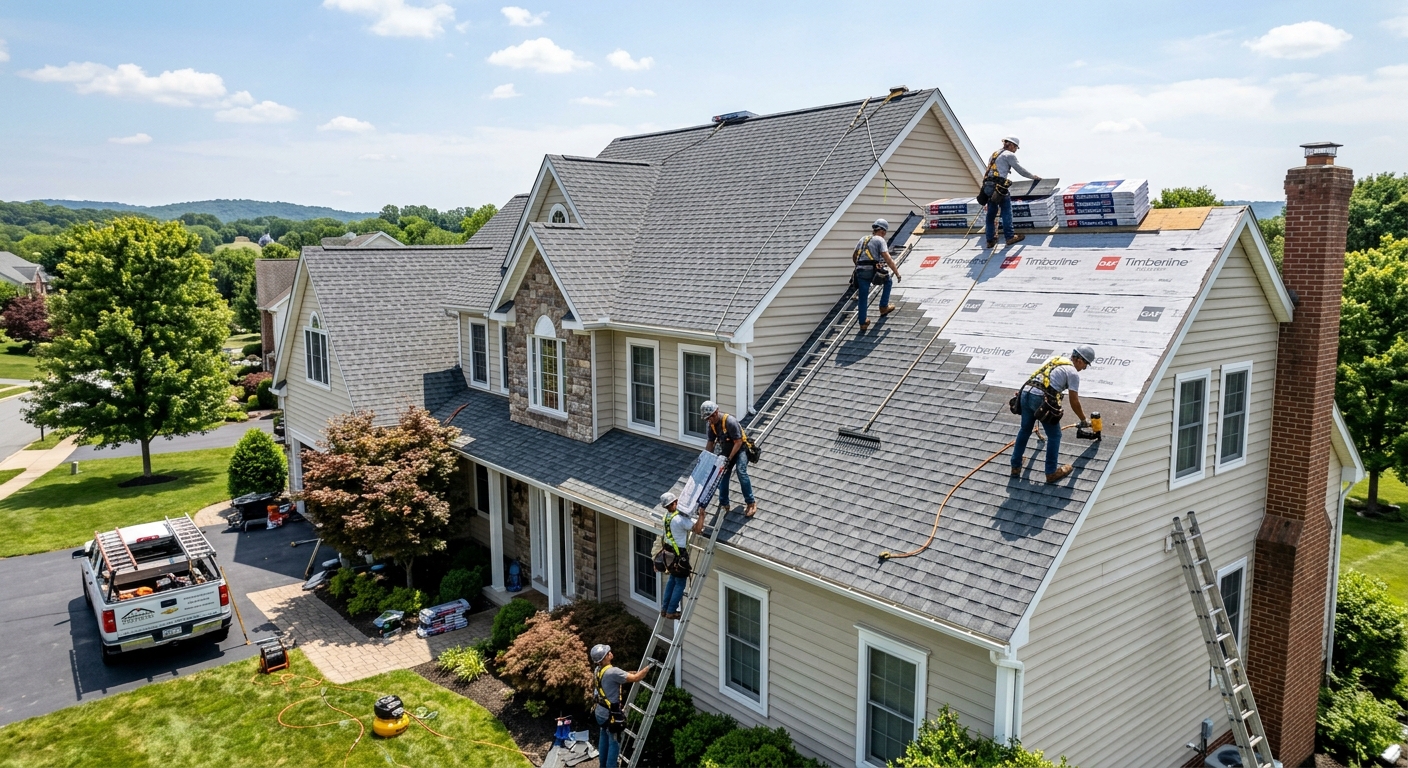
North Cornwall roofing prices by material and scope — 2026
North Cornwall’s roofing market reflects the character of Lebanon County: a stable, mostly owner-occupied community, with 55.3% of homes built as single-family and a homeownership rate of 67.2% (U.S. Census Bureau, ACS 2024). Because nearly half the homes here were built before 1980, many asphalt shingle roofs have already been replaced once or are now reaching the end of their second cycle. When Lebanon’s housing stock surged between 1945 and 1975, rapid development favored basic ventilation and affordable materials—choices that now drive both frequent re-roofing and a steady stream of attic ventilation upgrades. It’s common here to find older vents or none at all, meaning many projects must address both shingle replacement and airflow to prevent new warranties from being voided by ice damming or moisture issues.
Homeowners weighing replacement or repair need to make local choices. Architectural asphalt shingles remain dominant because they match most homes built in that postwar era. Storm-driven wind events, especially along the local uplands, also shape repair and replacement frequency. Expect the table below to cover locally relevant price bands for typical North Cornwall homes, reflecting real-world jobs over the last few years.
| Material / Scope |
Lifespan |
Best for |
Price range (installed) |
| Asphalt shingles — architectural (30-yr) |
25–30 yrs |
Single-family homes, pitched roofs, most local replacements |
$9,400–$19,500 |
| Asphalt shingles — impact-resistant (Class 4) |
30+ yrs |
Wind-prone ridgelines, high-end replacements, insurance upgrades |
$15,500–$19,500 |
| Metal standing seam |
40–70 yrs |
Historic homes, farmhouse, long-life upgrades |
$22,500–$40,500 |
| Flat roof — TPO or EPDM |
15–25 yrs |
Porches, additions, low-slope sections |
$12,000–$23,500 |
| Roof repair — leak or isolated section |
n/a |
Small storm damage, aging flashing, spot repair |
$500–$1,850 |
Prices are estimates for a typical North Cornwall home and vary with roof size, pitch, decking condition and material selection.
Decking, ventilation and flashing — the hidden roof costs
Many North Cornwall roof quotes don’t show the true final cost until existing layers are stripped. The biggest wild card is rotted or delaminated decking. Thanks to freeze-thaw cycling and decades of minor attic leaks, it’s common in Lebanon County to discover bad wood beneath the shingles. Expect replacement sheathing to add $175–$375 per sheet (installed). On older homes with pre-1980 decking, we see a blend of original plank and patchwork plywood, sometimes revealing gaps where wind-driven snow once found its way in.
Pennsylvania’s cold climate and our 12 °F winter design temperature mean attic ventilation isn’t optional. Poor venting—typical of homes built during the postwar surge—leads to ice dams, which cause leaks and early failure. If the roof has mold or insulation packed against the decking, upgrades might run $550–$2,200 for ridge vents or new intake. Don’t forget detailed line items for flashing at chimneys, valleys, and sidewalls: copper or aluminum step flashing can run $400–$950 per job. If your roof’s boots and collars haven’t seen a replacement since the last reroof, tack on $125–$300 per penetration.
Drip edge and ice barrier are now required by both Pennsylvania code and most shingle warranties, but we still see corners cut on older homes. These add $450–$1,050 to a typical replacement for proper eaves protection. The soft costs, like cleanup and disposal, should always be itemized, not bundled in a lump sum.
Pennsylvania code and Lebanon County permit rules for roofing
Roofing work in North Cornwall falls under the Pennsylvania Uniform Construction Code (UCC), built from the International Residential Code (IRC). Enforcement depends on your exact address: Townships like North Lebanon have their own permit offices, while cities such as Lebanon use the City of Lebanon Code Enforcement Office. A building permit is only triggered if roof work involves structural decking or truss repairs—not just a shingle overlay. Minor repairs covering less than one roofing square (100 square feet) typically do not need a permit in county townships, so replacing a few damaged shingles can proceed without one. Full tear-offs and replacements that leave the framing and decking in place do not usually require a permit, unless your municipality has opted for stricter enforcement.
Any contract over $500 must use a contractor registered as a Home Improvement Contractor (HIC) through the Pennsylvania Office of Attorney General. Homeowners can verify registration at hic.attorneygeneral.gov, and you should never sign without checking a contractor’s HIC status. All employers must also carry workers’ compensation insurance, which you can confirm through WCAIS (wcais.pa.gov). These rules are important safeguards, as Pennsylvania has no dedicated roofing license—the only credential that counts is the statewide HIC registration. Always insist on a written contract and keep in mind your three-business-day right to cancel, as required by the Home Improvement Consumer Protection Act (HICPA).
What insurance covers on a North Cornwall roof
When storm, hail, or wind damages your North Cornwall roof, your best outcome starts with documentation. Take detailed photos before cleaning up and get written confirmation of what was damaged—especially for common problems like wind-lifted shingles or ridge-cap loss on homes near the South Mountain upland. Your insurance claim follows a set sequence: After your claim is filed, an adjuster will visit to write a scope of loss detailing what repairs or replacement your policy will cover. Most policies pay out based on “Actual Cash Value” (ACV)—meaning they deduct for age and wear—but if you have replacement cost coverage, you’re entitled to the full price of a comparable new system once repairs are done.
Pennsylvania consumer protection law requires a written contract on any roof work over $500 and gives you a three-day right to cancel. It is explicitly illegal for a contractor here to “waive” or cover your insurance deductible—if someone suggests this, it’s a clear sign to walk away. Insurers expect the deductible as your personal responsibility. Accepting a deductible waiver can not only void your policy but expose you to fraud liability. Be wary of any estimate promising to “absorb” your deductible or of anyone urging you to start work before adjuster approval. The right contractor helps you match the adjuster’s scope to your roof’s actual needs and won’t proceed until coverage is clear. Save all documentation and avoid any vendor trying to rush you or bid “too good to be true.”
Reading a roofing estimate line by line
A clear North Cornwall roofing quote shows all the facts you need to compare offers. Look for the total roof area (in squares) and the pitch—a key driver of cost in our region’s mix of Cape-style and split-level homes. Tear-off and disposal should spell out the number of layers removed and if dumpster or dump fees are included. Underlayment should list the product by manufacturer and type (synthetic, 30# felt, etc.), and ice-and-water shield should specify the coverage width at eaves (typically one to three rows).
If extra decking is found, the price per sheet must be stated. Flashing—especially at chimneys and side walls—needs a line item, as these are common roof leak points in Lebanon County. Your workmanship warranty should be listed separately from the manufacturer shingle warranty, and the payment schedule should require no more than a 15% deposit, with the rest due on completion. If a quote gives you one lump sum or leaves out square count, you can’t accurately compare it to anything else. Always challenge vague line items and ask for breakdowns in writing.
| Line item |
What to look for |
Red flag if… |
| Roof area |
stated in squares, with pitch |
no measurement given |
| Tear-off and disposal |
number of layers, dumpster included |
bundled into one figure |
| Underlayment |
product type and coverage |
listed only as 'felt' |
| Ice and water shield |
coverage height at eaves |
omitted entirely |
| Decking |
per-sheet contingency price |
no allowance at all |
| Warranty |
workmanship years stated separately |
only the shingle warranty |
| Payment |
deposit under 15%, balance on completion |
large upfront cash |
Low-slope and flat roofs in North Cornwall
In North Cornwall, many homes have a flat or low-slope section—often on a rear addition, porch, or entryway. These areas can’t use regular asphalt shingles because North Cornwall’s freeze-thaw cycles and moderate snowfall mean standing water quickly finds every gap. When shingles go on a roof pitched less than 3/12, leaks and premature failure are almost guaranteed due to poor drainage and our local propensity for ice damming in shaded areas.
Flat and low-slope roofs should be finished with a membrane system like TPO or EPDM. These single-ply products form a watertight barrier, lasting 15–25 years if installed properly. For most North Cornwall homes, membrane installation falls in the $12,000–$23,500 range per typical section. Ponding water is a particular issue in local housing, especially on older additions where settling has created uneven slopes. Membranes resist slow leaks where shingles never could, and many come with tailored warranties if installed by a certified contractor. If you’re quoted shingles for a roof with a 2/12 pitch, that’s a sign the roofer doesn’t know—or isn’t telling you—the right system for our winters.
North Cornwall homes and their roof lines
The largest share of North Cornwall’s houses were built during Lebanon County’s postwar surge, between 1945 and 1975, with 47.2% of homes predating 1980 (U.S. Census Bureau, ACS 2024). On these homes, you’ll often find roof pitches between 5/12 and 8/12—steep enough for reliable shingle drainage but gentle enough to allow walkable roofs. The original decking from this era is a mix, with early homes showing spaced pine planks and most later structures using 3/8" or 1/2" plywood. OSB is less common in these older neighborhoods but appears in 1990s infill and additions.
Ice and water barrier wasn’t typically code or standard until much later, so roofs aged 40 years or more often lack protection at the eaves and valleys. Multiple layers of shingles are common, especially where “one more roof” was put over the last before the UCC enforcement became strict in the City of Lebanon and suburbs. When replacing these older roofs, contractors often find two or even three layers and hidden rot at the eaves from leaking ice dams. For neighbors in newer subdivisions, you’re likely facing your first full replacement cycle, not the chronic decking decay of older housing stock—but either way, understanding your particular roof means knowing the era and code at the time it was built.
Frequently asked questions — roofing in North Cornwall
Are there historic district rules affecting roofing in North Cornwall?
North Cornwall itself is not subject to the historic commission rules present in some parts of the City of Lebanon. Most homes here were built after 1945 and don’t fall under special preservation overlays. There are no restrictions in the Lebanon County facts requiring specific shingle types or colors for standard replacements. If your home is part of a local HOA or on the border of a registered area, always check any deed restrictions, but roofing in North Cornwall typically sticks to community standards. Replacement with architectural asphalt shingles in the $9,400–$19,500 range is common and meets local expectations. If you’re told you must use slate or wood, ask for the underlying requirement in writing.
What is the best time of year to replace a roof in North Cornwall?
The ideal roofing window for North Cornwall is from late March through October. Spring and early fall are especially good—temperatures stay above the 40°F mark needed for asphalt shingle adhesives to bond, and crews can work safely without extreme summer or winter weather. Lebanon County’s moderate snowfall and pronounced freeze-thaw cycles mean you want jobs completed before November if possible. Roofs installed during the warm months are less likely to suffer cold-related bonding failures or early blow-offs. With a typical architectural shingle replacement running $15,500, scheduling for the right season ensures you get the full intended lifespan without the early issues seen on cold-set jobs.
What are the signs of hail damage on a roof?
In North Cornwall, hail tends to leave behind distinct marks: bruised or crushed shingle granules, circular spots with missing granules, and sometimes cracked tabs. On many homes built before 1980, the older shingles will show soft spots or even exposure down to the felt after a summer hailstorm. You may also see dented metal on vents or gutters. Unlike wind, which strips whole tabs, hail damage appears as pockmarks or rapid granule loss. If you suspect hail, get photos before any cleanup and call your insurer. Repairs for limited hail damage can often be completed in the $500–$1,850 range, but insurance may cover a full roof if enough sections are affected.
What underlayment should be used on a North Cornwall roof?
Modern North Cornwall roofing jobs are best served by synthetic underlayment or a quality 30# felt, along with at least one layer of ice and water shield at the eaves and valleys. Older homes from Lebanon County’s mid-century boom usually lack these, increasing their risk in freeze-thaw events. With our 12 °F winter design temperatures, failure to install an ice barrier means ice damming and roof leaks become almost inevitable. On most jobs, the price for synthetic underlayment and appropriate ice shield is already baked into the $9,400–$19,500 architectural shingle roof range, but always check these are called out by name on your estimate to avoid corners being cut.
What's the cheapest way to replace a roof in North Cornwall?
For North Cornwall homeowners on a tight budget, selecting basic architectural asphalt shingles and waiting until early spring or late fall—when contractors are less booked—offers the lowest installed price. Skipping proper underlayment or code-required ice barrier is a costly false economy: it usually voids the warranty and can lead to leaks and further repair costs, especially on homes with older or suspect decking. The lowest legitimate price you’ll see for a full asphalt shingle replacement here is $9,400, anywhere below that should raise flags about labor shortcuts or unregistered contractors. If the deck and flashing are still solid, take care of any urgent repairs in the $500–$1,850 range and save for a proper replacement next season.
Do I need my own inspection before the adjuster visits?
Having your own roofer or trusted inspector look at your roof before the insurance adjuster arrives can make a real difference in North Cornwall. Roofers who know the local code and common failure points can document damage the adjuster might overlook—especially wind-related and ice-dam leaks seen in pre-1980 homes here. While insurers ultimately write their own scope, having a contractor’s line-item estimate (mentioning everything from decking to flashing) in the $500–$1,850 band for repairs, or full replacement as needed, makes the process more transparent. Your roofer is not allowed to negotiate with the insurer for you, but a thorough pre-adjuster inspection arms you with solid evidence about the roof’s real condition.
Are storm-chasing roofers a problem in North Cornwall?
Storm-chasing roofers appear in Lebanon County after major wind or hail events, offering quick fixes and suspiciously low bids. In North Cornwall, their presence increases after severe ridge-line storms. Always insist on verifying the contractor’s Home Improvement Contractor (HIC) registration at hic.attorneygeneral.gov and check their workers’ compensation status at WCAIS. These short-term operators rarely offer proper contracts or warranties—many disappear after cashing the first deposit. Repairs are often quoted at the lowest end of the $500–$1,850 price band, but the work may fail within a year. Stick with established local contractors who provide a proper contract, verifiable insurance, and references in Lebanon County.
How much does a new roof cost in North Cornwall?
A complete architectural asphalt shingle roof replacement in North Cornwall typically falls between $9,400–$19,500, depending mainly on home size and whether rotted decking or major flashing upgrades are needed. Metal standing seam systems are a step up, priced between $22,500–$40,500, and flat roof membranes for porches or additions land in the $12,000–$23,500 range. Small spot repairs are usually in the $500–$1,850 band. Keep in mind that deck and ventilation repairs can add hundreds or thousands to the base cost, particularly on North Cornwall’s many homes built before modern codes.
Does attic ventilation matter in North Cornwall's climate?
Attic ventilation plays a crucial role in North Cornwall’s roofing performance. Our pronounced freeze-thaw cycling and 12 °F winter design temperatures mean poor airflow causes warm air to rise and collect under the decking, melting snow and triggering ice dams at the eaves. This results in leaks, rot, and the kind of decking damage that can add $175–$375 per replaced sheet during a roof job. Most of the local housing stock, built between 1945–1975, has inadequate ventilation by current code and shingle warranty standards. Upgrading to ridge vent and proper intake keeps the attic dry, improves shingle lifespan, and protects your investment, especially on homes nearing their second or third reroof.