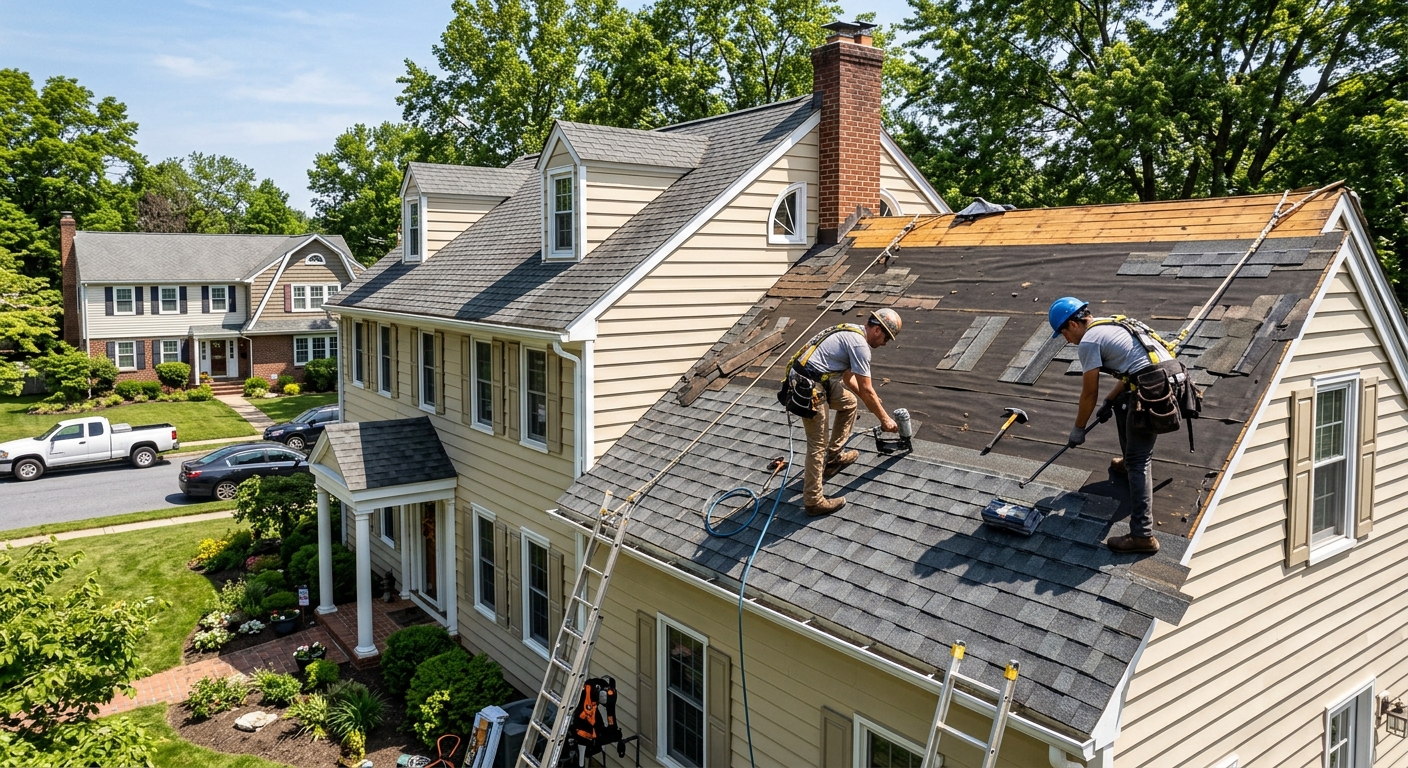
Penn Hills roofing prices by material and scope — 2026
In Penn Hills, roof replacement and repairs draw from a housing stock where more than 90% of homes were built before 1980 (U.S. Census Bureau, ACS 2024). With a homeownership rate over 70%, most residents manage their own repairs, and recurring roof work is the norm. Age shows up not only in outdated shingles but also in the wood decking beneath, which often needs repair or full replacement when a roof is torn off. Most local roofs have had at least one prior re-roof, making tear-offs almost always more involved—and costly—than in newer areas. That generally means higher labor and disposal costs on top of material choices.
Because much of Allegheny County housing dates 1900–1950, expect to find plank decking and multiple shingle layers on Penn Hills homes. Homes built in this period rarely included ice barrier underlayment, so code-compliant upgrades (and sometimes deck repairs) are routine here, not exceptions. All of this means most Penn Hills residents are shopping real replacement numbers—far from a simple layover.
| Material / Scope |
Lifespan |
Best for |
Price range (installed) |
| Asphalt shingles — architectural (30-yr) |
25–30 yrs |
Western PA family home |
$8,900–$19,000 |
| Asphalt shingles — impact-resistant (Class 4) |
30+ yrs |
Areas exposed to hail/wind |
$14,500–$19,000 |
| Metal standing seam |
40–70 yrs |
Low-maintenance, high-durability roofs |
$21,500–$38,500 |
| Flat roof — TPO or EPDM |
15–25 yrs |
Low-slope additions/porches |
$11,500–$22,500 |
| Roof repair — leak or isolated section |
n/a |
Small leaks, missing shingles |
$475–$1,800 |
Prices are estimates for a typical Penn Hills home and vary with roof size, pitch, decking condition and material selection.
Material comparison for Penn Hills homeowners
The real decision for most Penn Hills homeowners is whether to stick with architectural asphalt—by far the most common material here—or to consider an upgrade like metal or impact-resistant shingle. Architectural asphalt dominates not just for cost but because it stands up to this region’s 30 pounds per square foot snow load and will typically keep watertight for 25–30 years. Metal sheds heavy, wet snow efficiently and shrugs off Ohio Valley wind gusts, but its upfront price often only makes sense if you plan to own your home for decades or want to reduce maintenance to an absolute minimum.
For most local homes, architectural asphalt makes sense: it performs well at the winter design temperature of 8 °F and is forgiving if venting isn’t perfect—both factors for Penn Hills’s older homes. Metal is unbeatable for long-term durability and quick snow-shedding, but if you have a simple cape or bungalow, it’s hard to justify $21,500–$38,500 outlay given the value of the local housing stock. Flat membrane systems (TPO/EPDM) are reserved for porches and additions with low slope where shingles simply won’t work. Class 4 impact-resistant shingles may be considered in higher-risk wind/hail pockets, but the price premium doesn’t always pencil out given most hail here is not large enough to necessitate them.
| Material |
Installed cost |
Lifespan |
Cold-climate performance |
Maintenance |
| Asphalt architectural |
$8,900–$19,000 |
25–30 yrs |
Reliable at 30 psf snow, 8 °F |
Low; replace vent boots, check flashing |
| Asphalt Class 4 impact-resistant |
$14,500–$19,000 |
30+ yrs |
Withstands hail better |
Low; similar to architectural |
| Metal standing seam |
$21,500–$38,500 |
40–70 yrs |
Sheds snow, resists ice damming |
Minimal; inspect fasteners, clean valleys |
| TPO / EPDM membrane |
$11,500–$22,500 |
15–25 yrs |
Best for low-slope; not for main roof |
Check seams and penetrations annually |
Roofing permits in Penn Hills: what you need before work starts
Roof replacement in Penn Hills falls under the Pennsylvania Uniform Construction Code (UCC), which is based on the International Residential Code. In the greater Pittsburgh region, including Allegheny County, code enforcement is overseen by the Department of Permits, Licenses, and Inspections. As a rule, replacing more than 50% of your roof area triggers a requirement for a building permit. Like-for-like patching or minor shingle repairs in small areas commonly proceed without a permit.
For projects over $500, Pennsylvania law requires that roofing contractors hold a Home Improvement Contractor (HIC) registration, which is issued by the Office of Attorney General. You can—and should—verify a contractor’s registration at hic.attorneygeneral.gov. All employers must carry workers’ compensation insurance, which you can check via the state system at wcais.pa.gov before hiring anyone. Doing both steps may seem redundant, but in Penn Hills, the saturated Pittsburgh-area contractor market means it’s easy for unregistered outfits to circulate. For your own protection, never start roof work—especially a full replacement—without seeing proof of permit (where required), Pennsylvania HIC registration, and active comp insurance direct from the source databases.
Snow load, ice dams and wind in Penn Hills
Penn Hills sits on Allegheny County’s path for Ohio Valley storms, which means roofs here absorb frequent strong winds and the occasional hail event. The region’s ground snow load of 30 psf is enough to accumulate heavy, wet snow in a single storm, and with winter temperatures routinely dropping to 8 °F, the conditions are set for ice dams along eaves. The cycle is simple: snow melts higher up on the roof (either from sun or attic heat loss), refreezes at the colder eave, and forms a dam. Water backs up under shingles, soaking the roof deck or even leaking inside—a quick recipe for needing an urgent repair that runs $475–$1,800 or a decking replacement in the range of $8,900–$19,000 for full reroof jobs.
Hail in Penn Hills is rarely huge, but it does bruise asphalt shingles—granules get knocked loose without obvious holes, which can cut shingle lifespan by a decade or more. That’s why tear-offs here often reveal “healthy-looking” shingles on the surface but water-stained decking below. Given these conditions, Penn Hills roof quotes should always include ice and water shield at the eaves (not just felt), and shingle repairs should focus on vulnerable roof areas sheltered from wind-driven snowmelt. Underlayment upgrades cost a bit more up front, but the alternative is repeat repairs or insurance claims after the next round of valley storms.
Penn Hills homes and their roof lines
With 90.8% of Penn Hills houses built before 1980, most local roof lines reflect the working-class capes, ranches, and bungalows of the early-to-mid 20th century. Roof pitches tend to be moderate—neither flat nor especially steep—because attic space was typically unfinished. Expect plank, not plywood, deck boards, and in homes from the 1930s and 1940s, those boards can show gaps or wide knots, especially after multiple layers of roofing have compressed them over the decades.
This building wave predates code requirements for ice barrier underlayment or even proper attic ventilation, so these upgrades are common on every quality reroof in Penn Hills. If the roof hasn’t been done since the 1980s, there’s a strong chance it still has at least two layers: original shingles underneath, topped with a later reroof. Full tear-off is essentially standard for the area, since few decks from this era will pass inspection once uncovered. For homeowners, the real maintenance question isn’t just “shingle choice?” but whether you need plank repair or even partial replacement—something that’s almost a given here because of the age and material of the original decking.
How to compare roofing quotes in Penn Hills
A reliable Penn Hills roof estimate clearly spells out the number of squares (100 sq ft units), pitch, and total tear-off layers—because most homes have multiple. Itemized tear-off/disposal, including dumpster fees, should be separate from installation. Underlayment (felt, synthetic, or ice shield) should be specified by brand or grade, not just “felt,” and ice barrier at least 3 feet up from each eave is a minimum for this area. Look for a per-sheet price for OSB/plywood: old plank decks here often need surprise repairs. All flashing, vent boots, and penetrations must be spelled out. Warranties: you want to see manufacturer and workmanship guarantees listed separately. Payment shouldn’t see more than 15% down; the balance is due only when the work is complete and cleanup done.
The most common red flag is a vague quote—a single price, no measurement, no breakdown. That’s not a quote, it’s a guess. When you don’t see a square count or specified product, you can’t compare value or scope between bids, and there’s no way to hold the roofer to contract details under Pennsylvania’s Home Improvement Consumer Protection Act.
| Line item |
What to look for |
Red flag if… |
| Roof area |
stated in squares, with pitch |
no measurement given |
| Tear-off and disposal |
number of layers, dumpster included |
bundled into one figure |
| Underlayment |
product type and coverage |
listed only as 'felt' |
| Ice and water shield |
coverage height at eaves |
omitted entirely |
| Decking |
per-sheet contingency price |
no allowance at all |
| Warranty |
workmanship years stated separately |
only the shingle warranty |
| Payment |
deposit under 15%, balance on completion |
large upfront cash |
What moves the price of a roof in Penn Hills
Roofing quotes in Penn Hills frequently diverge because of the overlap between old construction and weather exposure. Size is the first driver: the larger the roof, the higher the cost, but small differences in pitch or access can multiply labor costs, since most older homes have obstacles like dormers or steep valleys. For example, a 24-square roof with one layer and easy driveway access could come in close to $8,900, while a similar home with two layers and a steep pitch can exceed $14,500.
Another major local price driver is the number of layers to tear off. As many Penn Hills roofs date from the 1930s–50s, it’s common to find two or even three layers up there—each requiring additional labor, dumpster costs, and time. Decking repairs are a near-certainty, with soft plank or water stains revealed only after shingle removal; each rotten sheet adds a line item at $75–$150 each. Because winters can pile up wet, heavy snow, local code and practical experience demand ice barrier at all eaves, increasing material and labor compared with regions not susceptible to damming.
The Penn Hills storm track explains occasional spikes in quotes: if a home is in a wind-prone part of the township or has suffered hail, roofers may push for Class 4 impact-resistant shingles, which carry a premium of up to $2,500 over standard architectural products. For homeowners, understanding these factors allows for honest apples-to-apples bid comparisons—and will show when a quote is inflated beyond actual site conditions.
| Factor |
Why it matters here |
Cost impact |
| Roof size in squares |
each square is 100 sq ft of roof surface |
primary multiplier |
| Pitch and access |
steep pitches need harnesses and slow the crew |
+20–30% labour |
| Existing layers to tear off |
two or more layers means full tear-off and disposal |
$500–$1,500 per layer |
| Decking condition |
rot is found during tear-off, not before |
$75–$150 per sheet |
| Ice barrier at eaves |
required where ice damming has a history |
$300–$800 |
| Material grade |
3-tab vs architectural vs Class 4 impact-resistant |
$500–$2,500 |
Frequently asked questions — roofing in Penn Hills
What should a roofing quote include in Penn Hills?
A roofing quote for a Penn Hills home should always break down the total square footage, number of squares, roof pitch, number of layers to tear off, dumpster and disposal costs, product brand for underlayment and shingles, coverage area for ice and water shield, and a line-item contingency for possible decking repairs—since old plank decks are common. It should also spell out both the manufacturer’s shingle warranty and the roofer’s own workmanship warranty, plus a payment schedule with no more than a 15% deposit. This holds the contractor to the written contract required by Pennsylvania’s Home Improvement Consumer Protection Act. If your quote is a lump sum with little detail, you have no way to compare costs—or prove scope if there’s a dispute. For instance, a typical replacement should fall between $8,900–$19,000, so anything far outside those bounds (either high or suspiciously low) is a red flag for hidden scope or skipped steps.
What is the difference between replacement cost and actual cash value?
Replacement cost is the current price to install a new roof of similar kind and quality—what it takes to fully restore your Penn Hills home with no deduction for age or wear. Actual cash value factors in depreciation for the age of your roof. Most standard insurance policies in Pennsylvania only pay actual cash value unless you’ve paid for a replacement cost endorsement. For example, if your 20-year-old shingle roof (originally $14,500) is destroyed in a storm, actual cash value benefits might only pay a fraction, depending on the roof’s remaining life. For older Penn Hills homes, that usually means a sizable out-of-pocket gap unless you upgrade your policy, since 90% of local homes are pre-1980 and more likely to trigger depreciation deductions.
Why is my Penn Hills roofing quote higher than the online average?
National averages rarely align with Penn Hills conditions because local homes are overwhelmingly pre-1980 and have more than one shingle layer, awkward valleys, and plank decking. Internet averages are usually for simple, single-layer asphalt tear-offs and often exclude costs for decking repair, ice barrier, and full dumpster removal that are near-universal here. That’s why a real Penn Hills replacement for a 28-square roof generally comes in at $14,500 versus the lowball numbers circulating online. Add in the demand for Home Improvement Contractor (HIC) registration and workers' comp, enforced locally, and you’re paying for a true apples-to-apples job—not strip mall pricing from out-of-state sites.
Is a sagging roof line an emergency?
A sagging roof in Penn Hills—especially given how many homes use original plank deck boards from the 1940s or '50s—should always be checked quickly, but it’s not an automatic emergency. Many older houses here have minor sags where the plank or rafter has bowed over the decades, without immediate risk of collapse. However, if the sag is new, worsening, or there are signs of leaks nearby, call a reputable contractor or inspector as soon as possible. Some minor sags can be stabilized and corrected alongside a planned replacement ($8,900–$19,000). If severe rot, active leaks, or structural issues are found, you might be looking at more urgent and costly repairs—and delays for engineering or permit approval under local code enforcement.
How much does a new roof cost in Penn Hills?
In Penn Hills, a new architectural asphalt shingle roof typically costs between $8,900–$19,000, depending on total squares, number of layers, pitch, and how much old decking needs repair. Metal standing seam roofs run higher (up to $38,500), but most homes don’t require or justify that premium. Flat membrane roofs for porches and additions are between $11,500–$22,500. The vast majority of replacements land near the $14,500 mark, as local homes are older, with multiple tear-off layers and plank decks. Always ask for a written breakdown, as real costs reflect these hidden extras.
Does attic ventilation matter in Penn Hills's climate?
Yes, it’s critical on Penn Hills homes. Poor attic ventilation is a big reason why so many local roofs fall victim to ice dams and premature shingle failure. The combination of the area’s 8 °F winter design temperature and heavy snow load means warm attic air can melt snow from underneath, refreezing at cold eaves. Balanced intake and exhaust ventilation helps minimize this cycle—and can even extend the roof’s life, potentially saving you from a $8,900–$19,000 reroof before its time. Most local homes built pre-1980 have little or no attic venting, so it’s worth addressing during any replacement.
Do I need a permit to replace a roof in Penn Hills?
You will need a permit if replacing more than 50% of your roof area—the threshold enforced countywide by the Department of Permits, Licenses, and Inspections for Penn Hills and surrounding municipalities. Minor spot repairs (like replacing a few shingles) do not typically require a permit. Always ask your contractor to show proof of the proper permit and verify their Home Improvement Contractor (HIC) registration online before work starts. For a full replacement (usually ranging between $8,900–$19,000), skipping the permit exposes you to fines and headaches if an inspection is triggered.
How far ahead should I book a roofer in Penn Hills?
Especially in peak season (late spring and fall), reputable roofing contractors serving Penn Hills book out three to eight weeks in advance. This is because the Greater Pittsburgh metro market is saturated with demand for replacement jobs, driven by a large supply of pre-1980 housing stock. Emergency leak repairs—typically billed at $475–$1,800—are more rapidly scheduled, but full replacements require more time for permits, material delivery, and crew scheduling. Don’t wait until your old roof is leaking to get on a roofer’s list.
What is the best roofing material for Penn Hills's climate?
For most Penn Hills homes, architectural asphalt shingles are the best fit: they balance cost, lifespan, and snow/ice resistance given the 30 psf ground snow load and 8°F design temp. That’s why architectural asphalt dominates the local roof scene. Metal standing seam is the gold standard for snow-shedding and durability, but it’s expensive (up to $38,500) and rarely justified unless you plan to stay decades or want to eliminate nearly all ongoing maintenance. For porches and low-slope additions, TPO or EPDM membrane systems are best. In most cases, your money goes furthest with quality architectural shingles plus ice and water shield at the eaves.