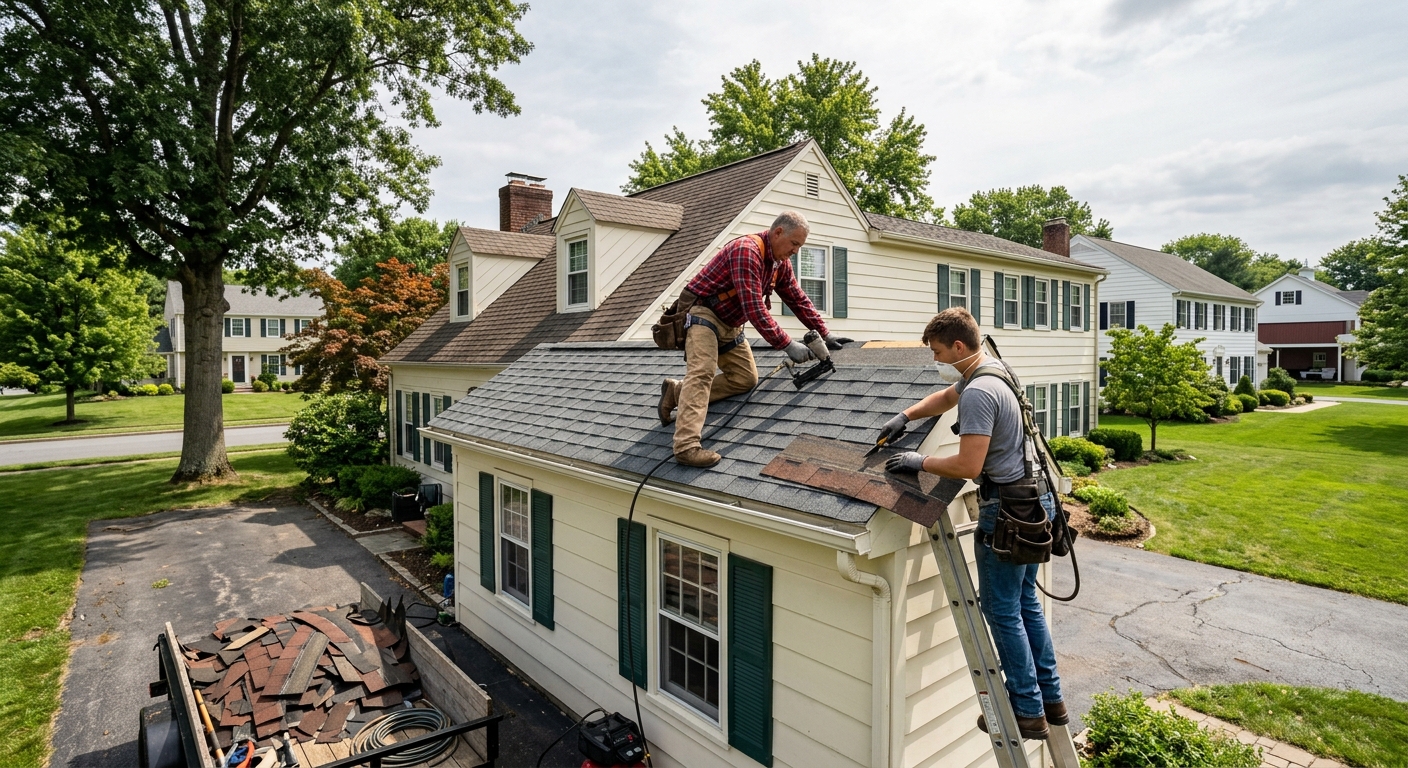
Penn roofing prices by material and scope — 2026
Penn homeowners face a unique roofing market, shaped by Lancaster County’s deep mix of old housing and steady homeownership. With 48.7% of the homes built before 1980 and a strong 77.6% homeownership rate (U.S. Census Bureau, ACS 2024), most roofing projects here aren’t just a matter of swapping shingles. Many Penn roofs cover steep lines and have multiple shingle layers hiding under the surface—not surprising for a county packed with early-20th-century construction. That age means a roofer here expects to do more tear-off work, reinforce weak decking, or navigate quirks from three generations of repairs. If you own one of Penn’s classic frame houses, odds are you’ll face a roof project that’s more complex and expensive than a simple overlay.
The saturated contractor market—thanks to Lancaster city’s metro pull—keeps prices honest, but older homes often require skilled labor familiar with steep slopes and legacy materials. Options range from affordable architectural asphalt shingles, driven down in price by the region’s Amish and Mennonite crews, to standing seam metal for those wanting longevity and less maintenance. Flat roof sections (like porch add-ons and rowhouse rears) need specialized membranes to combat the local freeze-thaw cycle and moderate snow loads.
| Material / Scope |
Lifespan |
Best for |
Price range (installed) |
| Asphalt shingles — architectural (30-yr) |
25–30 yrs |
Pitched roofs on typical Penn single-families |
$9,400–$20,000 |
| Asphalt shingles — impact-resistant (Class 4) |
30+ yrs |
Homes with tree cover or severe storm history |
$15,500–$20,000 |
| Metal standing seam |
40–70 yrs |
Historic steep-pitch roofs, long-term owners |
$22,500–$40,500 |
| Flat roof — TPO or EPDM |
15–25 yrs |
Flat porch roofs, low-slope rear additions |
$12,000–$23,500 |
| Roof repair — leak or isolated section |
n/a |
Small area fixes, flashing failures |
$500–$1,900 |
Prices are estimates for a typical Penn home and vary with roof size, pitch, decking condition and material selection.
Permits and code requirements in Penn
Roofing in Penn falls under the Pennsylvania Uniform Construction Code (UCC), which is based on the IRC. In Lancaster city, if your roof replacement includes new sheathing or any structural work, a building permit from the City of Lancaster Bureau of Code Compliance is mandatory. In the surrounding townships, basic repairs—such as replacing a few shingles due to a leak—often proceed without permits, but structural changes or deck replacements typically bring code enforcement into play. Always clarify requirements with your specific municipal office before work starts, as Lancaster County’s townships run their own code enforcement separate from the city.
For contracts over $500, only hire contractors holding a Home Improvement Contractor (HIC) registration from the Pennsylvania Office of Attorney General. You can check HIC registration status at hic.attorneygeneral.gov before you sign anything. Written contracts are required under the Home Improvement Consumer Protection Act, and you get a 3 business-day right of cancellation. Employer-provided workers’ compensation insurance is mandatory in Pennsylvania. You should ask your roofer for proof and can independently verify any Pennsylvania employer’s coverage using the WCAIS system at wcais.pa.gov. There is no trade license required for roofers in this state—if someone claims otherwise, walk away.
Gutters, drainage and roof longevity in Penn
Addressing gutters and roof drainage is not optional in Penn if you want your new roof to last. Steep roofs and multiple shingle layers are common here, and many old homes have gutters that are undersized or pull away due to repeated patchwork. Replacing the roof but leaving failing gutters is a half-done job; water can quickly get behind new fascia or overwhelm your drainage system, leading to rot or attic leaks. Downspouts that empty too close to a home’s foundation invite basement water problems, particularly with the area’s moderate snow and frequent summer downpours off the Susquehanna valley. Roofing warranties—especially for architectural shingles and membrane systems—often require proper drip edge, flashing, and sound gutter discharge away from the foundation.
When budgeting, expect average seamless aluminum gutter and downspout replacement alongside a roof in Penn to run $2,100–$4,000 for a typical single-family home, depending on size, stories, and whether leaf guards are included. For older homes, additional work reinforcing fascia or adjusting grading near splash blocks can be a smart investment—less for appearance and more to keep your basement dry and your new roof warranty intact.
Workmanship vs manufacturer warranty
Warranties on roofing in Penn come in two distinctly different types: manufacturer and workmanship. The manufacturer warranty, offered by the shingle or membrane brand, covers material defects—such as premature cracking or granule loss. These warranties are typically prorated after the first ten years. Mistakenly, some local contractors let homeowners believe this covers leaks or poor installation. It doesn’t. The workmanship warranty comes from your installer, and covers problems from improper flashing, nailing, or underlayment errors. Its value depends more on company stability than its stated length—a supposed “25-year” warranty from a two-year-old firm in Lancaster County is worth far less than a solid 10-year warranty from a company with deep local roots.
Both warranty types can be voided. Over-layering new shingles over old, failing to vent the attic per code, or making post-install modifications all risk nullifying coverage. If you want your warranty to transfer to a new owner, check fine print: some manufacturers and most contractors allow this only once, and usually require notification within 30–90 days of sale. Skipping contract registration (usually within 60 days of installation) can also void coverage. Local standards make one thing clear—don’t trust a handshake or a brochure. Insist on both signed paperwork and a clear commitment to registered warranty transfer if you plan to sell within the next decade.
Choosing a roofing material for Penn's climate
Your roofing choice for a Penn home should fit Lancaster County’s moderate but challenging climate. With a ground snow load of 30 psf and harsh freeze-thaw cycles, roofs here must handle both winter’s 12 °F design temps and punishing summer storms off the Susquehanna. Standing seam metal is excellent at shedding snow and needs little maintenance, but the upfront cost—often $22,500–$40,500—puts it out of reach for most projects. Metal’s real value shows on steep, older roofs, where shedding and long life matter. For most Penn homes, architectural asphalt dominates. Why? The Amish and Mennonite crews in the area have pushed down installation costs, making it the budget winner. At $9,400–$20,000 installed, it reliably handles the local snow and won’t break the bank if a branch comes down in a summer microburst. Class 4 impact-resistant shingles run closer to $15,500–$20,000, and only make economic sense in the rare spot that sees frequent treefall or large hail (not typical here).
Flat or low-slope sections—think porch additions and rear-rowhouse caps—can’t use shingles. TPO or EPDM membrane is required to avoid ponding, common in our local freeze-thaw regime. That runs $12,000–$23,500 installed, but it’s non-negotiable where standing water forms by midsummer. Unless you plan to keep your house 30+ years or want a historic look, metal is rarely worth the premium. Most Penn homeowners get more value out of architectural shingles installed by a reputable local team.
| Material |
Installed cost |
Lifespan |
Cold-climate performance |
Maintenance |
| Asphalt architectural |
$9,400–$20,000 |
25–30 yrs |
Handles freeze-thaw, moderate snow |
Periodic cleaning, replace damaged shingles |
| Asphalt Class 4 impact-resistant |
$15,500–$20,000 |
30+ yrs |
Better against wind/debris, good for exposed sites |
Same as standard architectural |
| Metal standing seam |
$22,500–$40,500 |
40–70 yrs |
Sheds snow rapidly; best for steep slopes |
Minimal; occasional inspection |
| TPO / EPDM membrane |
$12,000–$23,500 |
15–25 yrs |
Resists ponding and freeze-thaw cracking |
Clear debris; inspect seams annually |
Penn homes and their roof lines
Penn sits in a region where nearly half the homes were built before 1980 (48.7%), and that shapes every roofing conversation. The most common sight here is a steep roofline—older houses in Penn usually boast slopes meant to shed moderate snow, not flatter postwar designs. Under those layers, decking is likely to be true plank or 1x tongue-and-groove, not factory OSB or plywood. That means when you go to replace your roof, there’s a real chance of running into soft wood, uneven surfaces, and cases where past roofers locked in problems by laying new shingles over old ones (sometimes multiple layers deep).
Ice barrier underlayment was not part of code for most of Penn’s historic housing boom, so many existing roofs lack any ice dam protection at the eaves. That increases the risk of interior leaks during a strong freeze-thaw event, especially along north-facing slopes or in valley areas. Since removing three generations of shingles can reveal hidden rot or retrofitted framing repairs, budgets in Penn need to allow for more than surface work—expect a properly scoped job to include deck repair and full ice barrier installation. If you’re in one of the area’s less common post-1980 homes, you’ll see manufactured trusses, plywood or OSB decking, and usually no more than one previous roofing layer, which makes projects more predictable. But for most, Penn roof jobs are all about solving accumulated problems and updating old work to modern standards.
Low-slope and flat roofs in Penn
Flat roofs are common in Penn, showing up on porches, additions, and rear sections of older rowhouses. Unlike the main steep-pitch roof, these areas face chronic drainage problems if not handled with the right materials. Standard shingles start to fail below a 4/12 pitch; on the 2/12 slopes or true flats found here, water and snow linger, finding their way under even well-installed architectural shingles. That’s when leaks and rot become annual hassles. TPO or EPDM membrane systems are the correct answer for these parts of the roof—they let water run off or evaporate instead of seeping in, and last 15–25 years under freeze-thaw and moderate snow (running $12,000–$23,500 for most local jobs).
Ponding water is the main enemy—adding more shingles or “rolling” granulated roofing paper just delays the inevitable. If a roofer in Penn suggests putting standard shingles on a near-flat section, they’re advertising their inexperience or willingness to skirt code. Insist on membrane systems for flat areas: the upfront cost is worth it, and insurers as well as buyers will look for evidence that the job was done right. Repairs are simpler and last longer compared to patching layered shingles on a failing low slope.
Frequently asked questions — roofing in Penn
Why do roofs fail faster in south-central Pennsylvania?
Roofs in Penn and the rest of Lancaster County take a beating from our unique climate conditions. The pronounced freeze-thaw cycle—where snow or rain enters a crack, freezes overnight, then thaws and refreezes—quickly works its way under shingles, especially on older, steep-pitch roofs with multiple layers. Sudden wind bursts from Susquehanna River valley thunderstorms can peel back loose shingles or stress flashing, which is not as big of an issue in counties with more stable weather. Most homes here are pre-1980, so older materials and prior over-layering (a common shortcut) contribute to early failure. Repairs for isolated leaks typically cost $500–$1,900, but without addressing underlying issues, that’s often just the start. In Penn, proactive full replacement with modern underlayment and a single shingle layer is the best way to maximize roof life, rather than repeated small fixes that don’t solve the climate-driven causes.
Is ice barrier underlayment required in Penn?
Most older Penn homes were built before ice barrier was part of the code, so it’s not present on many roofs unless they've been fully redone in recent years. Today, the Pennsylvania Uniform Construction Code (UCC) does require an ice barrier (commonly called ice-and-water shield) at the eaves for new roof installs. Homeowners in Penn should insist on it for replacements, especially with our 30 psf snow load and regular freeze-thaw events. Installing a new roof without it, even if not strictly enforced for a repair, is asking for winter leaks. The cost for a proper install is included in replacement pricing—so when you get a quote in the $9,400–$20,000 range for architectural shingles, make sure ice barrier is itemized. Skipping this step is a false economy, as water entry and attic damage are far more costly to fix after the fact.
Is a sagging roof line an emergency?
In Penn, a sagging roof line—whether you see a dip or wave from the ground or spot it in the attic—is a structural warning, not just an aesthetic one. Given Lancaster County’s many pre-1950 homes, sagging can mean old plank decking has rotted or past over-layering has overloaded undersized rafters. While you don’t need to panic at the first sign, you shouldn't delay an evaluation. A true structural issue can escalate in a single season, especially during heavy snow events. Expect inspection plus isolated deck or rafter repairs to cost between $500–$1,900, though full remediation could push a project into full roof replacement pricing. In Penn, calling in a seasoned roofer familiar with the area’s old framing—even if you decide not to replace just yet—is the right move to prevent a minor issue from turning catastrophic.
Does homeowner's insurance cover roof replacement in Penn?
Homeowner’s insurance in Penn usually covers roof replacement only for sudden, accidental damage—like a tree falling during a Susquehanna valley thunderstorm, or wind ripping up shingles. Age-related wear, neglect, or failing materials on a 25-year-old roof aren’t covered. Insurers in Pennsylvania will send an adjuster to assess, and may only pay the actual cash value, especially if your roof was nearing end-of-life. Some policies require documentation of maintenance or regular inspections if you want to claim. If you have a qualifying event, you’ll still be responsible for paying your deductible—under state law, it’s illegal for contractors in Pennsylvania to waive your deductible as an inducement. For context, the typical architectural shingle replacement runs $9,400–$20,000; if an insurer pays, it’s usually just what’s necessary to restore function, not to upgrade materials.
How far ahead should I book a roofer in Penn?
In Penn, especially around Lancaster city, roofing crews are always busy. The saturated contractor market offers choices, but with 67.8% of households in single-family homes, good roofers often book up months ahead—especially after severe summer storms hit the Susquehanna valley. If you’re eyeing a full replacement for fall or spring, reaching out 2–3 months ahead gets you on reputable contractors' schedules, particularly if you want specialized work (such as standing seam metal, which runs $22,500–$40,500 installed). Emergency repairs are usually handled within a week, but quality replacement or large flat-roof membrane jobs can take longer. Avoid pushy, immediate-availability teams unless you have an active leak—last-minute jobs may skip crucial prep or overlook the layers and deck issues that come with Penn’s older housing stock.
Does roof pitch affect the price in Penn?
Yes, and even more so here in Penn, where many homes are steep-pitch, pre-1980 construction. Steeper slopes mean higher labor costs, more safety setup, and difficulties hauling materials to the ridge. On a shallow pitch, roofers can move quickly and stage materials easily, lowering your bill. With the steep lines seen on Penn’s older homes, most contractors factor in extra labor and harness time, sometimes making a project land at the high end of the $9,400–$20,000 range for architectural shingles. If you’re comparing quotes, ask how pitch factored into pricing. A steep roof also limits material choices: some membrane systems aren’t suitable, and standing seam metal—while costly—can sometimes be warranted for both performance and lower maintenance as well.
How long do architectural shingles last compared to 3-tab?
In Penn, most shingle replacements now use architectural (dimensional) shingles, which are thicker and outperform old-school 3-tab in every way. While 3-tab shingles might scrape by for 15–18 years (sometimes less with freeze-thaw and local wind), architectural shingles are rated 25–30 years, with the best installs reaching their full lifespan. At a replacement cost of $9,400–$20,000 for architectural, they’re a better investment compared to paying a little less for 3-tab and then facing a full replacement a decade earlier. The better uplift resistance of architectural shingles is important too, especially on Penn’s steep, exposed roofs. Only opt for 3-tab if you’re prepping to sell and need the bare minimum—otherwise, the extra up-front spend on architectural or Class 4 makes sense in this local climate.
Are storm-chasing roofers a problem in Penn?
While Penn doesn’t see the hail events that attract large teams from out-of-state, after a big Susquehanna valley windstorm, you may see new faces knocking at your door or leaving flyers. These storm-chasers often offer deals “if you act now,” and some may hint at covering your insurance deductible—a practice that’s illegal in Pennsylvania. Local requirements (like HIC registration, which you can check at hic.attorneygeneral.gov) and a written contract mean legitimate Penn contractors are easy to verify. Don’t be rushed by aggressive sales tactics; if a roofer can’t show their HIC number or provide a local reference, move on. Our prices for reputable repairs ($500–$1,900) are set by honest competition, so you don’t need to gamble with outsiders.
Is a metal roof worth the extra cost in Penn?
For most Penn homes, the premium for standing seam metal (commonly $22,500–$40,500 installed) comes down to your plans with the house. Metal is a hurricane against heavy snow and outlasts two or three shingle roofs, especially on older, steep-pitch homes where snow loads and runoff matter. If you plan to stay put for 30 years or your roof endures regular debris from tall old trees, the extra spend can be justified for lower maintenance and longer warranty. But the math is harder on a typical Penn single-family. Architectural shingles, with their strong local competition, deliver most of the value for less than half the upfront price. Unless you have a historic home you’re rehabbing for the long haul or just love the look, most Penn homeowners find metal isn’t worth it in the current market.