Scranton roofing prices by material and scope — 2026
Roofing costs in Scranton reflect the specifics of the city’s old housing stock, changing weather, and the high percentage of early-1900s wood-frame homes. With 87.2% of houses here built before 1980 and a homeownership rate just over 50% (U.S. Census Bureau, ACS 2024), most neighborhoods are filled with duplexes and row homes stacked close together. These types of structures, especially common in Scranton and Old Forge, drive up the need for decking repairs and uncover plenty of surprise carpentry as older plank boards are exposed during tear-off.
This locally dense and aging housing means roof replacements often become more involved here than in newer suburbs. Many roofs have steeper pitches and multiple layers of shingles going back decades, thanks to a pattern of covering instead of stripping—until city-permitted full tear-offs are now required. Most Scranton projects also need repairs to rotted deck boards and new ice barriers, adding cost but protecting against the region’s heavy snow and ice-dam conditions. This all puts the lower end of replacement prices firmly above what some might expect: homeowners regularly face project totals that land in the middle of the bands below, with few truly “easy” jobs left in the city’s core.
| Material / Scope |
Lifespan |
Best for |
Price range (installed) |
| Asphalt shingles — architectural (30-yr) |
25–30 yrs |
Most Scranton and Dunmore homes needing affordable replacement |
$8,400–$18,000 |
| Asphalt shingles — impact-resistant (Class 4) |
30+ yrs |
Exposed hilltop homes in Scranton, Archbald, or South Abington |
$14,000–$18,000 |
| Metal standing seam |
40–70 yrs |
Long-term owners or homes with frequent ice-dam damage |
$20,500–$36,500 |
| Flat roof — TPO or EPDM |
15–25 yrs |
Multi-family or mixed-use row buildings with low-slope roofs |
$10,500–$21,500 |
| Roof repair — leak or isolated section |
n/a |
Minor leaks or missing shingle repairs, not full replacement |
$450–$1,700 |
Prices are estimates for a typical Scranton home and vary with roof size, pitch, decking condition and material selection.
Roofing season and lead times in Lackawanna County
Scranton’s roofing season usually opens in late March and can run through early November, but conditions on the ground—not the calendar—dictate when real work can happen. Asphalt shingles, the most common material here, need consistent daily highs in the upper 40s to seal properly. Early spring installs can be risky, as some valleys and north slopes stay icy through April, meaning shingle adhesion and slip hazards are a real factor for crews.
Summer is the peak booking window for Scranton roofing contractors. The market here is crowded with small outfits all chasing jobs, and even with that saturation, crews book up fast from June through August. If you need a roof done before school starts, aim to book by May. By September, the backlog usually eases, and rates occasionally edge down a bit. Labor remains tight through late fall—especially in October, when homeowners suddenly discover leaks as the rain returns and oak leaves gather in gutters. If you have an emergency, such as a ridge vent torn off by wind in February, be prepared for a premium price and slower response. Cold-weather work may even require temporary tarping until a safe full replacement is possible.
Thanks to Scranton’s high contractor density, you’ll usually get a faster site visit than in rural Pennsylvania—but long-standing crews with real experience are rarely available for next-day tear-offs except for true emergencies, and their calendars fill quickly after July.
Choosing a roofing material for Scranton's climate
Roofing material choice in Scranton comes down to how well it stands up to heavy snow (40 psf design load) and cold snaps down to 4 °F. Asphalt shingles are everywhere for good reason: they’re budget-friendly and robust enough to last 25–30 years if properly installed on a solid deck. Most local homes are steep-roofed, letting snow slide to the gutters, which suits shingles. Upgrading to Class 4 impact-resistant asphalt makes sense for houses on exposed hills, like parts of Archbald and the east side of Scranton, where wind-driven ice and tree limbs do real damage—but the jump in cost is only worth it for owners intending to stay long-term.
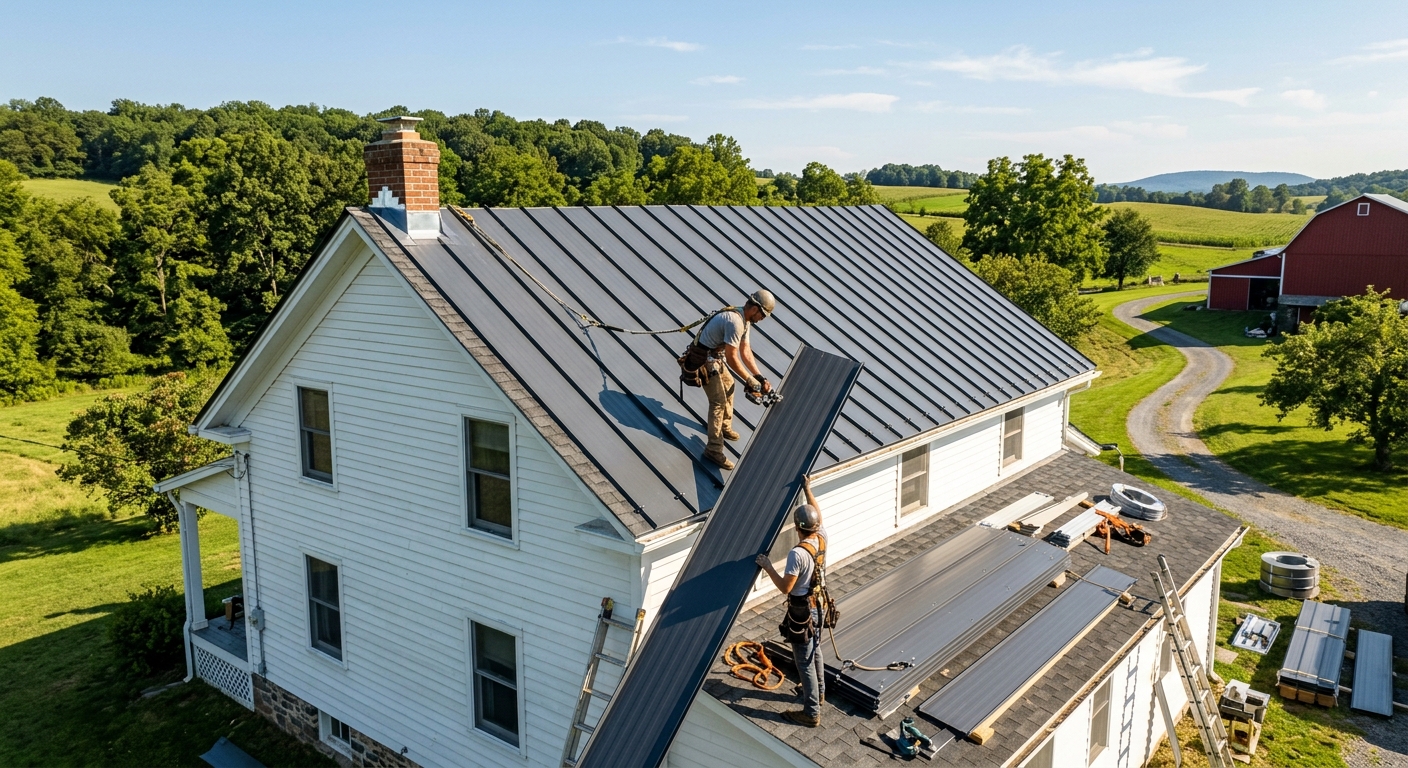
Metal standing seam roofs outperform in snow and ice-dam-prone areas: snow slides off quickly, and they don’t absorb water from melting and refreezing cycles. This material is a real investment—two to three times the outlay of shingles—but for homes that have chronic ice-backup issues, it pays for itself in avoided repairs. Flat TPO or EPDM membrane is the go-to for row houses and older duplexes with low slopes. Membrane roofs are vulnerable to punctures from foot traffic or debris, so they’re mostly chosen where the structure demands low slope, not by preference.
Asphalt remains dominant on Scranton and Dunmore homes not only because of cost, but because old wooden framing and steep pitches make layering shingles practical and attractive for neighborhood look. Metal is best reserved for severe ice-dam addresses or forever-homes; for the average homeowner, especially in Scranton's core, architectural shingles are the logical call.
| Material |
Installed cost |
Lifespan |
Cold-climate performance |
Maintenance |
| Asphalt architectural |
$8,400–$18,000 |
25–30 yrs |
Good with proper ice barrier |
Check for ice dams and clear gutters |
| Asphalt Class 4 impact-resistant |
$14,000–$18,000 |
30+ yrs |
Better in hail, wind, and on exposed ridges |
Minimal, same as standard shingle |
| Metal standing seam |
$20,500–$36,500 |
40–70 yrs |
Excellent for snow and ice, best leaks resistance |
Clear snow drifts at eaves, inspect fasteners |
| TPO / EPDM membrane |
$10,500–$21,500 |
15–25 yrs |
Handles Ponding if well-installed, but more vulnerable to sharp ice |
Annual seam check, patching as needed |
Roof age and construction era in Scranton
Scranton’s core housing stock—and a good deal of Old Forge’s—is made up of homes built before 1980, with the overwhelming majority going up before the late 1940s. With 87.2% of residences built before 1980 (U.S. Census Bureau, ACS 2024), this means most roofs you see are pitching steeply, with planked rather than plywood or OSB decking underneath. Back then, roofs were covered in either cedar shingles or the earliest generations of three-tab asphalt—then covered right over, layer after layer, across decades.
Most of these older homes never saw eave ice barrier until very recently, since that was not required by code. Strip a roof in central Scranton today, and you’ll likely find a hodgepodge of old deck boards, plenty of voids to patch, old nail holes, and often enough, two full layers of shingle to remove. Deck replacement is common, and adding today’s code-mandated ice and water shield at eaves is standard because ice damming from snow melt is a given in this climate. If you’re buying or renovating a Scranton house built before the ‘80s, expect to budget for carpentry and insulation corrections as part of your roof project, not just shingles.
For the minority of newer single-families you’ll find in South Abington or on the edge of the county, first roof replacement tends to be driven by shingle wear and attic ventilation, not by severe hidden rot. But for most Scranton homes, every roof is at least part restoration job.
What moves the price of a roof in Scranton
Price swings on Scranton roof quotes usually come down to the reality of old construction, not tweaks in the estimator’s math. The most obvious lever is size—roof area in “squares” (100 sq ft each) sets your baseline on labor and materials. Steep-pitched, two-family dwellings are standard here, often meaning more vertical than horizontal travel for the crew, which adds to install time and cost through harness setups and slower shingle placement.
Decking surprises are historically common in Scranton due to aged plank boards covered over many times. During every full replacement, we end up changing at least a few sheets, typically at $75–$150 apiece. Two or more layers of old shingle must come off by code if you want to pass local inspection, which doesn’t just add landfill costs ($500–$1,500 per extra layer), but means more haul-off and labor hours as well. Add in the mandatory ice barrier at the eaves for any roof with a history of winter leaks—an upgrade you can't skip in neighborhoods that routinely see ice damming for weeks—and that’s another $300–$800 on most jobs.
Material selection accounts for some spread: picking impact-resistant shingle adds around $500–$2,500, but pays for exposed ridgeline homes that see more wind and frozen branches. What really sets Scranton apart from rural areas is the way contractor competition can either raise or drop your quote, depending on how tight the schedule is after a big storm, and who’s available to do the work to code.
| Factor |
Why it matters here |
Cost impact |
| Roof size in squares |
Each square is 100 sq ft of roof surface |
Primary multiplier |
| Pitch and access |
Steep pitches need harnesses and slow the crew |
+20–30% labour |
| Existing layers to tear off |
Two or more layers means full tear-off and disposal |
$500–$1,500 per layer |
| Decking condition |
Rot is found during tear-off, not before |
$75–$150 per sheet |
| Ice barrier at eaves |
Required where ice damming has a history |
$300–$800 |
| Material grade |
3-tab vs architectural vs Class 4 impact-resistant |
$500–$2,500 |
Roofing permits in Scranton: what you need before work starts
In Scranton, roofing jobs that involve a tear-off and full roof replacement on any one- to four-family residence typically require a building permit. The authority responsible for code enforcement is the City of Scranton Department of Licensing, Inspections & Permits. They administer the Pennsylvania Uniform Construction Code (UCC), which follows the International Residential Code—but with direct enforcement at the city level rather than by the state.
For minor like-for-like shingle repairs covering only a small area, no permit is usually required in Scranton and Dunmore—that work is routinely performed with no official paperwork. But if your contractor is replacing a full roof, changing the deck or underlying structure, a permit must be secured before any dumpsters hit the driveway or the first shingle is pulled off.
For legal compliance, any job over $500 must use a contractor registered as a Home Improvement Contractor (HIC) with the Pennsylvania Office of Attorney General. As a homeowner, you can verify HIC registration directly at hic.attorneygeneral.gov. Workers’ compensation coverage for all employed roofers is required by state law, and you can check proof through the state’s WCAIS portal (wcais.pa.gov). Always insist on seeing both HIC registration and workers’ comp insurance before signing a contract, or you risk liability, project shutdowns, and, at worst, denied claims.
Reading a roofing estimate line by line
A clear, detailed roofing estimate helps you compare bids and avoid surprise upcharges. Every Scranton estimate should state roof area in squares (with pitch specified—don’t accept one listed just as “20 squares” with nothing else) and list each item as a separate line: tear-off and dumpster, product and underlayment brand, how much ice shield, and what the contingency pricing is if deck sheets are rotten. Flashing and vent boots, essential on nearly every home in town, should be called out separately by type or area covered.
Your estimate should show both the manufacturer’s warranty (usually on the shingles or membrane itself) and the contractor’s labor warranty—these are not the same, and separation is your protection if workmanship is ever in question. Payment terms should be clear: an honest local contractor will ask for a modest deposit (under 15%, enough for materials) and the rest on completion. Any bid with a large upfront cash demand or only a lump sum (with no breakdown) should be questioned seriously or set aside entirely. Scranton’s housing complexity means surprises happen, but the cost to replace rot should always be stated “per sheet” before you sign.
| Line item |
What to look for |
Red flag if… |
| Roof area |
Stated in squares, with pitch |
No measurement given |
| Tear-off and disposal |
Number of layers, dumpster included |
Bundled into one figure |
| Underlayment |
Product type and coverage |
Listed only as 'felt' |
| Ice and water shield |
Coverage height at eaves |
Omitted entirely |
| Decking |
Per-sheet contingency price |
No allowance at all |
| Warranty |
Workmanship years stated separately |
Only the shingle warranty |
| Payment |
Deposit under 15%, balance on completion |
Large upfront cash |
Frequently asked questions — roofing in Scranton
How do I know if my Scranton roof needs replacing?
A Scranton roof often gives warning signs before it fails. In this area—especially with the average home built pre-1980—look for curling, cracked, or missing shingles on steep slopes, dark streaks from long winters, and granules piling in gutters. If your home has had more than one layer applied over plank decking, common in early-1900s row houses here, leaks or sagging often means there’s underlying deck rot. Another local clue is ice damming every winter—if water backs up under shingles or stains show indoors, the roof and eaves likely need full replacement with modern ice barrier. For most owners, if repairs and patching are adding up to more than $1,700 a year, it’s money better spent on a full replacement. A reliable local contractor can give you a free site visit and honest answer—sometimes a full tear-off isn’t needed if damage is truly isolated, especially in neighborhoods where spot repairs are an accepted solution.
Will the crew damage my landscaping or driveway?
In Scranton—where older homes often have narrow side yards and small parking pads—there’s real risk to landscaping and driveways during a full roof replacement. Crews should always tarp shrubs, decks, and walks, and lay wood or plywood under dumpsters to avoid gouging concrete or asphalt. A reputable roofing company will walk you around the house at the end of the job to check for missed nails, debris in the yard, or scratches to siding/gutters, especially with the dense layout of classic Scranton and Dunmore lots. Get this cleanup in writing as part of your estimate. While careful crews still can’t dodge every flat tire (from stray old nails) or minor scuff during jobs that cost $8,400–$18,000, you should see a commitment in the contract to repair any direct damage done by their crew or their equipment—just don’t expect them to fix pre-existing cracks in hundred-year-old sidewalks.
Is metal roofing noisy in rain?
Metal standing seam roofs—while increasingly common on Scranton homes with major ice problems—don’t have to be noisy if installed correctly. Most noise complaints come from old farm outbuildings where there was no attic insulation. On a typical Scranton house, you’ll have original wood decking, new underlayment, and some insulation in the attic—all of which blunt the “tin roof” effect. In practice, the difference in sound between a $20,500–$36,500 metal roof and high-end shingles is small unless your attic is unfinished and open. If quiet is your top priority, talk with your contractor about adding batt insulation or a sound-deadening underlayment during installation. The upsides of metal—like lifelong leak resistance and snow shedding—are usually worth the very modest uptick in noise, and for most owner-occupied Scranton homes, the “drum” is closer to a white noise than a distraction.
Will filing a roof claim raise my premium?
In Pennsylvania—including Scranton—insurance carriers may consider your claim history when setting future premiums. Filing a roof claim after hail, wind, or ice-dam damage could lead to a rate increase at renewal or your policy being flagged for non-renewal if you’ve filed multiple claims in recent years. For a minor repair, such as a leak fix in the $450–$1,700 range, you’re usually better off paying out of pocket to avoid the long-term hit on your rates. However, for total roof losses or major storm damage, going through your insurance is unavoidable. Always check your deductible before calling in a claim; in this region, wind/hail deductibles can be higher than you expect. Scranton’s climate means claims are not rare, so ask your insurance agent for advice before you file—some companies will non-renew for multiple small claims, even if they’re legitimate, and it’s much harder to get re-insured in the same neighborhood.
Is a metal roof worth the extra cost in Scranton?
A metal standing seam roof is a big investment up front—between $20,500–$36,500 for a classic Scranton home—but for certain properties, it absolutely makes sense. If your house sits on a ridgeline or sees repeated ice-dam damage every winter (common on north-facing slopes in Hill Section or Archbald), metal sheds snow and resists freeze-thaw cycles much better than shingles. For owners planning to stay twenty years or more, that longevity can pay for itself in avoided repairs. On flatter or shaded roofs, or if you’re not planning to stay past the next decade, asphalt architectural shingles at $8,400–$18,000 get you 25–30 years of solid performance with much less outlay. For most Scranton homeowners, unless the roof’s shape or local ice problem is severe, the upgrade to metal isn’t needed—but it’s the best money spent on chronic-problem houses.
Why do roofs fail faster in northeastern Pennsylvania?
Roofs in Scranton and across northeastern Pennsylvania take more abuse than the national average. Ground snow load is rated at 40 psf here, putting constant winter pressure on older decks, and heavy ice-dam formation is common where attic insulation is spotty—especially in early-1900s row and duplex homes. Add to that ridge-line winds funneled along the Lackawanna Valley, and shingles often lift or wear out well before their national life expectancy. Many houses here also lack modern ventilation, so summer heat degrades asphalt and wood framing underneath. The combination of freeze-thaw cycles, snowmelt seeping under old flashing, and the age of deck boards means even a well-installed asphalt roof may need replacement after 22–25 years—short of the 30 years seen in milder regions. If you’re getting repairs every few winters at $450–$1,700, it's a sign local conditions are catching up with your system.
What does roof replacement cost per square in Scranton?
In Scranton, the installed price for roof replacement is usually quoted per “square”—100 square feet of surface area, steep slope counted as-is. For an architectural asphalt shingle system, expect $420–$600 per square on most jobs, adding extra for steep pitches, rotten deck replacement, or complex roof lines. Upgrades like impact-resistant shingles push that closer to $700 per square. Metal standing seam is much higher, generally starting around $1,050 per square and going up for detailed trim and fastener systems. With Scranton’s old housing, remember most estimates will include some deck patching and ice barrier—both real cost inflators. Ask your estimator for both a total and a per-square price to compare bids accurately. If you’re seeing per-square pricing far below these numbers for a full tear-off, something is probably missing from the bid, or short cuts are planned.
What should a roofing quote include in Scranton?
A Scranton roofing quote should lay out the project in clear sections. First, roof area should be listed in exact squares, with a note of the roof’s pitch, as this determines labor and material needs. Tear-off and disposal must specify how many layers are coming off—here in Scranton, two old layers isn’t rare—and whether a dumpster is included. Look for underlayment and ice barrier called out by product type and area covered, since local code requires ice shield at the eaves in any area prone to ice dams. Deck replacement should be a clear per-sheet price; never accept a bid without this contingency, as it’s almost always needed in our early-1900s stock. Flashing, vent boots, and chimney work should all be broken out. Warranty terms must specify both workmanship (from the installer) and material (from the manufacturer). Expect a deposit no more than 15% up front, balance on completion. For a full architectural shingle replacement, costs total $8,400–$18,000, so every dollar must be accounted for line by line.
Can I install new shingles over old ones in Pennsylvania?
Pennsylvania’s Uniform Construction Code allows one layer of overlay (new shingles over one existing layer) in most cities, but in Scranton, a full tear-off is commonly required on older row and duplex housing. This is because building inspectors and experienced contractors know that old plank decks and multiple shingle layers hide rot, sagging, and ventilation problems typical of the city’s early-1900s stock. Scranton’s Department of Licensing, Inspections & Permits will require full removal if there are already two layers, or if deck repairs are needed to meet code. Overlaying is sometimes suggested to save cost ($1,200–$2,000 less than a tear-off), but it’s only tempting if what’s underneath is in perfect shape—a real rarity here. A legitimate contractor will perform a full inspection and tell you straight if an overlay is sensible; honest ones turn down overlay jobs if there’s any doubt, since callbacks are a guarantee when hidden rot goes uncovered.