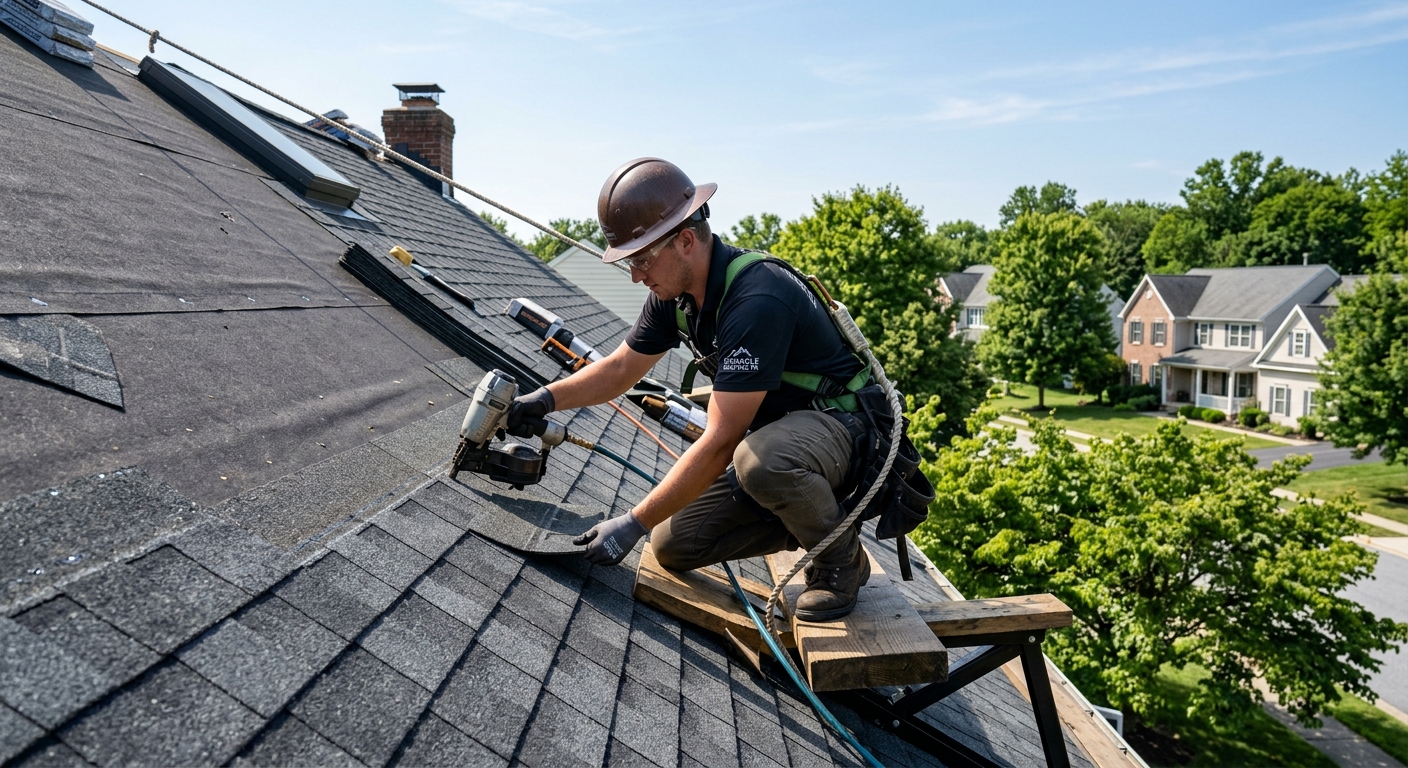
What roof replacement costs in Bethel Park in 2026
Roof replacement costs in Bethel Park depend heavily on the age and construction of the local homes. Most houses here—reflecting the 76.1% built before 1980 and the predominance of single-family ownership (U.S. Census Bureau, ACS 2024)—have roof decks that commonly need attention when reroofing. In practice, this means many jobs aren't just about new shingles; they also involve replacing sections of old wood, handling two or even three layers of prior roofing, and occasionally upgrading attic ventilation to meet modern standards.
Because much Allegheny County housing dates back to 1900–1950, significant tear-off and deck repairs are often necessary when replacing a roof in Bethel Park. Contractors experienced with these older structures anticipate surprises like hidden water damage or fragile sheathing. That additional labor and material is already reflected in Bethel Park price bands below.
| Material / Scope |
Lifespan |
Best for |
Price range (installed) |
| Asphalt shingles — architectural (30-yr) |
25–30 yrs |
Single-family homes, budget-conscious, meets local needs well |
$10,000–$21,500 |
| Asphalt shingles — impact-resistant (Class 4) |
30+ yrs |
Homes exposed to wind/hail near the Ohio Valley tracks |
$16,500–$21,500 |
| Metal standing seam |
40–70 yrs |
High-value homes, snow and ice control, long lifespan |
$24,500–$44,000 |
| Flat roof — TPO or EPDM |
15–25 yrs |
Low-slope or attached garage additions |
$13,000–$26,000 |
| Roof repair — leak or isolated section |
n/a |
Localized damage on sound roofs |
$550–$2,000 |
Prices are estimates for a typical Bethel Park home and vary with roof size, pitch, decking condition and material selection.
Choosing a roofing material for Bethel Park's climate
Bethel Park's winters challenge roofs with a ground snow load of 30 psf and design temperatures as low as 8 °F. Metal roofs are unrivaled for shedding heavy wet snow—especially on steeper slopes—but their higher upfront cost rarely pays off here unless you plan to stay decades or want to avoid snow slides. Asphalt architectural shingles dominate Bethel Park for good reason: they offer reliable freeze-thaw resistance for far less than metal, making them a sound choice for the area's typical 25–30 year replacement cycle.
As for impact-resistant shingles, they're worth considering if you're directly in the Ohio Valley storm path and want added protection against hail and wind. Flat roofs on additions or split-levels require TPO or EPDM membranes—the only practical options for slopes under 2:12. While membrane systems cost more per square foot than basic shingles, they're the only way to avoid leaks on low-slope roofs in Bethel Park's climate. If you're eyeing standing seam metal but don't plan to stay for decades or don't have a significant snow load problem, architectural shingles are where most homeowners put their money.
| Material |
Installed cost |
Lifespan |
Cold-climate performance |
Maintenance |
| Asphalt architectural |
$10,000–$21,500 |
25–30 yrs |
Good freeze-thaw durability; adequate against snow load |
Low—periodic inspection and shingle replacement |
| Asphalt Class 4 impact-resistant |
$16,500–$21,500 |
30+ yrs |
Better against wind and hail, similar thermal range |
Low—higher resistance to storm damage |
| Metal standing seam |
$24,500–$44,000 |
40–70 yrs |
Excellent—sheds snow, resists ice damming, long lifespan |
Minimal—paint/finish check every 10–15 yrs |
| TPO / EPDM membrane |
$13,000–$26,000 |
15–25 yrs |
Works only on low-pitch roofs; resists ponding if properly sloped |
Annual inspection, seams and penetrations maintenance |
Filing a roof claim after a Pennsylvania storm
When a storm damages your roof in Bethel Park, start by taking clear photos and notes of all affected areas—before you clean up. This documentation is crucial for your insurer. Next, contact your insurance agent to initiate the claim, and request a written scope of loss that shows the adjuster's assessment of both repair and replacement options. In Pennsylvania, homeowners often learn about "actual cash value" (the depreciated value of your roof) versus "replacement cost" (the cost to fully restore with new materials); your payout depends on which is in your policy.
Expect an adjuster visit as part of the process. A reputable local contractor familiar with Allegheny County storm patterns can also scope the damage and advocate on your behalf during the inspection. Pennsylvania’s Home Improvement Consumer Protection Act (HICPA) requires a written contract for roof work over $500—and you have a three business day right of cancellation by law. If any company offers to “waive your deductible” after a storm, walk away. It’s prohibited by state law because it drives up claim costs for everyone and is a sign the contractor isn’t operating honestly.
If a contractor tries to pressure you to sign immediately after major wind or hail, remember that Bethel Park is in a saturated metro market—you have choices. Get a detailed written scope, compare bids, and work with contractors who respect Pennsylvania’s regulations and your right as a homeowner.
What a proper Bethel Park roofing quote contains
Reading a Bethel Park roofing estimate means looking past the headline number. Every quote should explicitly state the roof area in “squares” (100 sq. ft. units) and record the roof's pitch; this tells you exactly what’s being replaced. Tear-off and disposal should name the number of layers and specify if dumpsters and landfill fees are included. Underlayment and ice barriers must list their product types and coverage—never as generic “felt.” Expect a per-sheet price for any plywood decking replacement, as older Bethel Park homes often need some sheets swapped due to prior leaks or rot.
The estimate should also detail new flashing and vent boots. Warranties should be split: workmanship (craftsmanship and installation) versus manufacturer (materials). Lastly, a fair payment schedule calls for a modest deposit (under 15%), with the remainder due on completion—never large cash up front. If you get a vague lump sum with none of this spelled out, you can’t compare offers or know what happens if hidden damage is found. Insist on a detailed, transparent quote—it protects your investment.
| Line item |
What to look for |
Red flag if… |
| Roof area |
stated in squares, with pitch |
no measurement given |
| Tear-off and disposal |
number of layers, dumpster included |
bundled into one figure |
| Underlayment |
product type and coverage |
listed only as 'felt' |
| Ice and water shield |
coverage height at eaves |
omitted entirely |
| Decking |
per-sheet contingency price |
no allowance at all |
| Warranty |
workmanship years stated separately |
only the shingle warranty |
| Payment |
deposit under 15%, balance on completion |
large upfront cash |
Patching vs full replacement in Bethel Park
In Bethel Park, the decision to patch or fully replace a roof hinges on a combination of age, visible wear signs, and the nature of existing leaks. If your roof is under 15 years old and you have a single, isolated leak, repair is practical and cost-efficient. But with so many local homes dating back to 1900–1950, even well-maintained roofs commonly show their age as they near 20–25 years—meaning leaks start cropping up in multiples, not just one spot.
Here's the financial reality: If you spend $1,500–$2,000 a year for three years running on repairs for a roof over 20 years old, you've quickly outpaced the cost of a new architectural shingle roof at $10,000–$21,500. In Bethel Park, leak-prone old decks and heavy storm exposure make repeated repairs a money sink after the 25-year mark. However, for a well-cared-for newer roof with one small issue, patch it and save your money until replacement is justified.
| Situation |
Recommendation |
Typical cost |
Reasoning |
| Under 15 years, one isolated leak |
Repair |
$550–$2,000 |
Shingles/posts can be matched; roof life isn’t affected |
| 15–25 years, several leak points |
Replace |
$10,000–$21,500 |
Underlying wear leads to continued leaks; repairs add up |
| 25+ years, any active leak |
Replace now |
$10,000–$21,500 |
Old decking and shingles fail together; money best spent on new system |
| Storm damage, wind or hail |
Document, claim, replace |
$10,000–$21,500 |
Insurance covers major loss; piecemeal repair rarely durable |
| Flat roof ponding or blistering |
Replace membrane |
$13,000–$26,000 |
Local patch won’t last; structural slope or insulation needs correction |
| Active leak entering winter |
Emergency repair, schedule replacement |
$550–$2,000 |
Cold weather rapidly worsens deck damage; temporary fix buys time |
How to vet a Bethel Park roofing contractor
Start by confirming the contractor’s Home Improvement Contractor (HIC) registration through the Pennsylvania Office of Attorney General at hic.attorneygeneral.gov. For jobs over $500, this registration is mandatory—and the law requires a written contract. Next, verify that the company carries up-to-date workers’ compensation (WCAIS: wcais.pa.gov) before they set foot on your roof. Ask to see current liability insurance certificates as well. Ignore anyone who dodges documentation; in this saturated Allegheny County market, reputable firms are used to these questions and provide paperwork without hesitation.
Here's a checklist for Bethel Park homeowners:
- Check HIC registration at hic.attorneygeneral.gov
- Verify workers’ compensation coverage via WCAIS
- Request and review a copy of business liability insurance
- Obtain a written contract (required for work over $500)
- Know your 3 business-day cancellation right under HICPA
- Ask for references on similar 1900–1950-era home projects
- Make sure the quote lists roof area, pitch, and material types
- Clarify tear-off/disposal, deck replacement contingencies
- Separate workmanship from manufacturer warranty terms
- Insist on a payment schedule—avoid large deposits
- Check the physical office address is in Allegheny County
- Avoid out-of-state plates or only cell phone contact info
Red flags unique to a busy metro like Bethel Park: out-of-state crews knocking after storms, anyone who claims a permit isn’t needed for large jobs, no HIC registration, or an estimate that bundles labor and material together without detail. Pressure tactics are a signal to slow down, not speed up.
Roofing permits in Bethel Park: what you need before work starts
Roofing in Bethel Park is governed by the Pennsylvania Uniform Construction Code (UCC), based on the IRC. For homes within Allegheny County, code enforcement—including building and roofing permits—is overseen by the Department of Permits, Licenses, and Inspections. In nearby Pittsburgh, for example, replacing more than 50% of a roof’s area usually triggers a building permit, while like-for-like minor shingle repairs below that threshold often do not require one.
Before hiring, confirm your contractor’s Home Improvement Contractor (HIC) registration at hic.attorneygeneral.gov. For insurance, verify workers’ compensation coverage via the PA WCAIS system (wcais.pa.gov)—this is mandatory for all employers on residential projects. These steps matter, since registration and coverage protect you if a worker is injured on your property or a dispute arises over workmanship. Always get a written contract for any job over $500, as the Home Improvement Consumer Protection Act (HICPA) requires.
If you have an older (pre-1978) home and suspect paint may be disturbed, federal EPA rules also apply. All properly-run companies are used to furnishing documentation—ask for it up front.
Frequently asked questions — roofing in Bethel Park
What's the cheapest way to replace a roof in Bethel Park?
To keep costs down in Bethel Park, stick to standard architectural asphalt shingles, which remain the dominant choice due to their reliability and the reasonable price band of $10,000–$21,500. Removing the old layers (especially from Bethel Park’s older homes) is a must—double-layer “layover” jobs may seem tempting but usually hide problems and will shorten your new roof’s life. Skip unnecessary upgrades like premium hip/ridge caps, “designer” shingles, or extensive decking replacement unless inspection reveals true deck rot. Get at least two detailed quotes from registered, local contractors and avoid storm chasers who mark up prices or try to upsell you on extras you don’t need for western Pennsylvania’s conditions.
What happens if it rains mid-replacement?
Rain interruptions are a fact of life in Bethel Park’s climate. Any reputable contractor here plans around forecasts and works with a “one-day open” approach, exposing only as much roof as can be dried-in and underlayment-protected by end of day. If a sudden storm hits, your crew should lay down synthetic underlayment or install emergency tarps to keep your attic and interior dry. It’s common practice in Allegheny County to halt tear-off as soon as rain appears and secure all openings. While weather delays can add a day or two to the project, the process rarely justifies extra costs unless damage occurs—then you might see a minor increase, but repairs are usually well below $2,000 unless major water intrusion happens.
Does attic ventilation matter in Bethel Park's climate?
Yes, attic ventilation is crucial here because of the freeze-thaw cycles and significant heating degree days (5,600 per year) in southwestern Pennsylvania. Poor ventilation in Bethel Park’s older homes is a leading cause of ice damming, mold growth, and premature shingle aging. Upgrading or correcting attic vents doesn’t add much to roof replacement cost—a typical system is only a small part of the total job, well within the base range of $10,000–$21,500. Proper ventilation is not optional; it helps keep utility costs stable, prevents moisture damage in cold months, and is a requirement if you’re updating insulation or the roof deck as part of a permitted job.
Is a metal roof worth the extra cost in Bethel Park?
Metal standing seam roofs offer major advantages in snow control and longevity—lasting 40–70 years—but in Bethel Park, the extra cost of $24,500–$44,000 is only justified if you plan to stay in the house for decades, have a steep roof collecting heavy snow, or are addressing recurrent ice dam issues. Most homes here use architectural shingles because the freeze-thaw risk is manageable, and the payback period on metal is long. Unless you need the low-maintenance and love the look (or have specific insurance or HOA reasons), you’re typically better off investing in high-quality asphalt and putting the savings into insulation or new gutters.
How much deposit should I pay a roofer upfront?
In Bethel Park, never pay more than 15% upfront—ideally less. Pennsylvania’s consumer protection laws require a written contract for roof work over $500 and frown upon large upfront payments. Most reputable contractors ask for a modest deposit to hold your spot and cover initial material costs, but the balance should be due only upon satisfactory completion. For example, on a mid-sized shingle job in the $10,000–$21,500 range, a $1,500–$2,000 deposit is more than sufficient. Be wary if anyone wants most of the job total up front or pressures you with “special pricing” if you pay all in cash before work begins.
How do I confirm a roofer carries workers' compensation?
In Bethel Park, you should never just “take their word for it.” Ask for their current workers’ compensation certificate and independently verify coverage status by searching the WCAIS system at wcais.pa.gov, which is Pennsylvania’s official insurance tracking portal. Having workers’ comp protects you legally if someone is hurt working on your roof. On projects ranging from small repairs up through full replacements (which in this market are $10,000–$21,500 for most homes), a contractor without proper insurance exposes you to major liability—even if they say their crew are “independent contractors.” Insist on proof and check it yourself.
What is the difference between TPO and EPDM?
Both TPO (thermoplastic polyolefin) and EPDM (ethylene propylene diene monomer) are flat roof membranes used commonly in the Bethel Park area for low-slope or flat sections, like garage or porch roofs. TPO is white, reflects sunlight, and can help lower attic temperatures in summer; EPDM is black, absorbs heat, and tolerates wide swings in temperature—useful for Bethel Park’s freeze-thaw cycles. Both offer reliable water protection, but TPO seams are heat-welded (tighter in stormy seasons), whereas EPDM uses adhesives. The cost for either in Bethel Park falls in the same market band: $13,000–$26,000 installed for a typical house section. Your roofer will advise based on slope, insulation, and desired energy performance.
What if my insurer denies my roof claim?
If your roof claim is denied in Bethel Park, don’t panic. Insurers often deny claims if they find the damage results from wear and tear rather than a sudden storm. Start by carefully reading the denial letter and asking your adjuster for a clear explanation. It’s your right to request a re-inspection, ideally with an experienced local contractor present—choose someone familiar with Ohio Valley storm tracks and who works with policies in Allegheny County. If you have strong documentation (photos of storm damage, dated repair receipts), push for a reconsideration. Upgrading your roof at your own expense (at $10,000–$21,500 for architectural shingles) is frustrating, but don’t cut corners—choose a contractor who follows proper claims procedures so you’re better positioned next time.
Can I inspect my own roof safely?
While inspecting your own roof in Bethel Park is possible on a single-story home with a steady ladder, older homes (especially those built before 1980) can have steeper pitches and fragile decking you might not anticipate. Walk the property from ground level with binoculars and check for missing shingles, rusted flashing, or sagging areas before considering a roof climb. Never step on wet, icy, or leaf-covered surfaces—in Bethel Park’s climate, slips are a real risk. If you suspect damage or need a documented inspection for repairs, consider paying a professional; localized repair is cost-effective, starting as low as $550–$2,000 for most common issues. It’s a small price for peace of mind and safety.