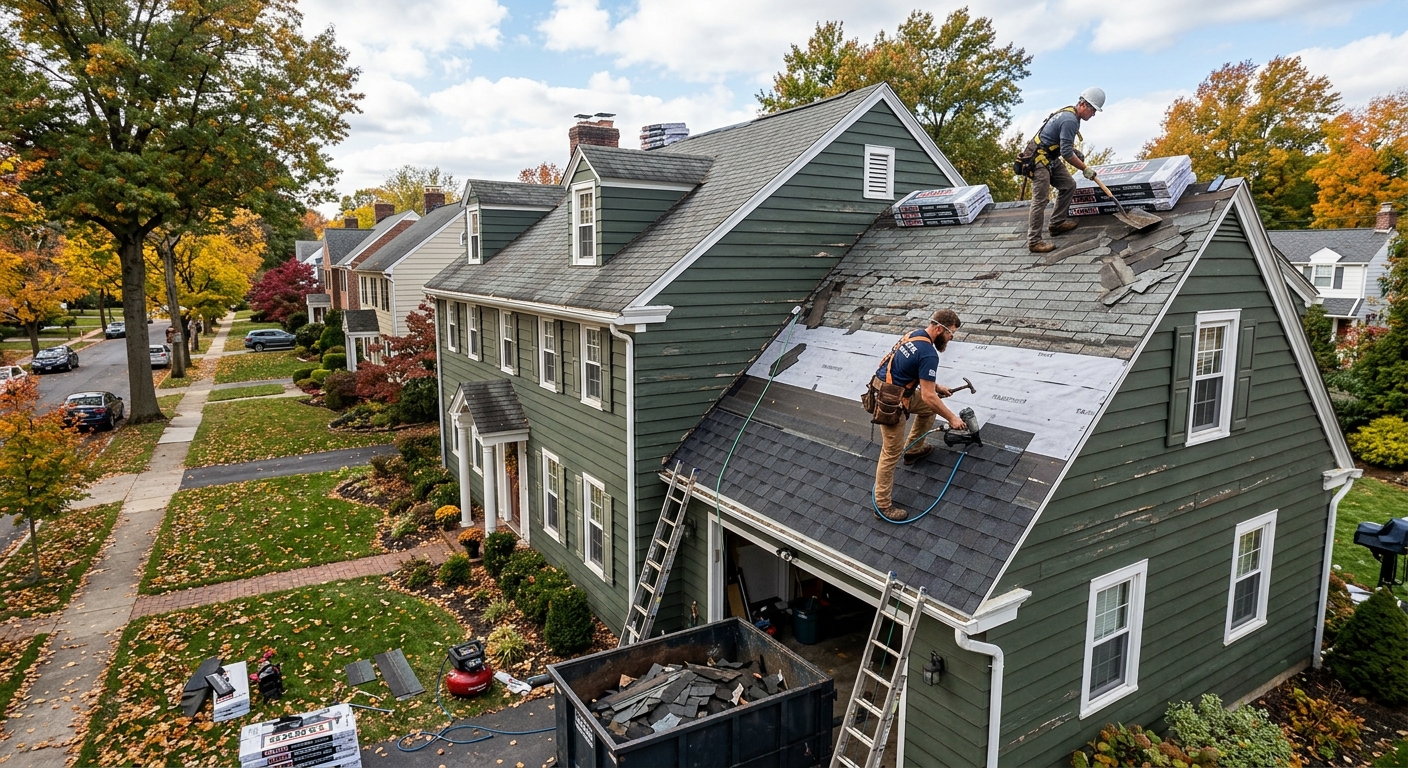
Roofing Replacement & Repair costs in Pittston — 2026
In Pittston, the realities of an older housing stock—where over 85% of homes were built before 1980 and the typical household income is below the state median—mean that roof replacement is both a regular necessity and a major investment. Homeowners here often need to weigh roof repair or full replacement more carefully because the mix of aging early-1900s construction and common regional weather exposures puts their roofs under frequent stress.
Much of Wilkes-Barre and Hazleton’s roofs share their design with Pittston: early-1900s row and twin homes, often with add-ons or enclosed porches. That means roofing scopes here often go beyond simple shingle swaps—think deck repairs, updating old ventilation cut-ins, and handling the quirks that turn up during tear-off. When the original roofers didn’t plan for ice dams or modern insulation, current Pittston jobs often include extra ventilation or ice barrier work.
Local roof pricing reflects these demands and the competitive contractor landscape in Luzerne County. For most Pittston homeowners, the choice comes down to the following systems and price bands:
| Material / Scope |
Lifespan |
Best for |
Price range (installed) |
| Asphalt shingles — architectural (30-yr) |
25–30 yrs |
Most Pittston homes; reliable against wind and snow |
$8,300–$17,500 |
| Asphalt shingles — impact-resistant (Class 4) |
30+ yrs |
Homeowners concerned about local wind or the rare hail event |
$13,500–$17,500 |
| Metal standing seam |
40–70 yrs |
Upper-end homes or those planning for near-zero maintenance |
$20,000–$35,500 |
| Flat roof — TPO or EPDM |
15–25 yrs |
Rowhouse additions, porches, rear flats |
$10,500–$21,000 |
| Roof repair — leak or isolated section |
n/a |
Small area fixes, punctures, flashing |
$425–$1,650 |
Prices are estimates for a typical Pittston home and vary with roof size, pitch, decking condition and material selection.
Reading the warranty on a Pittston roof
Roofing warranties in Pittston fall into two camps: the manufacturer’s coverage for the shingles or membrane itself, and the contractor’s workmanship guarantee. Too often, these get talked about like they’re one and the same—but they are very different in what they protect and how long they last.
A manufacturer warranty covers only material defects—like shingles that shed their granules or a membrane that blisters. These warranties often start out with full coverage but convert to “prorated” terms quickly. That means if you notice an issue with your Pittston roof in year 14, you’re probably not getting a full replacement. On the contractor side, workmanship warranties are all over the map. A ten-year guarantee from a company who’s worked Luzerne County for decades is meaningful; a “lifetime” promise from a firm that’s been around two years is, realistically, only as strong as their odds of seeing your next leak complaint.
Transferability at resale is important in Pittston, where homes change hands frequently—be sure to ask if either warranty travels with the house or resets. Common ways coverage is voided here include poor attic ventilation (which is common in older rowhomes) and “partially” reroofing—layering new shingles over old, which is tempting when budgets are tight but can cancel out warranty protection. Also note you generally must register a manufacturer warranty within 30–60 days of installation. Document everything, as Luzerne County contractors come and go.
Reading a roofing estimate line by line
No two Pittston roofs are quite alike—thanks to all the add-ons, steep pitches, and patched overyears—but reading your estimate should not feel like deciphering a secret code. Start by checking that the total roof area (in “squares”—each is 100 sq ft) and pitch are stated right up front. Tear-off and disposal should be broken out: older Pittston homes often have two or even three layers of shingle, and hidden disposal costs pile up fast.
Look for named underlayment (“synthetic” or a specific product, not just “felt”), and for an ice & water barrier line with a coverage height at the eaves—especially with local snow and ice dam exposure. Decking repairs are a wild card; your estimate should spell out a per-sheet contingency price, not just a blanket “included.” Flashings and vent boots need to be listed, since these are common leak points, especially on houses with multiple vent pipes or where old box vents were removed.
Make sure the contract clearly separates the manufacturer vs. workmanship warranty. The payment schedule should never require more than a small deposit—never a large cash up-front request. If the quote lumps everything into a “turnkey” number with no measurements or product detail, that’s a warning sign: you can’t compare apples to apples and may pay more for less work.
| Line item |
What to look for |
Red flag if… |
| Roof area |
stated in squares, with pitch |
no measurement given |
| Tear-off and disposal |
number of layers, dumpster included |
bundled into one figure |
| Underlayment |
product type and coverage |
listed only as 'felt' |
| Ice and water shield |
coverage height at eaves |
omitted entirely |
| Decking |
per-sheet contingency price |
no allowance at all |
| Warranty |
workmanship years stated separately |
only the shingle warranty |
| Payment |
deposit under 15%, balance on completion |
large upfront cash |
Low-slope and flat roofs in Pittston
Many Pittston homes—especially older twins and rows—have at least one flat or nearly flat section: a kitchen addition, enclosed porch, or rear build-out. These areas need a different roofing approach than the pitched main roof. Shingles simply aren’t reliable on pitches under 3/12: water moves slowly, snow and ice build up, and the seams let in drips that quickly turn into rot or stains inside. If a roofer quotes you shingles for a low-slope like 2/12, they’re either cutting corners or aren’t experienced working in Luzerne County housing.
On low slopes, a membrane like TPO or EPDM is the right material for Pittston’s climate. They’re fully adhered or mechanically fastened with heat-welded seams, so ponding water and winter melt don’t sneak underneath. While a standard shingle roof here is expected to last 25–30 years, flat roof membranes offer a lifespan of 15–25 years and come in at $10,500–$21,000 for a typical installation. If your home’s flat section sees ponding or is shaded by taller neighboring walls, plan on being proactive with drainage and inspections—standing water shortens membrane life fast in our climate.
Choosing a roofer in Luzerne County
If you live in Pittston, start by verifying the roofer’s Home Improvement Contractor (HIC) registration with the Pennsylvania Office of Attorney General at hic.attorneygeneral.gov—this is legally required for any contract over $500. Ask to see current workers' compensation proof; every operating contractor in Pennsylvania must carry this, and you can check via the WCAIS system (wcais.pa.gov). For jobs on homes built before 1978, confirm EPA Lead RRP Rule certification at certifiedrenovatorsearch.epa.gov—a must for the kind of older structures that dominate Pittston and much of Luzerne County.
- Check HIC registration online before you sign anything over $500.
- Ask for a current certificate of insurance and verify workers’ comp.
- If you have a pre-1978 home, ask if they’re Lead RRP certified.
- Get a written estimate with a breakdown of squares and materials.
- Look for clear language on warranty terms and who’s responsible.
- Require a separate workmanship vs manufacturer warranty statement.
- Confirm a deposit under 15%—never big upfront cash requests.
- Ask about decking replacement, especially for older homes.
- Know who’s pulling the permit if your job is in Wilkes-Barre.
- Check local references from recent jobs, not just “years in business.”
- Avoid contractors who want the whole job in cash or pressure you at the door.
- Don’t accept “turnkey” quotes with no materials or square count.
Red flags in Luzerne County’s dense roofing market: door-to-door pitches after storms, out-of-area license plates with no permanent address, “act now for your deductible” offers (illegal under state law), and firms that change names or ownership every couple years.
What moves the price of a roof in Pittston
In Pittston, roof prices can look wide apart even for the same style of home—and that’s not an accident. The main drivers here are the roof’s pitch and complexity, not just its size. Twin and row homes with multiple dormers and steep slopes cost more to reroof than a simple single-story ranch. Most Pittston homes built before 1980 often have shingle layers buried beneath, so tear-off and disposal dominate costs—removing two old layers can add $1,000–$3,000 depending on size. Snow load matters, too: the regional code recognizes a 40 psf ground snow load, so eave ice barriers and additional ventilation are standard line items, each moving your bottom line up.
Decking surprises drive up the “discovered” price during the job. In older row housing, soft or rotted boards under shingles are common, and at $75–$150 per sheet of replacement plywood, several bad spots can quickly push up your invoice. Choosing a higher-rated shingle—like the Class 4 impact-resistant option—is another cost mover, with a spread of $13,500–$17,500 on a typical Pittston job versus a standard product.
Contractor density in Luzerne County means price competition, but also many “no-frills” quotes skipping critical code or scope items to win the bid. If one company’s price is far below the others, check their square count, tear-off scope, and ice barrier details before signing—you often get less than you think.
| Factor |
Why it matters here |
Cost impact |
| Roof size in squares |
each square is 100 sq ft of roof surface |
primary multiplier |
| Pitch and access |
steep pitches need harnesses and slow the crew |
+20–30% labour |
| Existing layers to tear off |
two or more layers means full tear-off and disposal |
$500–$1,500 per layer |
| Decking condition |
rot is found during tear-off, not before |
$75–$150 per sheet |
| Ice barrier at eaves |
required where ice damming has a history |
$300–$800 |
| Material grade |
3-tab vs architectural vs Class 4 impact-resistant |
$500–$2,500 |
Permits and code requirements in Pittston
Roofing work in Pittston falls under the Pennsylvania Uniform Construction Code (UCC), which is enforced at the municipal level or, if the municipality opts out, by the Pennsylvania Department of Labor & Industry. In Wilkes-Barre, replacing your entire roof—including deck repairs—requires a building permit issued by the City of Wilkes-Barre Code Enforcement Office. If you’re in Hazleton, minor shingle patching under one roofing square is usually permit-free. Always check with your borough office before work begins for the exact standard.
Pennsylvania holds all roofers to the Home Improvement Contractor (HIC) registration requirement for jobs over $500. Verify this at hic.attorneygeneral.gov before signing a contract. Contractors must carry workers' compensation insurance—you can independently confirm active coverage through the WCAIS system (wcais.pa.gov). For older homes (pre-1978), federal lead-safe rules require contractors to be certified; verify EPA renovator status at certifiedrenovatorsearch.epa.gov.
There is no Pennsylvania state trade license for roofing. If any contractor claims a special Luzerne County or Pittston “roofing license,” that’s a red flag—what matters is the HIC registration and current insurance documentation.
Frequently asked questions — roofing in Pittston
How much does it cost to repair a roof leak in Pittston?
Roof repair in Pittston—whether it’s a small leak, missing shingle, or flashing issue—generally falls within $425–$1,650. Most repairs on row or twin houses, which dominate this area, tend to cluster around the middle of that range. The main factors influencing price are the roof’s pitch, ease of access, and whether the damage has impacted the wood decking underneath. Because many Pittston homes were built before 1980, there’s a higher chance that a simple leak has already caused rot or mold in the attic if left unchecked. When calling for repair, get a detailed quote that separates the labor from materials, and ask what the price covers—some companies only address the visible leak, not the underlying cause.
What happens if it rains mid-replacement?
In Pittston, where weather can change fast and sudden downpours are common, experienced roofers will never remove more roof than they can cover in a workday. If rain hits mid-job, crews will stop work and install tarps or heavy-duty underlayment to shield open sections. Emergency tarping is standard, especially when dealing with the older, double-layer roofs found on many Pittston homes. You shouldn’t pay extra for this protective step on a pre-scheduled job—the cost is already factored into your replacement price (which for an asphalt shingle roof starts around $8,300). However, if you need emergency service due to an unexpected storm, expect to see the repair price fall into the $425–$1,650 band. Always discuss contingency planning with your contractor before work begins.
How many quotes should I get for a roof in Pittston?
In Luzerne County’s competitive roofing market, it’s smart for Pittston homeowners to collect at least three written estimates before deciding. Because contractor density is so high in the Scranton–Wilkes-Barre–Hazleton metro, prices can differ for the same roof by as much as $2,000–$4,000, depending on the level of detail and company overhead. Collecting multiple quotes isn’t just about price—it also exposes differences in scope, warranty terms, and what contingencies (like bad decking) are covered. Make sure every estimate states the number of squares, layers to remove, underlayment and ice shield coverage, and shows a breakdown for critical items. Avoid taking the lowest bid if it glosses over product details or omits specific line items.
Does Pittston get enough hail to justify Class 4 shingles?
While Pittston isn’t known for large, damaging hail like the Midwest, the area still experiences enough wind-driven rain and occasional pea-sized hail to challenge an old roof. Most local roofing failures result from ridge-line winds and shingle uplift, but homeowners planning to stay in their house for 20+ years may consider Class 4 impact-resistant shingles if they want extra peace of mind. The price jump for Class 4 shingles in Pittston ranges from $13,500–$17,500 for a typical job. They’re not usually essential, but may net you small insurance discounts or help with resale for buyers worried about weather extremes.
What if my insurer denies my roof claim?
If your insurer denies a roof claim in Pittston—whether for storm, wind, or ice—you still have several options. Begin by reviewing the insurer’s reasoning in writing; claims are often denied due to an “old age” roof, missed maintenance, or exclusions around prior damage (which is common on older homes). You can request a second inspection, ideally alongside a trusted local roofer who knows how to spot covered damage like wind lift or flashing failures. If improvement is clearly needed, expect a replacement cost in the $8,300–$17,500 band for asphalt shingles. If your claim remains denied, you may want to consult a public adjuster—but do not let a contractor “waive your deductible,” as this is illegal under Pennsylvania law.
What is the best roofing material for Pittston's climate?
For most Pittston homes—especially early-1900s twins and rows—asphalt architectural shingles strike the best balance of performance and cost, withstanding local wind and 40 psf snow loads. If your house has a low slope, TPO or EPDM membrane is the clear winner. Metal standing seam is the best in terms of longevity (40–70 years), but at $20,000–$35,500, it’s a major investment. Your decision should also factor in the roof’s pitch, history of ice dams, and your expected years in the house. Ask your roofer for local references on the specific system you’re considering—not all installers are skilled with all materials.
What does roof replacement cost per square in Pittston?
Roofing costs in Pittston are most usefully compared “per square” (100 sq ft of roof surface). For a standard architectural shingle roof, expect a per-square rate between $350–$500 installed, depending on pitch, access, and number of old layers to remove. Specialty materials like metal or flat roof membranes cost more per square because of different labor and material requirements. Be sure your estimate spells out not only squares but also underlayment type, ice barrier, and deck repair rules, since these often reveal the true cost gap between quotes.
Do I need a permit to replace a roof in Pittston?
Whether you need a roofing permit in Pittston depends on your municipality. In Wilkes-Barre—the county seat—full roof replacement, especially if replacing decking, requires a building permit from the City of Wilkes-Barre Code Enforcement Office. Small repairs—like patching under one square—may not need a permit, particularly in places like Hazleton. Always contact your local municipal office to confirm. If your scope does require a permit, contractors should handle this process; never agree to work without written confirmation it’s in place, as unpermitted jobs can cause issues if you later sell or insure your home.
What are the signs of hail damage on a roof?
On Pittston homes, hail damage can look like bruised, cracked, or missing granules on shingles, dented metal flashing, or granules collecting in gutters—usually most visible on slopes facing the incoming storm. While Luzerne County isn’t often hit by huge hail, even small hail at high wind speed (which is possible given the region’s ridge-line winds) can shorten roof life. If you see shingle marks after a storm or granule piles on your driveway, get an inspection. Early repairs in the $425–$1,650 range can often prevent bigger leaks and costly interior repairs later on.