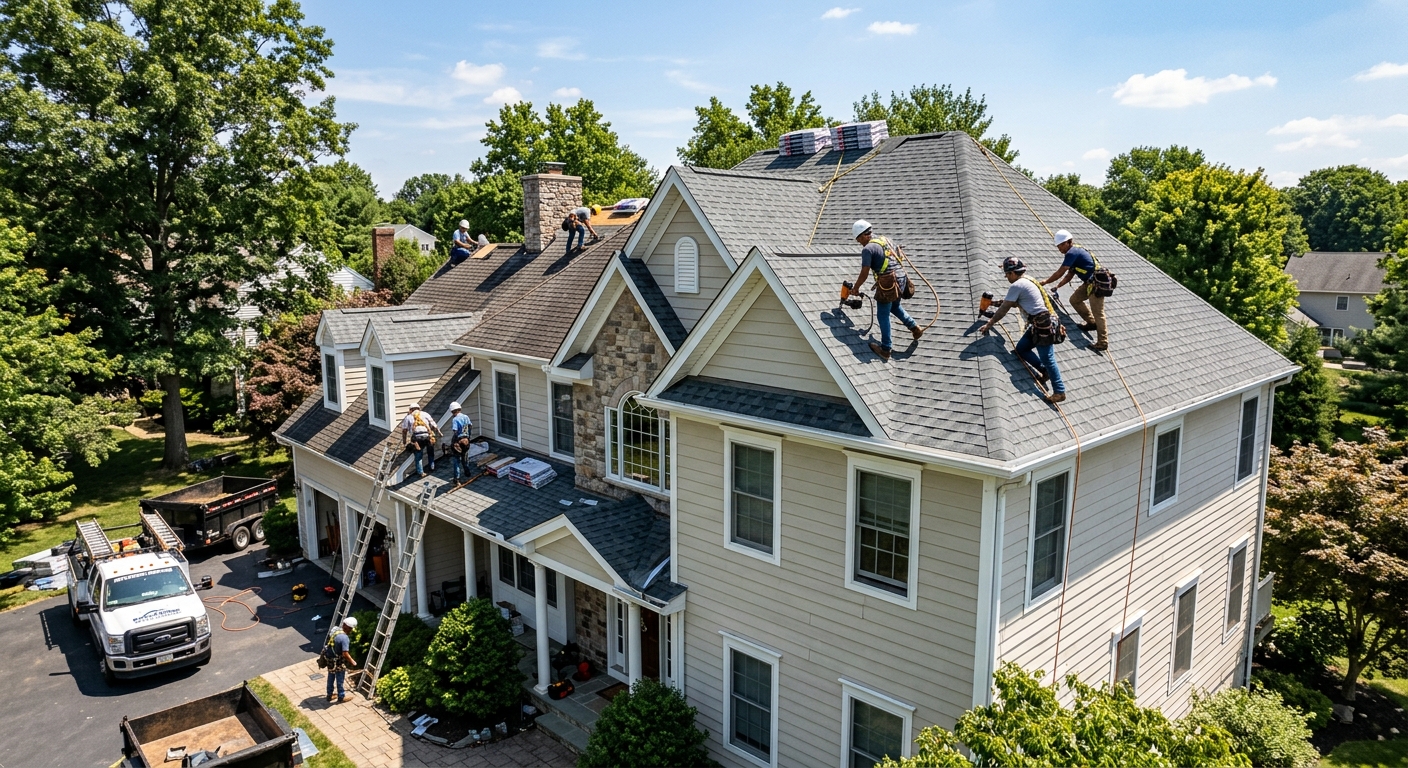
Montgomery roofing prices by material and scope — 2026
Montgomery County roofs see a unique mix of age and design, shaped by decades of post-war suburban expansion and today’s high homeownership rate. With 90.4% of area households owning their homes, the investment in quality roofing tends to be long-term, not a quick resale patch. Many of these homes are single-family structures—53.2%, to be precise (U.S. Census Bureau, ACS 2024)—which means larger roof footprints and sometimes steeper pitches than a typical rowhouse in nearby Philadelphia.
Post‑World War II tract housing across Abington and Cheltenham means many roofs are now at, or past, the end of their first life cycle. So, replacements aren’t just cosmetic: they address aged decking, weathered layers, and, quite often, code updates that didn’t exist when the homes were built. What passes for “replace” here usually means a full tear-off, not an overlay, due to shingle layers and the wear these roofs have seen over seventy years.
Below, you’ll find real price bands for the most common roof projects seen across Montgomery County’s neighborhoods.
| Material / Scope |
Lifespan |
Best for |
Price range (installed) |
| Asphalt shingles — architectural (30-yr) |
25–30 yrs |
Typical single-family homes in Abington, Cheltenham, and townships dominated by 1950s–70s builds |
$11,000–$23,000 |
| Asphalt shingles — impact-resistant (Class 4) |
30+ yrs |
Homes exposed to wind along the Schuylkill River valley or those concerned about hail impacts |
$17,500–$23,000 |
| Metal standing seam |
40–70 yrs |
High-end replacements, energy-efficiency upgrades, or homeowners planning to stay put for decades |
$26,000–$46,500 |
| Flat roof — TPO or EPDM |
15–25 yrs |
Rear additions, porches, and the flat sections seen on split-levels and some Norristown homes |
$13,500–$27,500 |
| Roof repair — leak or isolated section |
Expected to match main roof, varies by age |
Quick leak fixes, storm damage flashes, single-plane or small-area shingle replacement |
$550–$2,200 |
Prices are estimates for a typical Montgomery home and vary with roof size, pitch, decking condition and material selection.
TPO and EPDM on Montgomery homes
Flat or low-slope roofs are everywhere you look in Montgomery County: think of those rear additions in Norristown, or the enclosed porches common on split-level homes in Cheltenham. These sections need different roofing from the pitched main roof—typical asphalt shingles don’t work below a 3/12 pitch. Put shingles on a roof with too little slope, and you’ll get leaks or even rot where water ponds and can’t drain off.
This is why rubber-based membranes like TPO and EPDM are preferred. They’re designed to handle standing water and tight corners, lasting 15 to 25 years if installed right. In contrast, architectural shingles on a flat surface might fail in just a few winters, especially through our freeze-thaw cycles and humid summers. If a roofer suggests asphalt shingles for a porch or addition with a 2/12 pitch, they are ignoring basic best practices—or just trying to land the job fast instead of doing it right.
Expect to pay between $13,500–$27,500 for a typical flat roof membrane replacement in Montgomery County. That includes stripping off any built-up tar layers, fixing sagging or ponding, and installing new flashing at every wall and edge. While not cheap, it’s money better spent than chasing chronic leaks year after year.
The cost drivers behind a Montgomery roof replacement
Homeowners in Montgomery County often wonder why roof quotes for the same house can look so different. Two main reasons dominate here: the age and construction diversity of our housing stock, and our climate’s demands. In a market with many 1950s–1970s homes, roofing jobs may reveal layers of old shingles or plywood substrates in rough shape. Each extra layer of tear-off can add $500–$1,500 to disposal and labor costs, and if decking is rotted, figure on $75–$150 per 4x8 sheet to replace.
Montgomery’s winters aren’t brutal, but our ground snow load sits at 30 psf, so roofs need a structure and materials that handle periodic heavy snow. This can mean ice barriers at the eaves—a code-driven extra for areas with known damming issues—or impact-resistant shingles for homes near the Schuylkill River valley, where thunderstorm winds are more common. Code upgrades and insurance standards may also require thicker underlayment or special attic ventilation, depending on the township.
The region’s strong homeownership and higher-than-average incomes mean that many jobs are full tear-offs rather than overlays. Homeowners invest for long-term durability, favoring architectural over basic 3-tab shingles, which can move a job from $11,000 up to $23,000 with quality materials. Labor also comes at a premium in this metro market due to competition and the pace of jobs.
| Factor |
Why it matters here |
Cost impact |
| Roof size in squares |
Each square is 100 sq ft of roof surface. Larger homes in suburbs mean more labor and disposal costs. |
Primary multiplier |
| Pitch and access |
Steep pitches need harnesses and slow crews, especially on 1960s–80s split-levels. |
+20–30% labor |
| Existing layers to tear off |
Two or more layers means full tear-off and disposal—common on homes built before 1980. |
$500–$1,500 per layer |
| Decking condition |
Rot is found during tear-off, not before. More likely where old leaks went unchecked in 1970s housing. |
$75–$150 per sheet |
| Ice barrier at eaves |
Required where ice damming has a history—critical in shaded lots and older construction. |
$300–$800 |
| Material grade |
3-tab vs architectural vs Class 4 impact-resistant—homeowner preference plus HOA or insurance demand. |
$500–$2,500 |
Roof age and construction era in Montgomery
Montgomery County’s roofscape is directly shaped by the post–World War II construction boom, especially in pockets like Abington and Cheltenham. Over a fifth of homes here—21.3%—were built before 1980 (U.S. Census Bureau, ACS 2024). This means your roof deck might be original plywood or even plank in the oldest properties. For these older roofs, expect more than one shingle layer and some hidden rot, especially where ice damming or past leaks went unaddressed.
In neighborhoods with 1970s or 1980s homes, you’ll usually find moderate slopes, not the steep pitches of century-old houses. Roofers replacing these first-generation roofs often strip down to worn plywood, not true lumber. Ice barriers may not have been code when these homes were built, so upgrades are common during replacement.
On the other hand, large tracts built in the 1990s and 2000s—think Upper Dublin or later developments—are only now hitting the end of their first roof’s lifespan. These jobs are usually more straightforward since there’s just a single layer to tear off and 4x8 OSB or plywood decking below. For both eras, no two bids will be the same—but you’ll almost never see a true “roof overlay” called for in Montgomery; full replacements dominate unless the roof surface is nearly new.
Timing a roof replacement in Montgomery
The calendar matters for roof projects in this region. In Montgomery County’s climate, the ideal season for a full roof replacement runs from late March through early November. Shingles need mild temperatures—above 40 °F—to seal properly, and full teams can work efficiently once the spring rains back off. In winter, when the thermometer dips near our local design temp of 14 °F, shingles take longer to bond, and frost complicates every step.
Late summer and early fall—particularly September and October—are prime months for replacements, with demand peaking as homeowners push to button up houses before winter. That’s also when local roofing contractors are most booked up, especially in inner Montgomery suburbs where competition is fierce and most crews are running multiple jobs per week. Emergency work in February, when snow is on the ground and there’s a risk of ice or water intrusion, almost always carries both a wait and a winter surcharge.
In the most saturated parts of Montgomery—Lower Merion, for example—you may need to book 4–6 weeks ahead in fall, while late winter is “first-come, first-served” with a premium attached. Planning ahead (but avoiding peak booking crunch) is your best move for both cost and crew quality.
Pennsylvania code and Montgomery County permit rules for roofing
Roofing in Montgomery County follows the Pennsylvania Uniform Construction Code (UCC), which is based on the International Residential Code. This state code is enforced locally by each township, or by the Pennsylvania Department of Labor & Industry in those cases where a municipality has opted out. For Norristown, the Municipality of Norristown Codes Department is responsible for code enforcement and permits.
In practical terms: in Norristown, replacing more than 25% of your roof's surface triggers a building permit requirement. By contrast, in Lower Merion Township, you generally don’t need a permit for minor shingle repairs covering less than one square.
Contractors working on your roof must have a Pennsylvania Home Improvement Contractor (HIC) registration for jobs over $500—which is essentially every roof. You can verify HIC registration at hic.attorneygeneral.gov before signing a contract. Pennsylvania requires all roofing employers to carry workers' compensation insurance; status can be checked via the state’s WCAIS system at wcais.pa.gov.
If your home was built prior to 1978, federal law (EPA Lead RRP Rule) applies: your contractor must follow specific lead-safe work practices. Verify any lead renovator’s credentials at certifiedrenovatorsearch.epa.gov.
Checking out a roofer in Montgomery: what to verify
Hiring a roofer in Montgomery County means checking more than a business card and a ladder. First, make sure the company holds a current PA Home Improvement Contractor (HIC) registration—look them up directly at hic.attorneygeneral.gov. Then ask for workers’ compensation proof, and check status yourself on Pennsylvania’s WCAIS system (wcais.pa.gov). If work will disturb painted surfaces in a pre-1978 home, get their EPA Lead RRP certification and verify at certifiedrenovatorsearch.epa.gov. Confirm the job contract references your three business-day cancellation right under Pennsylvania law.
- PA Home Improvement Contractor (HIC) registration valid and current
- Workers' compensation insurance certificate (verify on wcais.pa.gov)
- General liability insurance—check coverage and expiration
- Written contract before paying any deposit
- Detailed scope of work spelling out material brand and type
- Physical address in Montgomery county or a local township
- No promise to “waive your deductible”—that’s illegal under state law
- EPA Lead RRP certification for pre-1978 homes, if disturbance expected
- Payment schedule capped at one-third upfront (state law)
- References from recent jobs in your township or nearby suburb
- Unsolicited “free inspections” after a storm—exercise caution
- Thorough written warranty issued, not just a handshake guarantee
Specific Montgomery red flags: door-to-door offers right after hail or wind storms (due to high metro density); companies without a local address; pressure to sign same-day “specials;” paying cash with no contract; or anyone who won’t produce current insurance and HIC paperwork. A saturated Philadelphia metro market means you must vet for quality and solvency—not every “big crew” has staying power or accountability.
Frequently asked questions — roofing in Montgomery
How much snow load can a Montgomery roof handle?
The building code for Montgomery County is the Pennsylvania Uniform Construction Code, which mandates that residential roofs be designed for a minimum ground snow load of 30 pounds per square foot (psf). This standard is enough for typical southeastern Pennsylvania winters, but it’s still possible to see drifts that stress older roofs—especially those built before trusses were computer-designed or with less robust materials. If your roof is original to a 1950s–1970s house, structural upgrades may be advisable when replacing shingles, especially if you’ve had issues with sagging or ice damming. Replacement costs for a standard architectural shingle roof in Montgomery run $11,000–$23,000, and that figure can climb if repair to the roof structure is needed due to snow damage discovered during tear-off.
Is a metal roof worth the extra cost in Montgomery?
Metal standing seam roofs do cost more upfront—typically $26,000–$46,500 in Montgomery County—but their lifespan (40–70 years) is much longer than asphalt shingles, and they shed snow and debris efficiently. For homeowners planning to stay in their house long-term, or those looking to boost efficiency and decrease maintenance, the upgrade can make financial sense over decades. HOA restrictions are not uncommon in townships like Upper Dublin, so always check local rules first. For most, standard architectural shingles still offer the best balance of cost and performance, but metal is gaining traction, especially on homes exposed to severe weather near the Schuylkill River valley.
What warranty should a Montgomery roofer offer?
A reputable Montgomery County roofer should provide two warranties: a manufacturer’s warranty (often 25–30 years for architectural shingles) and a separate workmanship warranty, typically 5–10 years. The latter is especially important here given our moderate freeze-thaw cycles and humid summers. Insist on the details in writing as part of your contract. For a full asphalt shingle roof replacement in Montgomery, expect coverage that matches at least the typical install cost range of $11,000–$23,000. If a roofer won’t stand behind their work with clear warranty language, you should keep looking.
Are there historic district rules affecting roofing in Montgomery?
Historic district regulations in Montgomery County are determined by the individual municipality, not county or state statute—Norristown and nearby townships each have different rules. If your property is within a locally designated historic area, you may face material and appearance restrictions that affect shingle type or color. Before scheduling any roof work—especially if considering a modern upgrade like standing seam metal (priced at $26,000–$46,500)—ask your local codes office for historic area requirements. Contractors familiar with Montgomery will know how to pull the right permits and avoid costly violations, but don’t rely on word of mouth—get the specifics yourself.
Do metal roofs shed snow better in Montgomery?
Yes, metal roofs—including standing seam systems—outperform asphalt shingles in shedding snow and ice from Montgomery homes. That’s important in our region, where ground snow load standards are set at 30 psf and winter thaw-refreeze cycles are common. Ice and snow tend to slide off metal, reducing the risk of damming along the eaves or extra weight on the structure. While the upfront cost—$26,000–$46,500—is higher than for shingles, the benefits in snow performance and long-term durability appeal to homeowners in storm-exposed areas like Upper Merion and Norristown.
What are the signs of hail damage on a roof?
In Montgomery County, hail damage to asphalt shingle roofs usually appears as dark spots where the granules have been knocked away, exposing the underlying mat. On steeper roofs, “bruises” or soft spots are common, while flatter sections can show cracks or shredded edges. A reputable roofer will document these issues with photos; repairs for hail damage here often fall within the $550–$2,200 range for localized fixes, but full replacement is possible if the damage is widespread. After severe storms, beware of door-to-door “inspectors”—stick with vetted, local contractors for inspections and insurance claims.
What is the best time of year to replace a roof in Montgomery?
The ideal window for roof replacement in Montgomery is from late March to early November. These months offer the best conditions for shingle sealing, minimal weather delays, and more competitive scheduling. Most local contractors book up quickly in September and October—right before winter sets in—so even though prices for a new roof (such as $11,000–$23,000 for asphalt shingles) don’t fluctuate much, timing can get you a better spot on the calendar. An emergency job in February may cost more and be subject to schedule delays, so plan ahead when possible.
How much does a flat roof replacement cost in Montgomery?
Flat roof membrane replacements—including TPO and EPDM—typically run from $13,500–$27,500 in Montgomery County, depending on square footage and tear-off complexity. These surfaces are most common on porch additions, rowhouse rears in Norristown, or split-level homes built from the 1950s on. Costs factor in removal of built-up roofing, correcting low spots or ponding areas, and new perimeter flashing. Membrane roofs last 15–25 years here if installed properly, making them a smart investment versus patching low-slope sections with shingles—which fail quickly in our freeze/thaw climate.
Will filing a roof claim raise my premium?
In Montgomery County, as elsewhere in Pennsylvania, insurance companies may increase premiums after a roof claim, particularly if the damage is due to weather and you’re in an area prone to repeat storms. While a single claim for a repair (often $550–$2,200 locally) isn’t likely to trigger a spike, repeated filings or a full roof replacement claim can label your property “high risk.” Always weigh the cost of paying out of pocket for minor issues versus the potential increase in long-term insurance costs, and work with contractors who document all findings for your records. Check with your agent for the specifics of your policy before authorizing major work.