Whitehall roofing prices by material and scope — 2026
Whitehall’s roofing market reflects not just Allegheny County’s seasonal extremes, but also a homeowner base weighted toward long-term maintenance: about 74.2% of households own their homes (U.S. Census Bureau, ACS 2024). Most residential roofs here aren’t new builds — 84% of homes were built before 1980, which often means more intensive roof work. When that original shingle roof comes off, you’re likely to encounter old plank decking and work around additions, dormers, and unique slopes. That’s why tear-offs and deck repair are not exceptions, but the rule in Whitehall roof jobs. Decking hidden under three generations of roofing is common, and the final invoice rarely matches minimal “overlay” quotes.
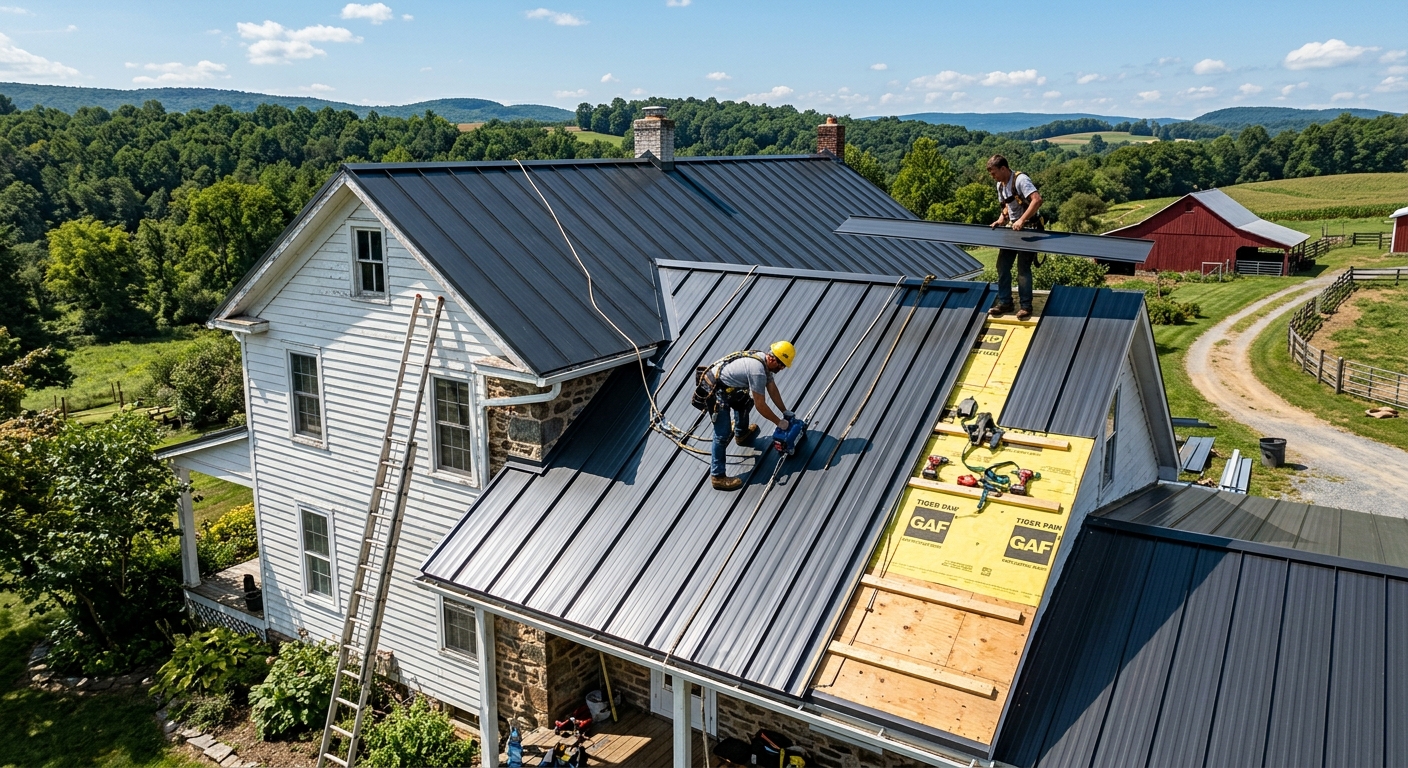
Historic homes may reward the investment of premium architectural or Class 4 asphalt shingles, as future repairs get more expensive with age. Standing seam metal roofs are a visible, growing choice, especially as more homeowners look to eliminate roof work for decades at a stretch. Flat roofs are still prevalent over porches and additions, requiring entirely different membranes than the main roof slope. All these factors, plus the area’s labor supply and material access in the saturated Greater Pittsburgh market, shape both what you pay and what you end up with.
| Material / Scope |
Lifespan |
Best for |
Price range (installed) |
| Asphalt shingles — architectural (30-yr) |
25–30 yrs |
Standard detached houses, sloped roofs |
$9,400–$20,000 |
| Asphalt shingles — impact-resistant (Class 4) |
30+ yrs |
Wind/hail prone areas, premium homes |
$15,500–$20,000 |
| Metal standing seam |
40–70 yrs |
Long-term owners, low-maintenance upgrades |
$23,000–$40,500 |
| Flat roof — TPO or EPDM |
15–25 yrs |
Porches, additions, low-slope roofs |
$12,000–$24,000 |
| Roof repair — leak or isolated section |
n/a |
Targeted leak or vent fixes |
$500–$1,900 |
Prices are estimates for a typical Whitehall home and vary with roof size, pitch, decking condition and material selection.
How to compare roofing quotes in Whitehall
A roofing estimate in Whitehall should let you see exactly what you’re paying for. Start with the basics: your quote should specify the roof area in “squares” (each 100 square feet) and the steepness or “pitch.” Next, look for separate lines detailing how many existing material layers will be torn off and how disposal is handled (a dumpster parked on-site is the norm here). Underlayment and ice barriers should be named by brand and type, not just generic terms — the wrong product in Allegheny County’s freeze-thaw cycle leads to early failure.
A good quote sets a price for sheathing replacement per sheet—it’s impossible to see every rotten spot before tear-off. Flashing and vent boots matter in Whitehall, where every third house has an old chimney. Warranties must be split: shingle warranties are from the manufacturer; true workmanship coverage is what your local contractor stands behind. Finally, upfront payments here shouldn’t exceed 15% by law if the contract is over $500.
If a quote doesn’t show the basics—square count, pitch, and line-by-line materials—it’s not much better than a handshake. Without those details, you can’t compare one bid to another or know where you might get upcharged late in the job.
| Line item |
What to look for |
Red flag if… |
| Roof area |
stated in squares, with pitch |
no measurement given |
| Tear-off and disposal |
number of layers, dumpster included |
bundled into one figure |
| Underlayment |
product type and coverage |
listed only as 'felt' |
| Ice and water shield |
coverage height at eaves |
omitted entirely |
| Decking |
per-sheet contingency price |
no allowance at all |
| Warranty |
workmanship years stated separately |
only the shingle warranty |
| Payment |
deposit under 15%, balance on completion |
large upfront cash |
The scope items Whitehall homeowners don't budget for
The most common surprise in a Whitehall roof replacement is what’s hiding underneath. Decades-old homes here often have sheathing boards that have warped or rotted, sometimes under three or more layers of shingle. When the old roof comes off, expect a typical per-sheet (4x8) replacement cost of $60–$125 added to your bill, and it’s not rare for 3–10 sheets to be required.
Another overlooked cost is attic ventilation. If your attic lacks adequate intake and exhaust, the region’s freeze-thaw cycles can cause ice damming, which in turn voids most manufacturer warranties. Bringing a Whitehall roof up to proper ventilation can run $450–$1,000 depending on the work required.
Chimney and wall flashing is another culprit, especially with older brick chimneys common in Allegheny County. Proper copper or steel flashing upgrades can add $500–$1,200, but skipping it almost guarantees repeat leaks. Failing vent boots and drip edge—often reused or overlooked—should be fully replaced for about $80–$150 per piece.
Finally, budget for a ridge vent if you don’t already have one. Total cost ranges from $400–$700, which is minor compared to future ice dam or rot repairs. These are the items that make a basic shingle quote balloon mid-job—make sure they’re addressed up front.
When a Whitehall roof is worth repairing — and when it isn't
A typical Whitehall roof faces weather that eventually wins. For houses built before 1980, which is the vast majority, a shingle roof installed after 2000 may still have 5–10 years in it, provided there’s been no history of shoddy repairs or neglect. If your roof is under 15 years and has a single leak (for example, around a vent), repair is sensible at $500–$1,900. However, repair after repair quickly adds up.
If your roof is 20–25 years old and you’re seeing multiple leaks, historical patches, or visible shingle curling, you’re throwing money away with every temporary fix. Three repairs in five years could easily reach $3,600—close to what you’d pay annually to finance a new roof at $15,500 over a five-year period. Wind and hail can take out even a “good” looking roof overnight; in those storm situations, it’s wiser to document, file an insurance claim, and replace.
For flat roofs, especially those with persistent ponding or membrane blisters, replacement at $12,000–$24,000 is almost always the only lasting fix. Treat active leaks before winter as emergencies, but don’t settle for endless repairs on a failing system.
| Situation |
Recommendation |
Typical cost |
Reasoning |
| Under 15 years, one isolated leak |
Repair |
$500–$1,900 |
Roof likely has usable life left; fix is cost-effective |
| 15–25 years, several leak points |
Replace |
$9,400–$20,000 |
Multiple failures signal the end of life; money spent on repairs is wasted |
| 25+ years, any active leak |
Replace now |
$9,400–$20,000 |
Underlying materials and shingles are beyond service |
| Storm damage, wind or hail |
Document, claim, replace |
$9,400–$20,000 |
Insurance typically prefers full replacement for wind/hail loss |
| Flat roof ponding or blistering |
Replace membrane |
$12,000–$24,000 |
Repairs won’t outlast underlying material breakdown |
| Active leak entering winter |
Emergency repair, schedule replacement |
$500–$1,900 |
Stop the leak, but plan for a full job before next winter |
Low-slope and flat roofs in Whitehall
In Whitehall, flat roofs aren’t just for commercial buildings. Many older homes have flat or very low-slope sections—back additions, covered porches, or even full rear wings on rowhouses. These areas are trouble spots because shingles can’t shed water fast enough below a 2/12 pitch, nearly guaranteeing leaks or premature failure, especially in Allegheny County’s freeze-melt cycles.
TPO (thermoplastic polyolefin) and EPDM (ethylene propylene diene monomer) membranes are the only lasting solution for truly flat areas. Their lifespan is about 15–25 years, compared to the 25–30 you might expect from architectural shingles on a pitched roof. With these membranes, you get tight seams and real resistance to ponding—not possible with shingles or roll roofing.
Expect to pay $12,000–$24,000 for a flat roof system on a typical Whitehall addition or porch. If a contractor is willing to install shingles on a 2/12 pitch, that’s a red flag—they’re ignoring best practice for this climate, where standing water leads directly to rot and mold. Choosing the right system is the difference between a 10-year repair cycle and 20+ years of leak-free performance on your addition.
Permits and code requirements in Whitehall
Whitehall follows the Pennsylvania Uniform Construction Code (UCC), based on the International Residential Code. In this area, the Department of Permits, Licenses, and Inspections in Pittsburgh oversees code enforcement countywide. For Whitehall homeowners, replacing more than 50% of your roof typically triggers a building permit. Simple, like-for-like shingle repairs covering only a small section (well under half the total area) usually do not require a permit.
Any roofing contract over $500 in Whitehall must be completed by a contractor registered as a Home Improvement Contractor (HIC), an ID issued by the Pennsylvania Office of Attorney General. You can check your roofer’s registration directly at hic.attorneygeneral.gov—this is the official record. Pennsylvania also requires contractors to have workers’ compensation coverage, even for a small neighborhood job; you can confirm current insurance through WCAIS (wcais.pa.gov). As a homeowner, you’re entitled to a written contract and a three business-day right of cancellation under the Home Improvement Consumer Protection Act.
It’s worth noting that Pennsylvania does not issue a roofing trade license—registration is as an HIC, not a specialized trade license. For pre-1978 homes, the federal EPA Lead RRP Rule also applies, and compliance can be checked at certifiedrenovatorsearch.epa.gov.
Whitehall homes and their roof lines
Whitehall’s residential roofs are defined by their age and construction methods. With 84% of homes built before 1980 (U.S. Census Bureau, ACS 2024), you’re likely dealing with 4:12 to 6:12 pitch gabled roofs that were typical in Western Pennsylvania bungalows and cape cods. Decking on homes from 1900–1950 often means 1x6 plank or diagonal boards, and you’re as likely to find roofs with two or even three layers of shingles—as mid-century codes never required complete tear-off.
Few homes this age will have modern ice and water barrier under the bottom courses of shingle; it became standard well after most Whitehall homes were built. This makes the first replacement in these houses more intensive. Exposed plank decking frequently demands reinforcement or complete sheet overlay, and flashing around original brick chimneys or sidewalls requires special attention. Even “simple” detached homes in Whitehall often present a patchwork of original and added rooflines, making for surprising labor and material needs.
If your house dates to the peak construction wave, anticipate extra sheets of decking, the need for upgraded ridge or soffit venting, and bring expectations for a thorough—sometimes complex—tear-off. The result is that roofers here rarely find a “quick and easy” job, but they do know the quirks of these older roof systems inside and out.
Frequently asked questions — roofing in Whitehall
What's the cheapest way to replace a roof in Whitehall?
For most Whitehall homeowners, the lowest-cost full roof replacement is a single layer of architectural asphalt shingles, with tear-off of old material as needed. Expect that most homes here will need some degree of deck repair, which can bump up a seemingly low estimate. The minimum you’ll see from a contractor who’s registered and insured, and including proper removal and disposal, is $9,400–$20,000. Be wary of “second layer” offers — stacking shingles over existing ones can void warranties and does not address hidden rot or ventilation problems, especially in houses built before 1980. In this market, a bare-minimum quote much below these numbers usually means the contractor is skipping repairs, using day labor, or working without the required registration and insurance. Skipping essentials isn’t cheap in the long term — ongoing leaks and decking failures will more than erase your apparent savings.
Is a sagging roof line an emergency?
In Whitehall, a roof that sags is a warning sign — particularly with the high percentage of homes built before 1980. Sagging may stem from rotted 1x planking, failed rafters, or long-term moisture intrusion, all of which only get worse over time, especially in Western Pennsylvania’s wet autumns and snowy winters. While it’s not always an immediate collapse risk, it's smart to treat it as a priority. Minor sags often become severe after just one harsh freeze-thaw cycle. If caught early, repairs might involve limited sheathing replacement and possibly some sistered rafters, with costs in the $500–$1,900 range for very localized work. Large sags spanning whole roof sections are almost always full replacement jobs. Don’t wait — prompt inspection will clarify if you can repair or must replace before the next storm.
Why is my Whitehall roofing quote higher than the online average?
Many national “average cost” numbers ignore what’s unique about Whitehall: older homes, multiple layers of worn-out shingles, and hidden rot that only becomes visible at tear-off. Labor and materials move up sharply with every sheet of decking that needs replacing, and the strong local demand (with homeownership at 74.2%) keeps competition honest, but not artificially cheap. Pennsylvania’s Home Improvement Consumer Protection Act also adds compliance costs, ensuring contractors are registered, insured, and working under enforceable contracts. In 2026, you can expect a replacement range of $9,400–$20,000 for architectural shingles here, which will look high compared to online generic statistics—because those numbers rarely include real prep, disposal, or required upgrades for houses built before 1980.
How much snow load can a Whitehall roof handle?
Allegheny County adopts a ground snow load of 30 pounds per square foot (psf) per code, which is enough for typical Whitehall winter snows but can be approached during rare, heavy events. Most homes, particularly those built in the mid-1900s, were framed for the snow and ice loads typical to southwestern Pennsylvania and can safely carry one to two feet of wet snow before risk becomes acute. However, older homes that have never been re-decked, or have suffered water damage, may struggle to meet design load if deterioration has set in. If you’re worried after a heavy dump, especially with visible leaks or sagging, a targeted inspection — $500–$1,900 for minor fixes — is money well spent.
Do I need my own inspection before the adjuster visits?
In Whitehall, if you’ve suffered obvious storm damage or suspect hail or wind have compromised your roof, an independent contractor inspection before the insurance adjuster arrives is a smart move, though not mandatory. Roofers familiar with Allegheny County homes can pinpoint issues adjusters might miss, especially oddball leaks at old brick chimneys or underneath layers of old shingles, and document them with photos. These findings increase the chance your claim leads to a full replacement, not just a patch. The typical inspection fee is sometimes applied toward repairs or replacement (in the $500–$1,900 range), and a reputable local contractor can walk the roof with the adjuster for you. You don’t need to spend on multiple inspections, but a knowledgeable pre-adjuster walk-through can pay off by catching what mass-adjusting firms overlook.
What is the best roofing material for Whitehall's climate?
For most Whitehall houses — especially with their steep pitches and decades-old structures — architectural asphalt shingles are the default, balancing cost ($9,400–$20,000 installed for most jobs) and durability against heavy rain, snow, and heat swings. If you’re looking to invest for decades or plan to never re-roof again, standing seam metal holds up best to ice, wind, and storm debris, with lifespans of 40–70 years and prices in the $23,000–$40,500 range. On flat sections, TPO or EPDM membranes are the only sane choice — shingles on a flat roof just won’t last through Whitehall’s freeze/thaw cycles. The best material isn’t always the cheapest, but it’s the one that fits both the home’s roof style and the realities of this region’s climate.
How long does a roof replacement take in Whitehall?
Replacing a roof in Whitehall typically takes from two to five days for a standard asphalt shingle job on a one-story detached home. Older houses, especially those built pre-1950, frequently uncover rotten decking or require additional chimney or flashing work, which can add a day or more. For metal standing seam projects, or for homes where multiple layers must be removed ($9,400–$20,000 for most jobs), four to seven days is a reasonable window — weather permitting. Large homes, complex rooflines, or widespread decking replacement extend timelines, while good pre-job planning and clear scope keep surprises to a minimum. Flat roof membrane jobs are about the same length unless structural repairs surface during tear-off. Always build in some weather cushion, since spring and fall rain can easily push a scheduled job back by several days in Allegheny County.
What should a roofing quote include in Whitehall?
In Whitehall, a quote should provide square footage and slope, list the number of shingle layers to be removed, name underlayment and water shielding brands, specify vent and flashing replacements, and include a contingency line for rotten decking at a per-sheet price. If the job is over half the main roof, expect mention of the building permit as well. Labor warranties should be separated from the manufacturer warranty so you know who to call for what problem. For a typical replacement, you’ll see totals in the $9,400–$20,000 range, line-by-line. Payment terms matching Pennsylvania law—less than 15% upfront, balance on completion—should also appear. If you’re quoted a lump sum with only one line of detail, get another estimate.
How do I confirm a roofer carries workers' compensation?
To confirm your Whitehall roofer has required Pennsylvania workers’ compensation insurance, use WCAIS (wcais.pa.gov) — the state-provided system for coverage lookups. All employers must have coverage, even for small residential jobs here. The registration number supplied on their contract or written agreement lets you check if the current policy is active. Don’t accept an “I’m exempt” line unless you’ve verified it through WCAIS. Uninsured crews put you at risk of liability if a worker is hurt on your property, and it’s illegal to skirt this requirement in Pennsylvania. Insurance costs are part of why a legitimate job here costs $9,400–$20,000 for full replacement, but they buy you real peace of mind and ensure recourse if something goes wrong.