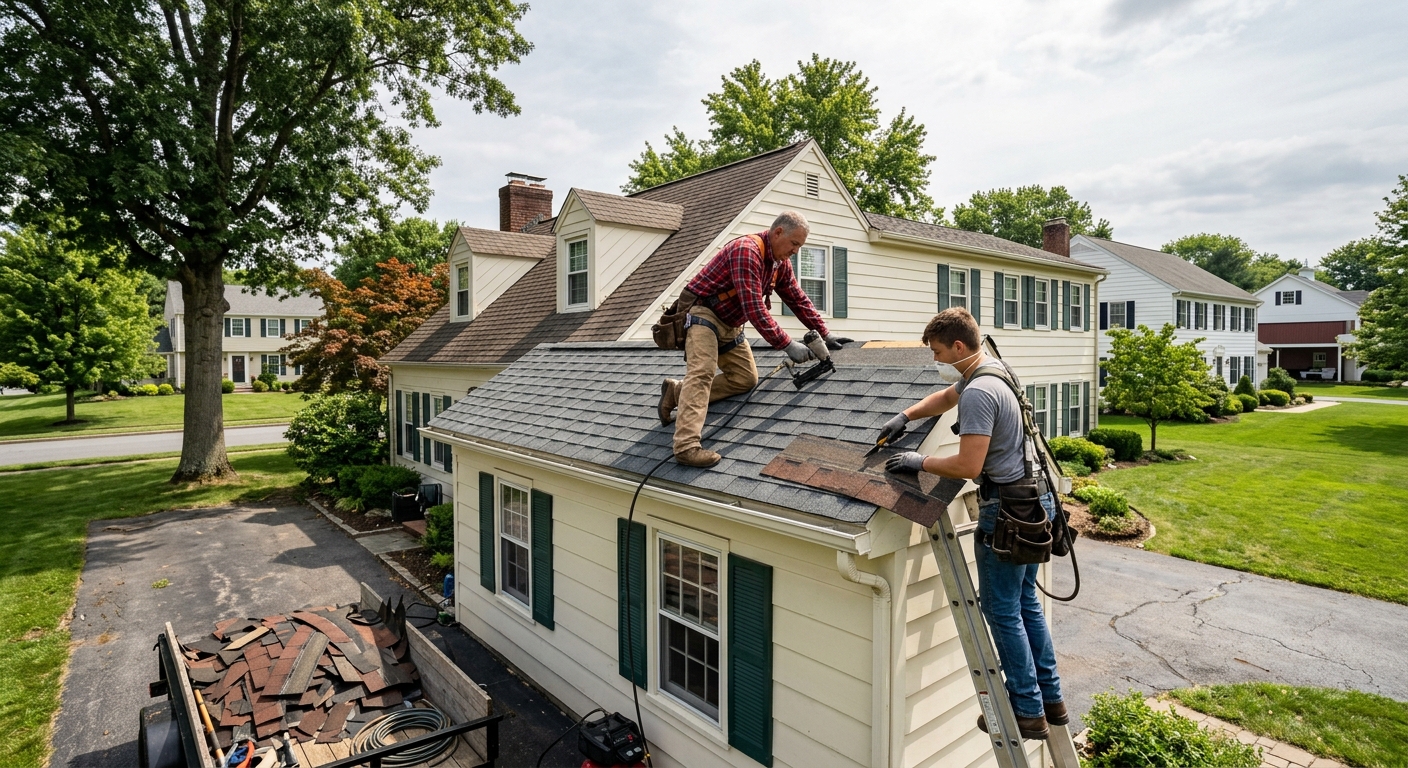
Roofing Replacement & Repair costs in West View — 2026
In West View, roof replacement costs are shaped by a housing stock where 84.9% of homes were built before 1980 (U.S. Census Bureau, ACS 2024) and nearly two-thirds are single-family. With such an established, aging mix, roofers in this community encounter everything from original plank decking to multiple shingle layers — which means jobs here often include both tear-off and more deck repairs than neighborhoods with newer construction. That translates to higher labor and disposal costs compared to post-1980 suburbs.
Much Allegheny County housing dates from 1900–1950, which is especially true along West View’s older blocks. For many residents, roof work isn’t just new shingles: it’s pulling off two or three existing layers, assessing soft spots, sometimes replacing entire sections of sheathing before a new roof system can be properly installed. Many roofs from that era need ice barriers added at eaves, because building codes at the time simply didn’t require them. Roofers here are well-acquainted with patching or re-building decks to get these older structures ready for a modern roof.
Here’s what you can expect to pay for the most common roofing scopes in West View:
| Material / Scope |
Lifespan |
Best for |
Price range (installed) |
| Asphalt shingles — architectural (30-yr) |
25–30 yrs |
Most single-family homes, cost balanced with performance |
$9,300–$19,500 |
| Asphalt shingles — impact-resistant (Class 4) |
30+ yrs |
Hail risk, homes facing Ohio Valley storms |
$15,000–$19,500 |
| Metal standing seam |
40–70 yrs |
Low-maintenance, snow-shedding, longevity builds |
$22,500–$40,000 |
| Flat roof — TPO or EPDM |
15–25 yrs |
Porches, additions, low-slope rows |
$12,000–$23,500 |
| Roof repair — leak or isolated section |
n/a |
Spot repairs, emergencies, storm aftercare |
$500–$1,850 |
Prices are estimates for a typical West View home and vary with roof size, pitch, decking condition and material selection.
What moves the price of a roof in West View
Roofing quotes in West View can swing from modest to steep, often for reasons specific to Allegheny County’s housing stock. Many homes here still have their original plank roof decking or multiple generations of old shingles, especially in those built between 1900 and 1950. Tearing off several layers isn’t unusual, and when decking is soft or shows old water damage, repairs or full replacement sheets drive added cost. A basic architectural shingle roof on a typical West View house starts around $9,300, but if substantial rot or multiple layers are uncovered, it’s not rare to approach $19,500.
The local winter risk matters too. The 30 psf ground snow load and heavy freeze-thaw cycles seen in Allegheny County require ice barriers at eaves and careful venting. Since ice damming is an issue on old pitched roofs, even a minor improvement like a proper ice barrier can add $300–$800 to a quote. Labor rates have some competitive pressure due to the crowded Pittsburgh-area contractor market, but the true wild cards on older West View homes are what’s discovered after tear-off—whether that’s rotten plank, clay-based sag, or two roofs stacked on top of each other from decades past.
| Factor |
Why it matters here |
Cost impact |
| Roof size in squares |
Each square is 100 sq ft of roof surface |
Primary multiplier |
| Pitch and access |
Steep pitches need harnesses and slow the crew |
+20–30% labor |
| Existing layers to tear off |
Two or more layers means full tear-off and disposal |
$500–$1,500 per layer |
| Decking condition |
Rot is found during tear-off, not before |
$75–$150 per sheet |
| Ice barrier at eaves |
Required where ice damming has a history |
$300–$800 |
| Material grade |
3-tab vs architectural vs Class 4 impact-resistant |
$500–$2,500 |
What West View's housing stock means for your roof
Most homes in West View were built before 1980, and many stand from long before World War II. This means you’re dealing with the quirks of an earlier building era: nearly all of the older roofs rely on plank sheathing rather than plywood or OSB, with varying gaps and thicknesses. In practice, that often leads to deck repairs anytime shingles are replaced, especially where old nails or leaks have softened the wood over the decades. Many roofs in these neighborhoods have passed through two or three shingle generations, and it’s common during a full replacement to discover both brittle decking and leftover layers hidden below the surface.
Ice barriers were not standard in that era — and aren’t present on many West View homes unless they’ve had a very recent code-driven re-roof. That makes eave and valley sections especially prone to damage after years of freeze-thaw cycles. When roofers quote your project, they’ll take into account not just visible shingle wear, but the likelihood of surprise deck work and the extra dump fees to remove old shingle layers. On a 1950s or older house, a roof replacement is not just a surface job, but a substantial rehab that prepares the whole assembly for modern code minimums and regional climate stress.
This is why fast, low-ball bids can end up misleading here — the hidden condition of your planks and multiple shingle layers make the true scope far larger than just nailing down new tabs or laminated shingles.
Choosing a roofing material for West View's climate
Roof material is more than just a personal pick in West View — it’s about handling Southwestern Pennsylvania’s snow loads, freeze-thaw, and the 8 °F winter design temperature. Asphalt architectural shingles dominate local roofs because they’re well suited to 30 psf ground snow loads and regular ice cycles, all for a realistic cost, especially on the hilly, complex roof shapes found in the area. Metal standing seam sheds snow quickly and generally lasts far longer, but upfront investment usually makes sense only if you plan to stay for decades, or if your home’s roof is especially straightforward to panel.
Flat membranes (TPO/EPDM) are rarely seen on main houses here but are essential for porch or addition roofs where a slope under 3/12 would doom shingles to leaks. The expensive “Class 4” impact-resistant shingles make sense if your property is directly exposed to hail-prone wind tracks, but for most West View homes, standard architectural shingles offer the best balance of price and performance.
| Material |
Installed cost |
Lifespan |
Cold-climate performance |
Maintenance |
| Asphalt architectural |
$9,300–$19,500 |
25–30 yrs |
Handles snow load, freeze-thaw; vulnerable to hail |
Minimal, routine inspection |
| Asphalt Class 4 impact-resistant |
$15,000–$19,500 |
30+ yrs |
Better hail & impact resistance |
Routine check after storms |
| Metal standing seam |
$22,500–$40,000 |
40–70 yrs |
Sheds snow rapidly, least ice buildup |
Low, occasional fastener check |
| TPO / EPDM membrane |
$12,000–$23,500 |
15–25 yrs |
Excellent for flat/low pitch, stops ponding leaks |
Annual seam/edge inspection |
Reading the warranty on a West View roof
Every roof comes with two layers of warranty — manufacturer and workmanship — and they’re not the same thing. Manufacturer warranties in West View, like elsewhere in Pennsylvania, focus on shingle or membrane defects. They’re almost always prorated, shrinking in value as time passes, and often require paperwork to be filed within a set deadline after install. These warranties may be transferable when a home is sold, but only if you handle the registration process, and usually only for one transfer.
The workmanship warranty comes from the roofer, not the company that made your shingles. It covers errors in installation or details missed during the job. Here’s the blunt reality: a 25-year labor warranty from a new contractor is not nearly as meaningful as 10 years from a long-tenured, locally established crew. If the company goes under, the paperwork is worthless, no matter how nice it reads. Workmanship coverage is also voided by things like poor attic ventilation, “roofing over” instead of full tear-off, or skipped manufacturer requirements. Always ask what voids the warranty — above all, verify that your job gets properly registered before the clock starts running.
Permits and code requirements in West View
In West View, roofing work is covered by the Pennsylvania Uniform Construction Code (UCC), which is enforced locally by the Department of Permits, Licenses, and Inspections for projects in Pittsburgh and surrounding Allegheny County. If your project replaces more than 50% of your roof area, expect a building permit to be required. Smaller, like-for-like shingle repairs typically don’t need permits, as long as they stay under the area threshold.
No specific “roofing” trade licence is required under Pennsylvania law — roofers must only hold active Home Improvement Contractor (HIC) registration for jobs over $500. You can verify this status at hic.attorneygeneral.gov. Written contracts are required for all roofing jobs over $500, along with a three-business-day right of cancellation for homeowners, and it is unlawful for contractors to waive your insurance deductible to win your job. Pennsylvania also requires every roofing employer to carry workers’ compensation insurance, which you can check through the WCAIS system at wcais.pa.gov. There is no special state mold, plumbing, HVAC, or electrical licence for roofing projects in West View; only HIC registration and local permit requirements come into play.
TPO and EPDM on West View homes
Many older homes and additions in West View feature a flat or very low-sloped section: a porch or back addition is a prime example. These areas cannot reliably hold shingles — even “low slope” versions — because Southwestern Pennsylvania’s heavy freeze-thaw cycles and ponding water lead to leaks and rapid shingle failure. Instead, flat roofs here require a membrane system like TPO or EPDM, which are designed to shed water instead of relying on gravity and overlapping tabs.
A well-installed TPO or EPDM membrane lasts 15–25 years on a typical West View home, and a full replacement on a modest flat section usually costs $12,000–$23,500. If a roofer suggests shingles on anything below a 2/12 pitch, it’s a sign they either don’t specialize in flat work or simply hope you won’t know the difference. Ponding, blocked downspouts, and flashing breakdown are frequent causes for leaks in these sections; membranes, correctly installed and flashed at edges and penetrations, are the fix.
Frequently asked questions — roofing in West View
How much does it cost to repair a roof leak in West View?
Roof leak repair in West View generally costs between $500–$1,850, with the final price depending on the leak’s location, roof pitch, and how much hidden damage is found once shingles or membranes are removed. In older West View homes, repairs often involve not just sealing a shingle or valley, but replacing underlying rotted decking, especially where past leaks were neglected or ice damming is common along the eaves. Emergency tarping after a storm is typically on the lower end of this range unless structural wood must be replaced. Because Allegheny County homes tend to have multiple layers and aged materials, spot repairs can sometimes discover “the tip of the iceberg.” Always get an itemized quote and ask the contractor to show you the problem firsthand, either in photos or on site, so you know what’s being fixed.
How much deposit should I pay a roofer upfront?
Pennsylvania’s Home Improvement Consumer Protection Act governs roofing contracts in West View, and most reputable contractors require a deposit of around one-third of the total contract price, but never more than this amount upfront. So if your roof replacement comes in at $15,000, expect to pay no more than about $5,000 as a scheduling or material deposit. Never pay a roofer cash in full before any work starts — balances should be due only as work milestones are reached or at job completion, not ahead of time. Make sure your written contract plainly states the deposit amount and payment schedule. Always check the company’s Home Improvement Contractor (HIC) registration before handing over money, as required by Pennsylvania law.
What does roof replacement cost per square in West View?
A “square” is 100 square feet of roof surface, and in West View, architectural asphalt shingle replacements typically cost $450–$650 per square installed. That range covers the basic tear-off, disposal, and new shingles, but can run higher where decking repairs, steep pitches, or extra layers are discovered. On many older West View homes, the price climbs as additional rot or required code upgrades come into play. Metal standing seam runs much higher, in the $1,000+ per square range, mainly due to labor and material costs. Always get quotes on a per-square basis so you can compare apples to apples, as roof size is the biggest driver of total cost.
How do I know if my West View roof needs replacing?
In West View, warning signs that your roof needs full replacement are often visible: missing or curling shingles, granule loss in the gutters, water stains on attic sheathing, or obvious sagging from old plank decking. On homes built before 1980, check for multiple shingle layers by lifting an edge near the eaves. Chronic ice damming under the lower shingles is another red flag. Wind or hail damage from Ohio Valley storms can break seals or create leaks that return every rain until properly addressed. If you’ve already spent $1,850 or more in repeated repairs, or your shingles are out of warranty, it’s time to price a new system before leaks begin causing major deck or interior damage.
How long do architectural shingles last compared to 3-tab?
Architectural asphalt shingles, common in West View, typically last 25–30 years, while traditional 3-tab shingles installed decades back were rated for 20 years but often delivered less in our climate. Heavy freeze-thaw, 30 psf snow load, and older plank decks lead to early failure of thinner 3-tab roofs here. While a new architectural roof costs $9,300–$19,500 installed, it generally means you won’t need to revisit the job for a full generation — a major step up in performance over the older 3-tab systems that many homes originally installed. The longer life and better wind/hail resistance make architectural the overwhelmingly smarter choice for homes in this area.
Can I install new shingles over old ones in Pennsylvania?
Pennsylvania code does allow one new layer of shingles over a single old layer, but this is rarely advisable in West View’s older homes. Plank decks, frequent hidden water damage, and year-round freeze-thaw cycles make proper “roof over” a risky shortcut. Adding another layer adds weight, can trap moisture, and may void your manufacturer’s warranty — especially if ice barriers or repairs are skipped. While a “roof over” might shave a few thousand off your upfront cost versus a full tear-off (say, $9,300 instead of $12,000), you’re asking for trouble down the road. Most experienced local roofers won’t recommend it unless the existing deck and layer are immaculate, which is rare for homes built before 1980.
What is the best time of year to replace a roof in West View?
The best time to replace a roof in West View is typically late spring through early fall. Pennsylvania’s 8 °F winter design temps make winter installs risky for both worker safety and proper adhesive curing — it’s why most reputable crews shut down during hard freeze periods. Early booking (April through June) means better scheduling and less chance of weather delays. Peak contractor demand lands mid-summer, so you might see higher rates; late fall can be a bargain if you can get a dry spell, but you gamble with rain and early cold snaps. Expect the same price bands — $9,300–$19,500 for a standard architectural shingle job — but faster turnaround and better site clean-up when the weather is on your side.
Does attic ventilation matter in West View's climate?
Yes, attic ventilation is critical in West View, particularly because of our frequent freeze-thaw cycles and 5600 heating degree days per year. Poor ventilation accelerates ice damming along eaves in winter and can quickly void the manufacturer’s warranty on your new roof. Attics that are hot and moist will cook shingles from below, making even a $15,000 new architectural roof fail sooner than it should. Homes built pre-1980 often lack code-standard venting. When you get a replacement quote, make sure the contractor addresses soffit, ridge, or gable vent improvements — it can mean the difference between a 30-year roof and one that’s ready for tear-off in 15.
What is the difference between replacement cost and actual cash value?
If you have to file a roof damage claim in West View, most insurance carriers offer policy choices: “replacement cost” pays for a new roof at today’s installed price ($15,000–$19,500 for architectural shingles), while “actual cash value” deducts for the age and wear of your existing roof. For older homes — and 84.9% in West View were built before 1980 — ACV can leave you with a large out-of-pocket gap if your shingles or deck are already halfway through their lifespan. Before storm season or a major project, check your policy to see which you have, and weigh if it makes sense to upgrade to full replacement cost coverage based on your home’s roof age and type.