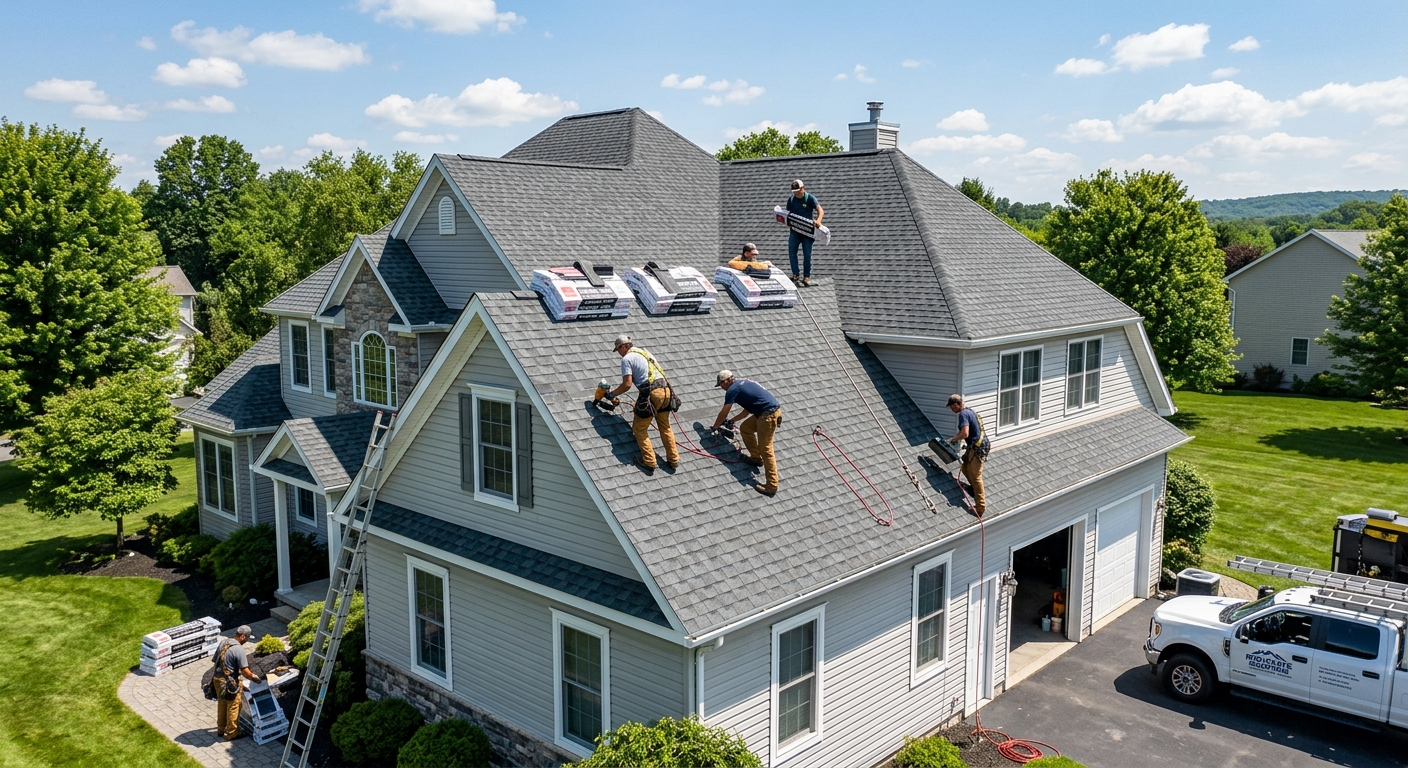
Pocono roofing prices by material and scope — 2026
Pocono’s roofing market is shaped by its mix of single-family homes and a high homeownership rate (U.S. Census Bureau, ACS 2024), which means replacement decisions here are made by people invested in long-term performance. In Monroe County, especially around the subdivisions of Pocono Township and Coolbaugh Township, the surge of homes built from the 1980s through the early 2000s has led to a wave of architectural shingle replacements as these original roofs reach their end-of-life. For many homeowners, this means roof replacements are happening now, not in some distant future.
Because Pocono’s homes are overwhelmingly single-family—most with simple rooflines and accessible pitches—the market is geared to straightforward replacement work, especially on subdivision houses that have reached their first or second reroof. Roofers here have structured their pricing and crew availability around that predictable demand. Flat roofs are much less common but show up on additions or porches. Metal roofs are requested by owners on the plateau or those with a history of shingle loss in wind events, but asphalt is still king because of cost and the influence of builder-grade originals in big subdivisions.
| Material / Scope |
Lifespan |
Best for |
Price range (installed) |
| Asphalt shingles — architectural (30-yr) |
25–30 yrs |
Typical subdivision homes |
$9,900–$21,000 |
| Asphalt shingles — impact-resistant (Class 4) |
30+ yrs |
Areas prone to hail or branch impact |
$16,000–$21,000 |
| Metal standing seam |
40–70 yrs |
Snow-prone ridge lines, wind exposure |
$24,000–$42,500 |
| Flat roof — TPO or EPDM |
15–25 yrs |
Low-slope additions or porches |
$12,500–$25,000 |
| Roof repair — leak or isolated section |
n/a |
Flashing leaks, valley repairs |
$500–$1,950 |
Prices are estimates for a typical Pocono home and vary with roof size, pitch, decking condition and material selection.
Roofing permits in Pocono: what you need before work starts
All roof covering replacements over structural decking in Stroudsburg Borough require a building permit—this is a municipal requirement enforced locally. Minor repairs such as patching a small leak or a few damaged shingles generally do not require permits in Stroudsburg, but full tear-offs and replacements do. Other Monroe County townships each have their own code enforcement offices, so requirements can differ just a few miles from your doorstep. All code enforcement in Monroe County operates under the Pennsylvania Uniform Construction Code (UCC), which is the state standard for residential work. In the limited cases where a municipality has opted out, the PA Department of Labor & Industry is responsible for enforcement.
Before you sign any contract, independently verify that your contractor holds valid Home Improvement Contractor (HIC) registration, which Pennsylvania requires for roofing contracts over $500. You can check the registration at hic.attorneygeneral.gov using the contractor’s number or business name. Workers’ compensation coverage is mandatory for all employers in Pennsylvania—this protects you if someone is injured on your property; verify current coverage status at the Commonwealth’s WCAIS portal (wcais.pa.gov). Don’t take paperwork at face value: a quick online check can stop you from hiring someone who’s cutting corners.
When to book roofing work in Pocono
Pocono’s roofing calendar is dictated by its cold, snowy winters and moderate local contractor density. From late October to early April, asphalt shingles struggle to seal reliably because daytime high temperatures seldom rise enough for thermal sealing, especially with Pocono’s winter design temperature as low as 4 °F. As a result, most full replacements are spring-through-fall affairs, with May through September being prime time for production crews. Lead time for reputable contractors in Monroe County generally stretches longer in September—especially after windstorms drive up roof failures—so booking six to eight weeks out is normal during those peak months.
Emergency work in the winter, including leak stops and temporary tarping, happens but costs a premium for rapid response in harsh conditions, with roof repairs running $500–$1,950 depending on urgency and accessibility. In contrast, a planned replacement scheduled for late summer or early fall can often be completed at the lower end of the full roof replacement band—particularly if your home is a straightforward single-story Pocono subdivision house. If you can plan ahead, you’ll avoid both the rush and the steepest pricing.
Why gutters get replaced with the roof
In Pocono, roofing and gutters aren’t independent systems—they’re your home’s first line of defense against our 40 psf snow loads and the heavy rainfall that can hit Monroe County. When the roof is replaced, doing gutters at the same time solves three problems at once: you get new drip edge and water-tight transitions, you ensure that meltwater or rain gets properly routed away from your foundation, and you avoid damaging old gutters during shingle tear-off. This is especially critical in Pocono’s single-family homes, where short overhangs mean water discharges near the basement wall—improper drainage can quickly turn into wet basement headaches.
Many manufacturer warranties (and some local code inspectors) require that positive drainage be provided as part of the roof installation. Typical gutter replacement during a roof job in Monroe County runs $2,400–$4,800 for a two-story home, if you want seamless aluminum gutters, downspouts, and basic guards. Skipping the gutters may save a buck now, but it risks foundation issues and voided warranties. When price-shopping, always specify whether gutter work and guards are included—you want apples-to-apples, not surprise scope gaps.
Choosing a roofing material for Pocono's climate
Monroe County’s climate hits roofs with two unique stressors: a ground snow load of 40 psf and a winter design temp of 4 °F. In these conditions, metal standing seam systems outperform every other material at shedding deep snow and refusing ice dams. Their interlocking panels and absence of exposed fasteners also hold tight in the ridge-line winds common along the Pocono Plateau. That’s why owners on exposed hillsides or those who’ve had past shingle blow-offs often upgrade to metal, despite the upfront cost of $24,000–$42,500.
Still, asphalt architectural shingles dominate subdivision roofing in areas like Pocono Township and Coolbaugh Township for a reason: they’re less expensive ($9,900–$21,000), install fast on simple gable roofs, and perform reliably for 25–30 years when correctly ventilated and flashed. Impact-resistant (Class 4) shingles offer a step up for homes under trees or in the hail zone but cost close to the top of the shingle band. Membrane systems—TPO or EPDM—only make sense for flat porch or low-slope additions. In Pocono, investing in metal only pencils out for high-risk or forever homes; for most owners, properly installed architectural shingles win on value, warranty support, and proven performance in this specific region.
| Material |
Installed cost |
Lifespan |
Cold-climate performance |
Maintenance |
| Asphalt architectural |
$9,900–$21,000 |
25–30 yrs |
Good when ventilated; vulnerable to ice dams if not |
Check flashings, keep gutters clear |
| Asphalt Class 4 impact-resistant |
$16,000–$21,000 |
30+ yrs |
Better hail/branch survival, same ice dam risk as regular asphalt |
As above; replace damaged ridge caps quickly |
| Metal standing seam |
$24,000–$42,500 |
40–70 yrs |
Best at snow and ice shedding; resists wind uplifts |
Check seams every 4–5 years, clear valleys |
| TPO / EPDM membrane |
$12,500–$25,000 |
15–25 yrs |
No shingle loss; seams must be welded perfectly for ice damming |
Inspect seams and drains annually |
Decking, ventilation and flashing — the hidden roof costs
Every roof replacement in Pocono starts with a visual check, but the real surprises show up at tear-off. Rotted decking is particularly common here in homes built from the 1980s to early 2000s, when OSB panels became the norm. The freeze/thaw cycle can trap moisture against the decking, rotting it out under bad valleys or past leaks. Replacing damaged roof decking typically runs $800–$2,200 for 2–5 sheets, but major structural repair can exceed that quickly.
Attic ventilation is not a formality—poor flow in Monroe County’s cold climate leads directly to ice damming, especially under the deep snow loads typical for this region. If your new roof traps attic heat, ice dams at the eaves can drive water under shingles and into living space, often voiding your shingle warranty. Upgrading a ridge vent or adding new soffit vents averages $650–$1,800.
Flashing is the next cost wildcard. Chimney crickets, step flashing along walls, valley liners and vent boots age out faster than shingles. Poorly done or omitted flashing is responsible for most ‘new roof, still leaks’ calls here. Isolated flashing repairs as part of a reroof add anywhere from $500–$1,950 to the bill. Don’t let it slide—it’s the cheapest insurance you can buy on a new roof.
What Pocono's climate does to a roof
Along the Pocono Plateau, wind-driven storms tear shingles from ridges and eaves, causing water intrusion in houses that were otherwise dry. These ridge-line wind events are frequent in Monroe County and rarely hit equally one county over—replacement claims spike after every major front. When shingles lift, even for a moment, the adhesive bond is broken; future leaks are nearly guaranteed. A single wind-blown repair can be $500–$1,950, but widespread shingle loss triggers a full replacement in the $9,900–$21,000 band.
Ice dams are another villain unique to deep snow counties: snow blankets the roof, attic leaks heat, and meltwater refreezes at the eaves. Water backs up behind the dam, flowing up under shingles unless special eave underlayments—like ice dam membranes—are used from gutter to at least 36 inches past the exterior wall line. Crews in Monroe County know to install these, but houses lacking an upgrade after the last major storm often wind up with rotted decking and moldy insulation.
Finally, hail in Monroe County won’t always punch holes. But it will bruise shingle mats, leaving compromised spots that leak years later. Most insurance adjusters won’t spot this on a visual drive-by; you need a local roof inspector who understands what hail looks like on Pocono’s most common architectural shingles—and the downstream effect can be a premature replacement that could have been prevented with Class 4 impact-resistant shingle selection. Local climate hits the roof in ways a flatlander simply won’t see coming.
Frequently asked questions — roofing in Pocono
Do I need a permit to replace a roof in Pocono?
In Stroudsburg Borough, replacing your roof covering—especially if it involves tearing off shingles down to the structural decking—almost always triggers a building permit requirement. That’s the local rule, enforced under Pennsylvania’s Uniform Construction Code, not just a best practice. Some surrounding Monroe County townships may operate differently, but most have similar standards. Minor patch repairs, like a handful of shingle replacements, are usually handled without a permit. Before signing a roofing contract, ask your contractor to clarify whether a permit is required for your house and who will secure it. The permit process exists to make sure your project meets code and is properly inspected—this matters, especially given that replacing a typical Pocono subdivision roof costs $9,900–$21,000.
What is the best time of year to replace a roof in Pocono?
The ideal window for roof replacement in Pocono runs from May to September. Above-freezing daytime temperatures are critical for shingles to seal properly. In late fall and winter, it’s often too cold for effective installation—our winter design temperature sits at 4 °F, and that can stretch a sealant’s cure time to weeks, if at all. Roofing crews book up fast after summer storms or during peak fall real estate closings, so plan ahead if you’re targeting a particular month. Emergency repairs do happen year-round, but expect to pay more for those—rapid response to winter damage can push even a basic repair bill to $1,950. For full replacement, September is popular because it avoids the summer rush and heads off winter leaks.
How can I tell if my roof decking is rotted?
The surest sign of rotted decking is a spongy or sagging spot you can feel underfoot in the attic or when walking the roof surface, but that’s not something most homeowners should try. Staining, mildew odor or visible daylight through the planks in the attic are more accessible indicators. In Pocono, roofers often discover rot at tear-off under valleys, chimneys, or former leak sites—problems hidden from view until shingles come up. If your home was built during the 1980s–2000s subdivision boom, OSB decking can go soft after years of trapped moisture from ice dams or neglected leaks. Replacing a few sheets typically adds $800–$2,200 to a roof job, but addressing it is non-negotiable for proper performance and code compliance.
Should I use a local roofer or a national company?
In Monroe County, local roofers know the region’s unique problems—ridge wind damage, ice damming, and fast aging of 1980s–2000s subdivision roofs. National brands may offer fast quotes and marketing polish, but they often subcontract to the same local crews at a markup. Only a roofer with real Pocono experience will spot problems like improper attic ventilation or the need for extra eave membrane to beat our 40 psf snow loads. You can verify any contractor’s Home Improvement Contractor (HIC) registration at hic.attorneygeneral.gov, and roofers here routinely deliver projects in the standard bands ($9,900–$21,000 for architectural shingle replacement). Local crews win when you want the best value for your money and local accountability.
Why is my Pocono roofing quote higher than the online average?
Online averages bundle costs from all over the country, but Monroe County has factors that push prices higher: the deep snow loads here require more ice and water shield at eaves, our climate takes a toll on materials, and rural travel surcharges are real for more remote homes. Labor rates and disposal costs in the Pocono market also exceed most sunbelt states. Throw in mandatory permit fees in Stroudsburg and the need for HIC-registered, insured crews, and the bottom line often ends up nearer $16,000 for a typical architectural shingle job. Your quote reflects what it takes to build a roof that survives our actual winters—not just the cheapest job off a spreadsheet.
How long do architectural shingles last compared to 3-tab?
In Pocono, architectural shingles are the default for new installations and replacements because they last longer and handle our severe winters better than 3-tab products. Expect 25–30 years service from a properly installed architectural roof, compared to 14–19 years for the few remaining 3-tabs around here. The upgrade isn’t just marketing—architectural shingles have layered construction that tolerates the freeze/thaw cycles and heavy snow loading we get across Monroe County. For homeowners facing a full roof job in the $9,900–$21,000 band, the extra decade of life more than earns its keep. When you see a 20-year-old roof still looking good in the Poconos, it’s almost always architectural, not 3-tab.
Do I need my own inspection before the adjuster visits?
If you’ve had storm damage in Pocono—missing shingles from a ridge-line wind, hail in a passing summer front—it’s smart to have a local roofer inspect your roof before your insurance adjuster arrives. Local contractors in Monroe County can spot subtle damage (like bruised shingles or flashing lifted out of place) that traveling adjusters sometimes miss. Having a detailed, written estimate in hand—say, referencing a repair in the $500–$1,950 range—gives you extra leverage to make sure nothing gets left off your claim. A local inspection is inexpensive insurance for a fair settlement, especially in a region where storm exposure causes plenty of borderline adjuster calls.
What's the cheapest way to replace a roof in Pocono?
If keeping costs down is critical, stick with standard architectural asphalt shingles for your Monroe County roof—they offer the best blend of service life (25–30 years) and installed price, with replacement bands beginning at $9,900 for simpler single-story homes. Don’t pay for “lifetime” upgrades or expensive metal unless you truly need the snow-shedding or wind resistance. Skip decorative add-ons and ask your roofer if you can bundle gutter work for a small savings. However, never cut corners on underlayment or ventilation; problems here cost more than the savings. Shop around, but don’t go below the lowest regional market rate or you risk ending up with uninsured crews or shoddy underlayment—both common ways cheap jobs go wrong in Pocono.
Why do roofs fail faster in northeastern Pennsylvania?
Northeastern Pennsylvania, including Monroe County’s Poconos, puts roofs through repeated freeze/thaw cycles, 40 psf snow loads, and wind events not seen in most of the country. These forces cause hidden shingle bruising, ice damming, and premature cracking—especially on roofs from the subdivision boom with marginal ventilation. While a shingle might last 30 years in a gentler state, in Pocono you'd be smart to plan for replacement closer to 22–25 years unless you’re meticulous with attic airflow and routine maintenance. Annual repairs in the $500–$1,950 range are common on older roofs, and ignoring early warning signs leads to full-deck rot or interior leaks that push reroof costs higher. Local climate compounds all the usual wear—there are no free rides for roofs here.