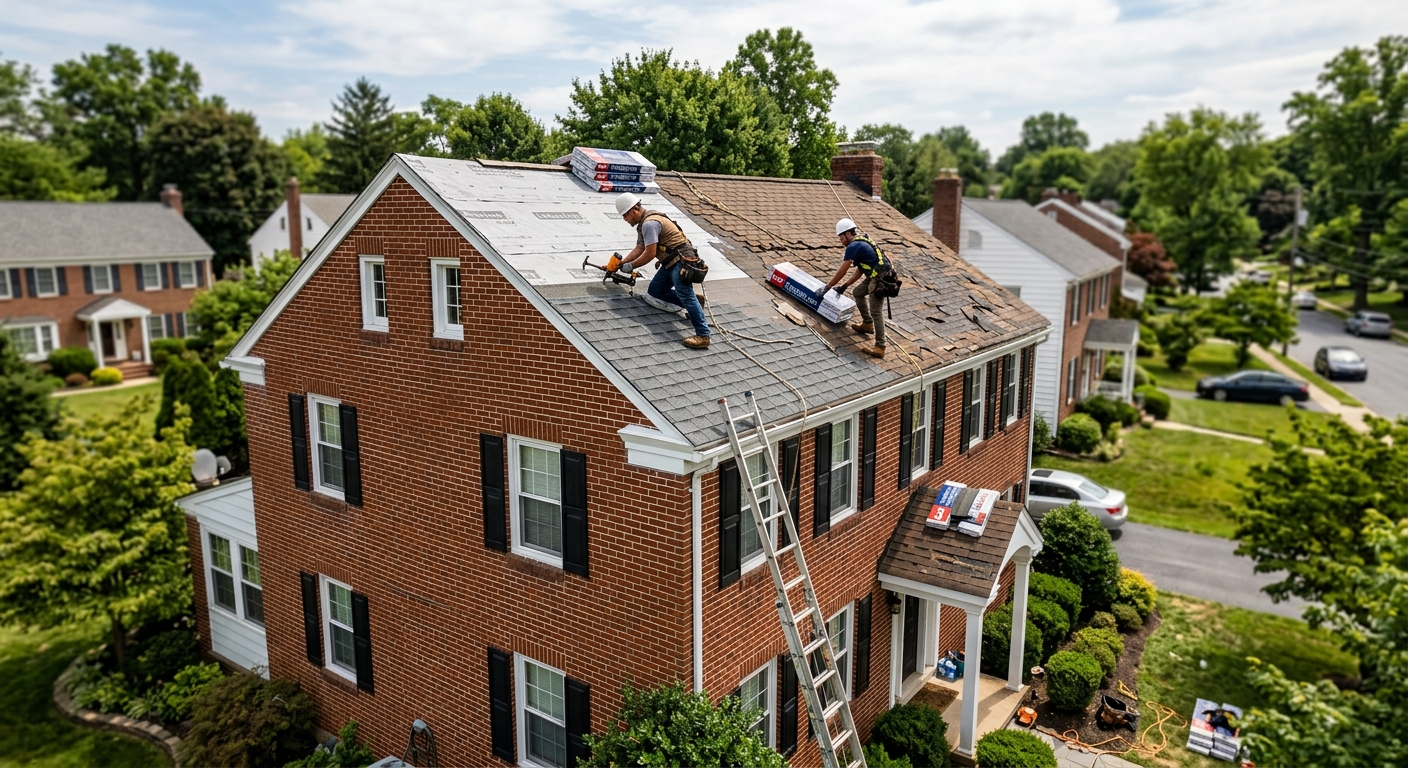
Middlesex roofing prices by material and scope — 2026
Middlesex homeowners – especially those in the 82.0% owner-occupied market (U.S. Census Bureau, ACS 2024) – face roofing costs that follow the rhythms of local housing stock. With more than one-third of homes here built before 1980, roof age and prior installation quality matter in understanding what you’ll pay today. Around subdivisions in Hampden and Silver Spring Townships, where post‑1950 tract houses set the tone, reroofing happens in bulk cycles: many houses went up together with near-identical asphalt roofs and now need replacements within a few years of each other.
This means most calls in Middlesex still center around asphalt shingle replacements, as these neighborhoods were originally shingled and local suppliers carry those products year-round. In newer tracts and rural builds, some homeowners are upgrading to metal standing seam for longevity. Flat roofs, often found over porches or additions, require a membrane system, which is markedly more expensive than shingles per square foot. Repairs for leaks or storm damage follow a predictable band, though scope can swing when older roofs conceal hidden water damage.
Below are installed price ranges for the most common roof materials and project types in Middlesex:
| Material / Scope |
Lifespan |
Best for |
Price range (installed) |
| Asphalt shingles — architectural (30-yr) |
25–30 yrs |
Main roof replacements in subdivisions |
$9,300–$19,500 |
| Asphalt shingles — impact-resistant (Class 4) |
30+ yrs |
Exposed ridge lots, storm-prone sites |
$15,000–$19,500 |
| Metal standing seam |
40–70 yrs |
Long-term rural or upgrade projects |
$22,500–$40,000 |
| Flat roof — TPO or EPDM |
15–25 yrs |
Porches, additions, low-slope sections |
$11,500–$23,500 |
| Roof repair — leak or isolated section |
n/a |
Small area water entry, flashing fix, vent boot |
$475–$1,850 |
Prices are estimates for a typical Middlesex home and vary with roof size, pitch, decking condition and material selection.
What insurance covers on a Middlesex roof
If your Middlesex home suffers roof damage from wind, hail, or a fallen tree, insurance can step in—if the sequence is right. First, document the damage thoroughly before any cleanup with photos of leaks, roof debris, and interior stains. Your policy will require this to establish that a particular storm event caused the loss. Next, file a claim and ask your insurer for a written “scope of loss”—a detailed explanation of what’s damaged and covered. Expect an adjuster to come out for a physical inspection, especially on higher-value claims like full replacements, where the stakes match the price band of $9,300–$19,500 for architectural shingles.
Most homeowner policies pay either “actual cash value” (ACV), which subtracts for age and wear, or “replacement cost value” (RCV), which covers what a new roof actually costs today. Know which you have, as payout can differ by thousands. The Home Improvement Consumer Protection Act (HICPA) requires a written contract over $500 and gives you a 3 business-day right of cancellation—no handshake deals, no pressure tactics. Pennsylvania law also forbids any contractor from waiving your insurance deductible. If someone offers to “eat your deductible,” they’re asking you to commit insurance fraud, and that’s a clear sign to walk away.
Work only proceeds after both insurance and homeowner agree on scope and cost—never authorize repairs before confirming your insurer’s approval, or you could be on the hook for uncovered work out of pocket.
Flat roof sections: the part most quotes get wrong
Many Middlesex houses mix roof types. If your place has a flat rear addition, enclosed porch, or sunroom, it needs a different roofing system than the pitched main roof. Traditional shingles don’t protect a low-slope (below 3/12) surface here—the freeze-thaw cycles in south-central Pennsylvania mean ponded water becomes ice, pushing water up under shingle laps and into the decking. You see leaks at seams and parapets first, which explains why patched shingle jobs on flats always wind up being temporary.
The right answer is a single-ply membrane—TPO or EPDM—custom-welded or adhered to the edges and penetrations. This lasts 15–25 years with proper drainage, far more than a quick shingle fix but less than a pitched roof. Expect to budget $11,500–$23,500 for a full membrane replacement on a typical Middlesex porch or addition. If a roofer quotes standard shingles for a 2/12 pitch, they are ignoring both the manufacturer’s warranty and local experience; in this county, that’s usually a sign to look elsewhere for someone who understands actual roof life.
The scope items Middlesex homeowners don't budget for
Several items commonly turn a Middlesex roof quote into a higher final invoice. First, it’s nearly impossible to spot all rotted or delaminated roof decking before tear-off, especially on homes built before 1980. Swapping in new plywood typically runs $650–$2,500 extra, depending on square footage. Attic ventilation is another frequent culprit—this region’s pronounced freeze-thaw cycle means that trapped attic moisture leads to ice dams at the roof edge, not just energy loss. When ventilation is found inadequate, replacing or adding ridge vent plus baffles can add $600–$1,600.
Chimney and wall flashing is sometimes caulked instead of replaced. Proper step flashing and counterflashing at walls, chimneys, and skylights adds $350–$1,100. Rubber vent boots and plumbing collars dry-rot well before shingles wear out, so full replacement is a smart $100–$250 per boot. Finally, drip edge (mandated by code) and ridge vent should be included but sometimes show up as “extras”—factor in another $350–$700 if they aren’t.
Roofing permits in Middlesex: what you need before work starts
Roof work in Middlesex is regulated under the Pennsylvania Uniform Construction Code (UCC), which is based on the IRC. Permits are enforced at the municipal level unless a municipality has opted out, in which case the Pennsylvania Department of Labor & Industry steps in as the authority. For most Middlesex homes, full roof replacements require a permit, while small repairs (like replacing a handful of shingles or flashing) typically do not. Always check with your township’s code office before work begins.
Pennsylvania requires Home Improvement Contractor (HIC) registration for any roof project over $500. You can—and should—verify a contractor’s HIC registration at hic.attorneygeneral.gov. Proof of workers’ compensation insurance is legally mandatory and can be checked on the WCAIS system (wcais.pa.gov). Contractors should supply their certificate, but you can verify the policy is active yourself to avoid jobsite liability as a homeowner. Written contracts over $500 are not optional: they’re required by law, along with your 3-day right to cancel.
Checking out a roofer in Middlesex: what to verify
Middlesex’s dense roofing market means there’s a wide range in contractor professionalism. The first step is always to check HIC registration directly at hic.attorneygeneral.gov. Homeowners should request current workers’ compensation certificates, which you can verify through WCAIS (wcais.pa.gov) to ensure the policy is active and the employer is properly listed. Ensure the contract is in writing for projects over $500 as required by state law.
- Check the HIC registration number at hic.attorneygeneral.gov
- Request a copy of workers’ compensation insurance; verify at wcais.pa.gov
- Get a written contract for any job over $500
- Obtain proof of liability/general insurance
- Ask for names of local suppliers – see if they pay for materials locally
- Request municipal permit receipts before work begins
- Verify references with addresses in Cumberland County
- Ask about EPA Lead RRP certification if your home predates 1978
- Check if the crew will be the same each day (important for storm periods)
- Review warranty terms—labor and material—before signing
- Ask what is excluded (decking, ventilation, flashing) up front
- Trust your gut about high-pressure or evasive answers
Red flags in Middlesex’s saturated market include: aggressive door-knocking after wind events, vague or verbal pricing, refusal to show insurance or HIC registration, no fixed local address, and anyone offering to “cover your deductible.” These are warning signs to move on.
What Middlesex's climate does to a roof
Middlesex sits in the path of ridge-line winds characteristic of the Cumberland Valley. These winds accelerate roof wear—especially on exposed farmsteads and subdivisions built along the ridges—by lifting shingles along the windward eaves and driving water up under laps and flashing. That physical stress, specific to this region, leads to early shingle failure and makes impact-resistant upgrades (Class 4) more common, raising roof replacement totals into the $15,000–$19,500 band for those who choose the extra protection.
The ground snow load here is 30 psf, and our winter design temperature hits 12 °F. This means melting and refreezing cycles push water back up under shingles at the eaves, forming ice dams. The result: wet insulation, rotted decking, and often a significant jump in repair cost—what starts as a $475–$1,850 leak repair can turn into thousands more if attic or wall damage is hidden. Flat sections—common on porches and additions in Middlesex—are especially prone to ponding water, which freezes and cracks inferior materials.
Even minor hail leaves behind bruised asphalt on the surface, with no visible holes, setting up early leaks a year or two later. That’s why adjusters look for “degranulation” as proof of loss, and local contractors push for thorough claims documentation to capture the true lifecycle cost, not just upfront repair.
Frequently asked questions — roofing in Middlesex
What happens if rotted decking is found after tear-off?
When roofers pull off old shingles in Middlesex, it’s common on homes built before 1980 to discover rotted or delaminating decking—especially after years of freeze-thaw cycles driving moisture up from ice dams or down through failed shingles. This isn’t always visible during estimates, since attic insulation often blocks interior signs and hidden leaks may not stain ceilings right away. If rotted plywood is found, it must be replaced to maintain your shingle warranty and avoid “soft spots.” Typical costs in this market are $650–$2,500, depending on how many sheets are needed. A detailed contract should state the price per sheet and specify when you’ll be notified if replacement is needed, so there aren’t any billing surprises mid-job.
Will filing a roof claim raise my premium?
In Pennsylvania—and specifically in Middlesex—filing a claim for a damaged roof will be noted on your insurance record. One claim due to storm damage (hail, wind, or fallen tree) is less of a red flag than claims for neglect or preventable leaks, but repeat weather-related claims in a short period can trigger premium increases or even non-renewal. Insurers track claims by address, not just the policyholder. With a full roof replacement here running $9,300–$19,500, it’s sometimes worth absorbing the cost of a small repair yourself and saving your policy for a major disaster, especially if you’re looking to sell in the next few years and want to keep your record clean.
How much snow load can a Middlesex roof handle?
Residential roofs in Middlesex are designed to meet a ground snow load of 30 pounds per square foot, as specified for south-central Pennsylvania. That covers typical Cumberland County snow events, but drifting and ice accumulation—especially on exposed ridge homes or large, low-slope sections—can lead to heavier localized loads. Roof trusses on post‑1950 homes were built for this standard, but additions or porches may not be reinforced to current codes. If you ever notice sagging or bowed ceilings under snow, make the small investment in a midwinter roof inspection (well under $475–$1,850 for a thorough check and minor ice dam removal) to prevent catastrophic failure.
What does roof replacement cost per square in Middlesex?
In Middlesex, the typical installed cost per “square” (which is 100 square feet of roof area) for architectural asphalt shingles falls between $465–$700 per square, based on the full replacement band of $9,300–$19,500 for most single-family homes. Metal and flat membrane systems are higher by square, reflecting both materials and installation complexity. Local suppliers carry standard bundle sizes, and the denser population of owner-occupied homes means there’s price competition—but labor is rarely the cheapest line item in this market.
Why is my Middlesex roofing quote higher than the online average?
National averages can’t capture local code, labor, or demand cycles. Middlesex is part of the Harrisburg–Carlisle metro and sees elevated material and labor costs compared to low-cost states. More importantly, strict enforcement of the Pennsylvania Uniform Construction Code means inspections, proper underlayment, and full flashing work are non-negotiable—items some online sources leave out. Experienced contractors here build in allowances for surprises on homes with a high percentage built before 1980. With most full asphalt replacements ranging from $9,300–$19,500, you’ll pay the local rate for work that meets code and avoids warranty voids.
Are storm-chasing roofers a problem in Middlesex?
Yes—being in a saturated suburban market, Middlesex sees an uptick in door-to-door “storm restoration” contractors after strong wind or hail events sweep east through the Cumberland Valley. These crews often lack HIC registration, propose quick jobs with no permit, or claim they can “waive your deductible,” which is illegal in Pennsylvania. Some work out of temporary addresses or offer suspiciously low cash-only bids. Protect yourself by checking hic.attorneygeneral.gov and insisting on a written contract (required under the Home Improvement Consumer Protection Act) for anything over $500.
What does it mean if my shingles are curling or losing granules?
Curling shingles or a gritty layer of granules in your gutters are two of the most reliable warning signs that your Middlesex roof is nearing the end of its lifespan. Both happen when asphalt dries out and loses flexibility—from UV, attic heat, and freeze-thaw stress. In exposed ridge or subdivision settings, wind events speed this process. At this stage, spot repairs ($475–$1,850) can buy you some time, but wholesale replacement is usually more cost-effective if you’re seeing these issues over wide areas—not just an isolated patch.
Are there historic district rules affecting roofing in Middlesex?
Most of Middlesex is not covered by a formal historic district administration; Carlisle itself has some local restrictions, but the surrounding townships generally do not. However, for any roof job on a house built before 1978, federal EPA Lead RRP rules apply if paint is disrupted—so you should confirm your contractor is certified and follows proper procedures. These add some cost to projects ($9,300–$19,500 is typical for full replacement where lead is not a complicating factor), but are required by federal law for occupant safety.
What underlayment should be used on a Middlesex roof?
In Middlesex’s climate, with its freeze-thaw cycles and a 30 psf snow load, the correct underlayment is not just a code requirement—it’s insurance against costly leaks. Ice and water shield should be installed from the eaves up at least two feet past the warm wall line, and synthetic or heavy felt is used elsewhere. For full replacements ($9,300–$19,500 for asphalt), this is non-optional. On ridge-line or older homes, extra coverage at step flashing and valleys is a smart upgrade, especially since wind-driven rain and ice dams are the prime sources of initial leaks here, not just heavy snow accumulation.