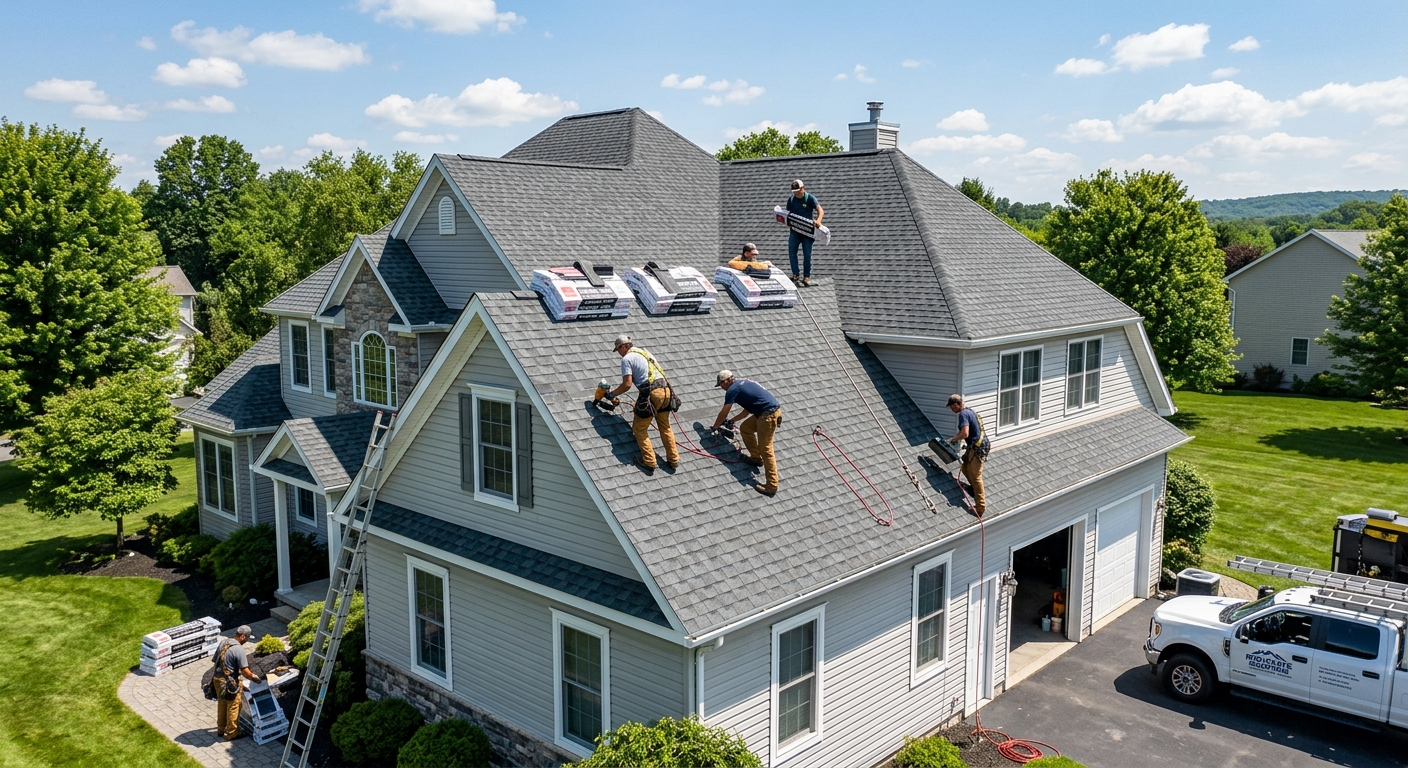
Roofing Replacement & Repair costs in East Rockhill — 2026
In East Rockhill, roof replacement costs reflect both the age and composition of the local housing stock. With an 84% homeownership rate and nearly half of all homes built before 1980 (U.S. Census Bureau, ACS 2024), the number of original roofs nearing the end of their lifespan is rising. Homeowners here see the impact of the 1950s postwar boom first-hand—Levittown’s massive tract-housing wave in nearby Falls and Bristol townships set the template for much of the region, with many older asphalt shingle roofs only now coming due for full replacement or major repair. This means a high demand for both standard architectural asphalt replacements and custom work to deal with decades of patching, layering, and past quick fixes. If you own a single-family house built before the 1980s, plan on work involving not just shingles but possibly decking and flashing updates. Steep roof pitches, attic ventilation, and snow load requirements all play into the real price on bid day. Most jobs quoted here will land squarely within the typical ranges shown below.
| Material / Scope |
Lifespan |
Best for |
Price range (installed) |
| Asphalt shingles — architectural (30-yr) |
25–30 yrs |
Widespread use on local postwar homes |
$11,000–$23,000 |
| Asphalt shingles — impact-resistant (Class 4) |
30+ yrs |
Homes exposed to Delaware River storm tracks, hail risk |
$18,000–$23,000 |
| Metal standing seam |
40–70 yrs |
Long-term owners, rural edges, steeper pitches |
$26,500–$47,500 |
| Flat roof — TPO or EPDM |
15–25 yrs |
Row homes, additions, porches |
$14,000–$28,000 |
| Roof repair — leak or isolated section |
n/a |
Flashing, missing shingles, vent/boot leaks |
$600–$2,200 |
Prices are estimates for a typical East Rockhill home and vary with roof size, pitch, decking condition and material selection.
Checking out a roofer in East Rockhill: what to verify
When hiring a roofer in East Rockhill, you need to check more than just references. Any contract over $500 requires that the roofer is registered as a Home Improvement Contractor (HIC) with the Pennsylvania Office of Attorney General—always verify this status at hic.attorneygeneral.gov. All employers must have workers' compensation insurance, regardless of company size; you can verify coverage through the WCAIS database (wcais.pa.gov). Written contracts are mandatory under the Home Improvement Consumer Protection Act, and you must receive a three-day right of cancellation. For homes built before 1978, make sure your roofer is EPA-certified for lead-safe practices, which you can check at certifiedrenovatorsearch.epa.gov. Never trust verbal promises for deductibles, as waiving your insurance deductible is explicitly prohibited.
- Confirm HIC registration at hic.attorneygeneral.gov
- Check workers’ comp coverage via WCAIS (wcais.pa.gov)
- Demand a detailed, written contract
- Ask for proof of insurance (liability and comp)
- Get references from recent jobs in Bucks County
- Check for EPA Lead RRP certification if your house is pre-1978
- Clarify who pulls the permit—contractor or owner
- Ensure material and workmanship warranties are documented
- Understand payment schedule; never pay large deposits
- Request before/after photos of past similar work
- Review exact scope (repair vs. replacement, layers off, etc.)
- Find out how debris and nails are handled on site
In Bucks County’s saturated roofing market, look out for storm-chaser crews appearing after a major storm, door-knockers pushing immediate commitments, companies unwilling to provide a local reference, or those asking for large cash deposits up front. Lack of HIC registration or refusal to provide insurance certificates is an immediate red flag.
Reading the warranty on a East Rockhill roof
Every East Rockhill roof job comes with two types of warranty—one from the manufacturer, and one from the installer. Manufacturer warranties cover only shingle or membrane defects, usually on a prorated schedule that drops sharply after the first few years. These often require you to register the roof within weeks of installation and can be voided if inadequate attic ventilation or a "roof-over" was done on old shingles. Workmanship warranties, on the other hand, cover installation labor—leaks, misaligned shingles, flashing errors. These are only as good as the installer’s history and likelihood they’ll remain in business. A 25-year labor warranty from a company that opened two years ago is worth less than 10 years from an established firm with a solid Bucks County track record.
Ask if the warranty transfers to a new owner should you sell—the paperwork and a small transfer fee are sometimes required. Clarify exclusions such as storm damage or acts of nature (which go through insurance, not warranty). Improper ventilation, using unapproved underlayment, or failing to register the warranty on time will leave you without recourse if the shingles curl or blister years down the line. Read carefully and keep all documentation—the burden is on the homeowner to prove compliance in a warranty claim.
Reading a roofing estimate line by line
In East Rockhill, scrutinizing every roofing estimate line is crucial since local roof sizes, pitches, and past maintenance can differ block by block. A good estimate spells out the job in "squares" (100 square feet), breaking down every element: tear-off (with dumpster or bagster details), underlayment specified by product (not just "felt"), and ice/water shield coverage by feet at eaves and valleys. Decking replacement should be listed as a per-sheet contingency—rot is common in older Bucks County homes. Flashing around chimneys and vents, plus new vent boots, should be called out by location.
Warranties should be divided into installation and manufacturer coverage, and payment schedules should never demand hefty upfront cash. A vague lump sum, with no square count or breakout, hides corners being cut—especially if there’s no contingency for decking or specifics on underlayment. Don't compare anyone who can't provide square footage, slope, and a material-by-material breakdown.
| Line item |
What to look for |
Red flag if… |
| Roof area |
stated in squares, with pitch |
no measurement given |
| Tear-off and disposal |
number of layers, dumpster included |
bundled into one figure |
| Underlayment |
product type and coverage |
listed only as 'felt' |
| Ice and water shield |
coverage height at eaves |
omitted entirely |
| Decking |
per-sheet contingency price |
no allowance at all |
| Warranty |
workmanship years stated separately |
only the shingle warranty |
| Payment |
deposit under 15%, balance on completion |
large upfront cash |
Permits and code requirements in East Rockhill
In East Rockhill, roofing work is governed by the Pennsylvania Uniform Construction Code (UCC), which follows the IRC. For all but the smallest repairs, a permit is needed for full roof replacements or major system repairs—replacement of the entire shingle or membrane roof, decking work, or structural changes. In this township, the code is enforced by the municipality, not the state, so permits are issued by the local code office as required by the UCC.
If your roofing contract is over $500, make sure the contractor is registered as a Home Improvement Contractor (HIC) with the Pennsylvania Office of Attorney General. You can confirm HIC registration at hic.attorneygeneral.gov. Always require proof of workers' compensation insurance, verified through the state’s WCAIS database (wcais.pa.gov). Liability insurance documents should be in-hand before anyone sets foot on your roof. If your home was built pre-1978, federal Lead RRP rules apply—check certification at certifiedrenovatorsearch.epa.gov. Remember: a written contract and three-day cancellation right are your legal protections. Local permits are not just paperwork—a failed inspection or skipped permit can delay a house sale or void an insurance claim down the line.
Decking, ventilation and flashing — the hidden roof costs
In East Rockhill, unseen roof surprises are common, especially on homes built before the 1980s. Decking—often non-plywood in older houses—is sometimes found rotted or delaminated at tear-off, requiring immediate sheet-by-sheet replacement at $75–$150 per piece. If a quote has no allowance for decking, expect a mid-job change order. Next, ventilation: Southeastern PA’s humid summers and moderate freeze-thaw cycles amplify ice damming risk if attic airflow is inadequate. Poor venting can void new shingle warranties and trigger premature failure. Installing or upgrading a ridge vent, soffit vents, or gable fans can add $500–$2,000, but cutting corners here often means a much shorter roof lifespan.
Flashing is another blind spot in old Bucks County roofs. Chimney and wall step flashing corrodes or cracks over decades, and simply caulking bad metal is a shortcut that won't last. Full replacement of chimney flashing often runs $250–$750 per chimney, while new vent boots are typically $50–$150 each. Missing or undersized drip edge and ice barriers at the eaves are still found in local install jobs from before code updates, creating leakage and warranty risks. Before you sign, insist on a line-item review of all potential “hidden” costs—an honest roofer will have explicit allowances and clear language in the contract.
What moves the price of a roof in East Rockhill
Roof prices in East Rockhill can differ sharply between bids, and it’s not just about contractor markup. Local house sizes, especially among the waves of 1950s-era homes, tend toward bigger footprints with moderate-to-steep roof pitches. Because much of the housing stock is older and with many past patch jobs, you’re more likely to see extra costs for removing multiple layers—local contractors often include a surcharge per extra layer, typically $500–$1,500 per level. Attic ventilation and ice damming issues are real concerns, not hypotheticals, given Bucks County’s 30 psf ground snow load and regular freeze-thaw winters.
Material choice moves the needle fast: a standard architectural asphalt job can run $11,000–$23,000, while swapping to Class 4 impact-resistant shingle adds $500–$2,500. Metal roofing, though more expensive up front, is gaining popularity among long-term owners and those on the township’s rural fringes tolerant of higher initial cost in exchange for 40–70 year service life. Flat roofs, mostly found on additions and porch roofs, cost less per square but require more frequent replacement, and their price is driven up by flashing complexity, not just membrane cost.
| Factor |
Why it matters here |
Cost impact |
| Roof size in squares |
each square is 100 sq ft of roof surface |
primary multiplier |
| Pitch and access |
steep pitches need harnesses and slow the crew |
+20–30% labour |
| Existing layers to tear off |
two or more layers means full tear-off and disposal |
$500–$1,500 per layer |
| Decking condition |
rot is found during tear-off, not before |
$75–$150 per sheet |
| Ice barrier at eaves |
required where ice damming has a history |
$300–$800 |
| Material grade |
3-tab vs architectural vs Class 4 impact-resistant |
$500–$2,500 |
Frequently asked questions — roofing in East Rockhill
Are storm-chasing roofers a problem in East Rockhill?
Yes, storm-chasing roofers are a real problem in East Rockhill and across Bucks County, especially after Delaware River valley thunderstorms or hail events. This saturated market draws out-of-area crews who canvas neighborhoods, offering quick repairs or “free” replacements. These companies often pressure homeowners into signing contracts on the spot and may cut corners or disappear after payment. Always verify Home Improvement Contractor (HIC) registration at hic.attorneygeneral.gov and insist on a written contract with clear scope. Local, stable contractors have references you can check and established reputations. Even for storm repairs costing $600–$2,200, do your homework—it’s better to wait a day for the right crew than get stuck with shoddy work and no follow-through.
Can I inspect my own roof safely?
It’s possible to perform a limited roof inspection yourself in East Rockhill if you’re comfortable with ladders and fall risks, but safety must come first—especially on steep or aging roofs. Use binoculars from the ground to check for missing shingles, curled tabs, or damaged flashing. Avoid walking on asphalt roofs, particularly in hot or cold weather, as you can damage the surface or lose footing. Cautious inspections can help you spot problems early, but if a repair is likely (sometimes just $600–$2,200 for a leak), it’s usually worth calling a pro. The older the roof, the greater the hidden problems—decking rot, loose vent boots, and weaknesses you can’t see without tearing off material. Most East Rockhill homeowners prefer to leave detailed inspections to insured contractors with proper harnesses and equipment.
How much does it cost to repair a roof leak in East Rockhill?
Roof leak repairs in East Rockhill typically cost between $600–$2,200. The actual price depends on where the leak is—around chimneys, at step flashing, or under vent boots. The township’s mix of aging 1950s homes and decades of patch jobs means some repairs look simple but expose hidden costs, especially if decking rot or poor ventilation is found. Bucks County storm clusters also mean many repairs are tied to wind-driven rain and hail. Always insist on a full inspection before agreeing to a price—honest contractors will explain what’s visible and what might appear once shingles or flashing are removed. If you have multiple leaks or roof sections near the end of their lifespan, sometimes a repair isn’t worth it compared to a replacement at $11,000–$23,000.
Does homeowner's insurance cover roof replacement in East Rockhill?
Homeowner’s insurance in East Rockhill often covers roof replacement only if the cause is sudden, accidental damage such as wind, hail, or falling tree limbs—issues Bucks County homes sometimes face thanks to storm corridors. General wear, old age, or leaks from deferred maintenance are excluded. Insurers will look for evidence of proper maintenance and may deny claims if multiple layers of shingles or poor ventilation are present. Be wary of anyone offering to “waive your deductible”—this is not allowed under Pennsylvania’s Home Improvement Consumer Protection Act. If your claim is approved, your out-of-pocket expense is limited to your deductible, but replacing a typical asphalt roof often costs $11,000–$23,000. Read your policy closely and get pre-approval for any work.
What is the difference between TPO and EPDM?
TPO (thermoplastic polyolefin) and EPDM (ethylene propylene diene monomer) are both types of flat roof membrane used across East Rockhill for porch roofs, additions, and row homes. TPO tends to be white, reflects sunlight, and is weldable, making it a favorite for energy efficiency. EPDM is black and rubbery, lasts just as long, and is highly flexible but not heat-weldable. Both systems last 15–25 years, and the installed price for a replacement in this area is typically $14,000–$28,000 depending on roof size, number of penetrations, and flashing complexity. There isn’t a clear “better” system for Bucks County—go with the material your contractor works with most, and make sure flashing details are spelled out in your contract.
How much snow load can a East Rockhill roof handle?
Roofs in East Rockhill are designed to handle a ground snow load of 30 pounds per square foot (psf), based on southeastern Pennsylvania code requirements. This is sufficient for most winters here, but ice damming and occasional heavy, wet snowfalls do occur. Steeper roofs shed snow more easily, but lower-pitched or flat roofs require more maintenance attention, especially as the roof ages. If you add insulation or change attic ventilation, make sure not to block airflow, as improper ventilation in this climate raises the ice dam risk. Should you have concerns about your roof’s integrity—especially if it was built pre-1980 or shows deflection—have a contractor check both the structure and attic insulation. If shoveling is ever needed, use a roof rake to avoid damage, even on a roof that otherwise can support 30 psf.
Does roof pitch affect the price in East Rockhill?
Absolutely—roof pitch makes a real difference on Bucks County jobs. Steeper pitches slow crews, require harnesses or scaffolding, and make tear-off/disposal more expensive. Typical 1950s structures here have moderate pitches, but certain layouts, especially dormered Cape Cods and garrison colonials, can have multiple slopes. Expect labor costs to rise by 20–30% on pitches above 8/12. On a mid-size roof where the base price is $18,000 for architectural shingles, steep slopes can easily add several thousand dollars to the quote. For flat roofs, pitch is less of a concern, but you’ll see cost differences tied to drainage and parapet work as well.
What happens if it rains mid-replacement?
In East Rockhill, roofing crews have to be ready for pop-up storms—especially in summer, when the region’s humid air brings fast-moving thunderstorms. Reputable contractors stage tear-off and underlayment in sections, never exposing more than can be covered and dried in a workday. If rain is forecast, crews will either halt work or use emergency tarps to protect open decking. Most companies here are quick to tarp—building codes require that no water-damaged wood gets left under new roofing. If a storm blows up mid-job, insist that all exposed areas are watertight before the crew leaves for the day. Any water intrusion needs to be reported and documented so it can be addressed, especially on jobs costing $11,000–$23,000.
How do I verify a roofing contractor is registered in Pennsylvania?
Verifying your roofer in East Rockhill is straightforward. All contractors doing home improvements over $500 must be registered as a Home Improvement Contractor (HIC) with the Pennsylvania Office of Attorney General. Go to hic.attorneygeneral.gov and enter the contractor’s name, company name, or registration number. You’ll see their status, company details, and complaint history. Do not move forward with anyone unable to produce a current HIC registration certificate. For further peace of mind—especially if you’re investing in a full roof replacement costing $11,000–$23,000—ask for proof of current workers’ compensation coverage and check it at wcais.pa.gov. Always do this before signing a contract or paying any deposit.