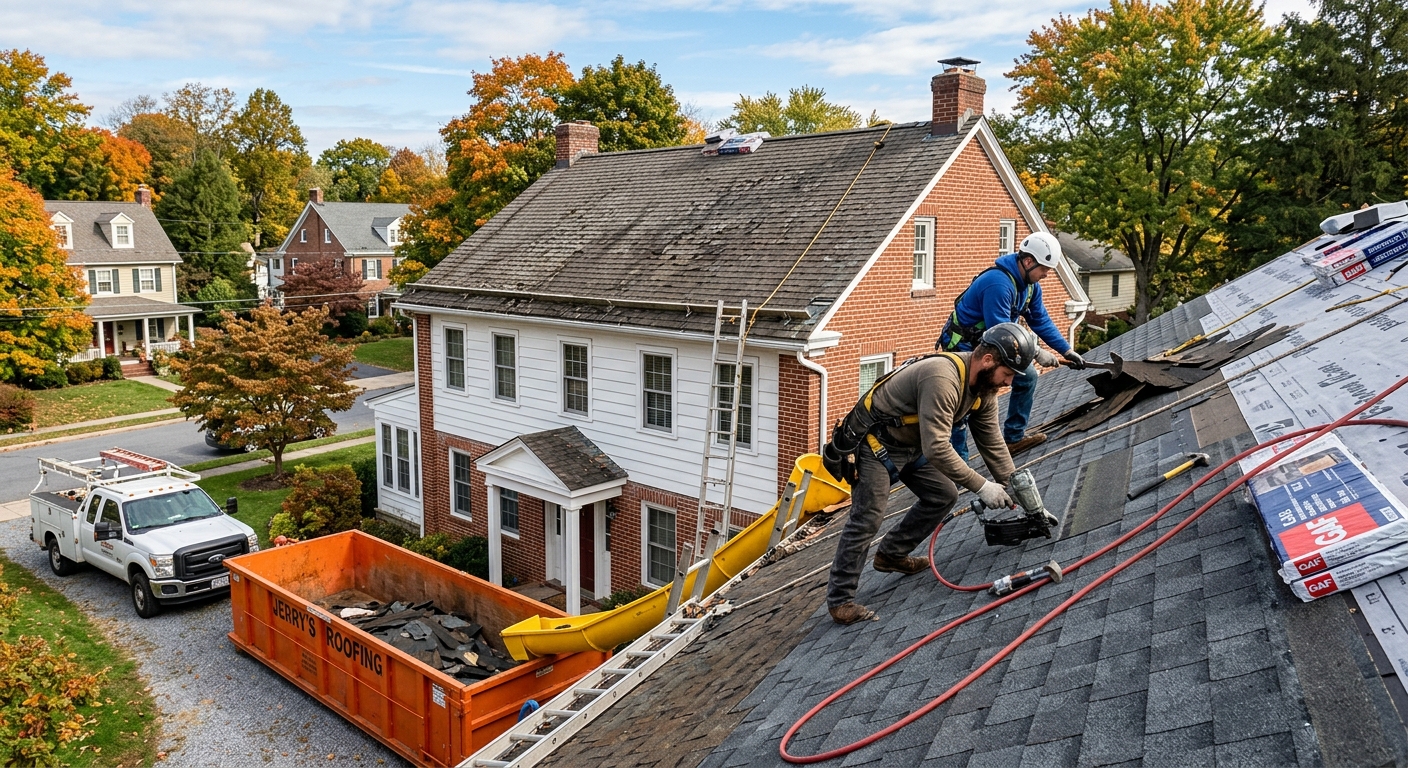
Roofing Replacement & Repair costs in Dickson City — 2026
In Dickson City, roof replacement and repair costs reflect the reality of working on homes where 81% were built before 1980 (U.S. Census Bureau, ACS 2024), meaning most replacement jobs involve more than just new shingles. With 70.9% of homes being single-family, much of the work here focuses on steep roofs common to older wood-frame houses. On almost every street, you’ll see early-1900s row homes and duplexes—especially in areas with similar housing stock to Scranton and Old Forge—where older planking and hidden decking issues drive up both the cost and labor of a proper roofing job. For these homes, simply replacing shingles isn’t enough; many jobs include repairs to planking and correcting ventilation mistakes made decades ago. Don’t be surprised when a Dickson City roof bid breaks out costs for partial decking replacement or shows extra labor for tear-off of double or even triple layers, especially on houses untouched since the 1970s.
Below is a table of 2026 price ranges you can expect to see, factoring in Dickson City’s typical roof shapes and local market saturation:
| Material / Scope |
Lifespan |
Best for |
Price range (installed) |
| Asphalt shingles — architectural (30-yr) |
25–30 yrs |
Sloped, single-family homes; most Dickson City roofs |
$8,700–$18,500 |
| Asphalt shingles — impact-resistant (Class 4) |
30+ yrs |
Ice-prone eaves, wind-exposed hillsides |
$14,000–$18,500 |
| Metal standing seam |
40–70 yrs |
Low-maintenance upgrades, historic homes, snow load |
$21,000–$37,500 |
| Flat roof — TPO or EPDM |
15–25 yrs |
Row homes, low-slope porches, garages |
$11,000–$22,000 |
| Roof repair — leak or isolated section |
n/a |
Emergency patches, small fixes |
$450–$1,750 |
Prices are estimates for a typical Dickson City home and vary with roof size, pitch, decking condition and material selection.
Timing a roof replacement in Dickson City
Dickson City sits deep in the snow belt of northeastern Pennsylvania, which makes roof scheduling a real balancing act. The prime roofing window runs from late April through early November, with shingle sealing most reliable when daytime highs stay above 50°F for several days at a time. In practice, most local contractors focus their biggest replacement jobs between May and October to avoid cold snaps that can prevent proper shingle adhesion and slow the work. In the winter months—especially January and February—snow and ice buildup not only make replacement dangerous, but also force roofers to charge a premium for short-notice work or emergency patches. If you need a full tear-off at 4 °F, expect a higher bill and fewer available crews.
Because Dickson City is part of the Scranton–Wilkes-Barre metro with many contractors competing for work, the market stays busy from late spring through early fall. After a summer hailstorm or September wind event, every reputable roofer can be booked out two to four weeks or longer, while uninsured crews knock doors. If you want the best price, plan your project for late summer or early fall, when material prices stabilize and the backlog starts to ease. Emergency work in winter—especially after snow or wind storms—can easily cost as much as $1,750 for a repair call, simply due to hazardous conditions and urgent demand.
Dickson City homes and their roof lines
Most Dickson City homes echo the older wood-frame architecture found throughout Scranton and Old Forge: classic rows, duplexes, and singles built before 1980, with steep roof pitches and complex valleys. With 81% of local homes dating before 1980 (U.S. Census Bureau, ACS 2024), it’s more common to find plank sheathing beneath the shingles instead of plywood or OSB. This older decking often reveals unexpected gaps or rot during tear-off—a factor in both the scope and cost of local roofing replacements. Roofs from this era rarely had ice melt barriers installed, since those weren’t required by code until much later. If your home hasn’t had a roof in the last 25 years, expect to find multiple layers up there: double-layers of old 3-tab shingles are routine, and triple layers show up more than you might expect.
Most of these roofs have a 6/12 or steeper pitch, which is ideal for shedding snow from the 40 psf ground snow loads northeastern Pennsylvania receives. However, this pitch also drives up install time and complicates repair. Existing flashing is almost always metal but rarely tied in with modern underlayment, so honest quotes will call out full eave protection and flashing upgrades as part of the job. A handful of newer homes do have plywood decking and pre-installed ice barrier, but they’re in the minority. For most Dickson City homeowners, your first step in getting a fair quote is understanding that your aging roof is unlikely to be a simple shingle swap.
How to vet a Dickson City roofing contractor
A good roofing job in Dickson City starts with finding a contractor who can handle old framing, multiple shingle layers, and proper weather protection. Any company you hire for work over $500 must carry valid Pennsylvania Home Improvement Contractor (HIC) registration, which you can check yourself at hic.attorneygeneral.gov. For jobs involving employees, current workers’ compensation insurance is mandatory in Pennsylvania; you can verify this through the WCAIS at wcais.pa.gov. The best companies put these numbers right on their proposals and never balk at showing certificates.
- Verify HIC registration at hic.attorneygeneral.gov
- Request proof of current workers’ compensation insurance; check at wcais.pa.gov
- Get a written contract (as legally required for jobs over $500)
- Make sure the estimate names shingle, underlayment, and flashing products
- Ask for a local address and proof of prior projects in Dickson City or nearby towns
- Insist on a clear payment schedule, never big cash up front
- Look for proposals that itemize tear-off, disposal, and decking replacement
- Ask how their warranty breaks out labor vs. material coverage
- Have them walk your roof and attic, flashlight in hand, before quoting
- Request a reference or two from neighbors in the area
- For pre-1978 homes, ask about EPA Lead RRP certification (if any painted surfaces will be disturbed)
- Make sure the proposal includes a 3-day right of cancellation, as required by state law
Red flags in a saturated local market like lackawanna: roofers with no local address, those who show up after big storms offering cash deals, anyone who can’t show a current HIC registration, and proposals that dodge details (“all included”–but no specifics). Out-of-town crews following storm tracks are common after a hail or wind event; always verify their paperwork yourself.
What a proper Dickson City roofing quote contains
In Dickson City—and anywhere codes are enforced from Scranton’s permit office outward—a proper roofing estimate isn’t just a one-line promise of a new roof. Look for an explicit roof area, named in squares (a “square” is 100 sq ft), with a pitch factor so you can compare apples-to-apples between bids. Tear-off and dumpster costs must be per layer, since many city homes have two or more old shingle layers. Underlayment and ice shield should list brand, product, and coverage area. Decking replacement on old plank-decked homes is almost always a contingency—so look for a per-sheet labor and material rate, not a vague line item. Flashing, vent boots, and edge metal ought to be spelled out, especially where old chimneys and parapets run through the roof line. A fair quote separates labor warranty (what the contractor stands behind) from the shingle manufacturer’s warranty. Payment terms matter: 10–15% deposit up front, with the balance paid after final inspection, is standard for reputable local roofers.
| Line item |
What to look for |
Red flag if… |
| Roof area |
stated in squares, with pitch |
no measurement given |
| Tear-off and disposal |
number of layers, dumpster included |
bundled into one figure |
| Underlayment |
product type and coverage |
listed only as 'felt' |
| Ice and water shield |
coverage height at eaves |
omitted entirely |
| Decking |
per-sheet contingency price |
no allowance at all |
| Warranty |
workmanship years stated separately |
only the shingle warranty |
| Payment |
deposit under 15%, balance on completion |
large upfront cash |
What moves the price of a roof in Dickson City
Roof prices within Dickson City can differ sharply—even among homes next door to each other—because of roof size, steepness, layers to remove, and just how much old decking needs repair. Most homes here date from before 1980, so contractors often have to deal with plank decking and two or more shingle layers. Pulling off extra layers typically adds $500–$1,500 per layer, which is common in these aging row homes and duplexes.
Weather exposure is another key factor. With a winter design temperature down to 4 °F, harsh winds along the valley, and 40 psf ground snow load, many Dickson City homeowners opt for ice-and-water shield upgrades or higher-grade shingles designed to withstand wind and freeze-thaw cycling. Adding an ice barrier at the eaves can tack on $300–$800, but in this climate, skipping this step is asking for leaks. Market competition helps keep labor margins tight, but costs for hazardous access, such as steep pitches typical in the pre-World War II homes up Shoemaker Street, drive up the total: steeper and hard-to-access roofs can increase labor by 20–30%.
| Factor |
Why it matters here |
Cost impact |
| Roof size in squares |
each square is 100 sq ft of roof surface |
primary multiplier |
| Pitch and access |
steep pitches need harnesses and slow the crew |
+20–30% labour |
| Existing layers to tear off |
two or more layers means full tear-off and disposal |
$500–$1,500 per layer |
| Decking condition |
rot is found during tear-off, not before |
$75–$150 per sheet |
| Ice barrier at eaves |
required where ice damming has a history |
$300–$800 |
| Material grade |
3-tab vs architectural vs Class 4 impact-resistant |
$500–$2,500 |
Permits and code requirements in Dickson City
Roofing work in Dickson City—like all Lackawanna County municipalities—follows the Pennsylvania Uniform Construction Code (UCC), which is based on the International Residential Code. In Scranton, the City of Scranton Department of Licensing, Inspections & Permits oversees code enforcement. A building permit is typically required for tear-off and full roof replacement on one- to four-family dwellings. Like-for-like shingle repairs covering a small area are routinely done without a permit in both Scranton and Dunmore.
Any contractor performing work totaling over $500 must have a Pennsylvania Home Improvement Contractor (HIC) registration; you can verify this directly at hic.attorneygeneral.gov. Workers’ compensation insurance is mandatory for all employers and current status can be checked through the WCAIS system at wcais.pa.gov. All roofing contracts over $500 must be in writing (per the Home Improvement Consumer Protection Act) and homeowners are entitled to a 3 business-day right of cancellation once signed. Keep in mind, Pennsylvania does not require a separate roofing trade license, so verifying HIC registration and insurance is key for any Dickson City roof job.
Frequently asked questions — roofing in Dickson City
What is the best roofing material for Dickson City's climate?
In Dickson City, with winters that bring 40 psf snow loads and the potential for severe ice damming, asphalt architectural shingles are the most practical and widely used option. They hold up well to the bitter cold and wind conditions typical here (winter design temperature is 4 °F). For homes that deal with more exposure—like those on a ridge or with a history of ice buildup—Class 4 impact-resistant shingles or metal standing seam roofing can be worth the extra investment for durability. Expect to pay $14,000–$18,500 for Class 4 shingles or $21,000–$37,500 for standing seam metal. Most homes in Dickson City, especially the older ones, benefit from the ice and water shield and a solid architectural shingle system.
What warranty should a Dickson City roofer offer?
A legitimate Dickson City roofer should provide two separate warranties: a manufacturer’s warranty for the shingle (often “lifetime” or prorated for 25–30 years) and a labor or workmanship warranty for the installation, which should be at least 5 years but often is 10. For a midrange job (say, a $14,000 roof), you want both warranties spelled out in the contract. Beware of contractors who only mention the product warranty—if a leak develops due to faulty installation, the shingle company won’t cover labor or water damage. Ask for everything in writing and don’t be shy about verifying prior warranty work with local references.
What are the signs of hail damage on a roof?
Hail damage in Dickson City most often appears as bruising or pitting on asphalt shingles, granule loss, and sometimes small, round bald spots where the shingle surface is broken. You might see flashing or vent covers dented, especially after a summer storm. Hail damage isn’t always obvious from the ground, but if your neighbors are getting inspections after a hailstorm, it’s worthwhile to have a licensed contractor check your roof. Repairs for isolated hail damage typically run $450–$1,750 in this area. Quick action helps if you expect to make an insurance claim—let a contractor with experience in the region identify and document every sign.
What happens if rotted decking is found after tear-off?
On Dickson City’s older homes, it’s not unusual for a roofer to find hidden rot in the plank decking after removing the old shingles. If this happens, a responsible contractor will show you photos, measure the area, and replace only what’s necessary. Decking repair is almost always priced per sheet—expect to pay $75–$150 extra for each sheet of plywood or OSB installed. Make sure this per-sheet price appears in your contract as a contingency, so you’re not faced with surprise labor costs. In most cases, you can opt to fix only the damaged sections.
What if my insurer denies my roof claim?
If your insurer denies your Dickson City roof claim—whether for storm damage or some other reason—have a reputable local contractor assess the roof and document the actual damage with photos and written notes. Sometimes, insurance adjusters miss or underestimate what’s needed for a home of this age and type. For non-covered repairs, you still want a clear bid and scope; isolated repairs typically cost $450–$1,750 here. Avoid padding or “creative” billing—local contractors know insurance fraud is taken seriously, and waiving your deductible is prohibited by state law.
How much does a new roof cost in Dickson City?
For most Dickson City homes, a complete asphalt architectural shingle roof replacement runs from $8,700–$18,500, with the local average around $14,000. Steeper roofs, double-layer tear-offs, or hidden decking rot can push costs toward the higher end. Metal standing seam systems, popular for longevity, fall between $21,000–$37,500. Flat roof membrane (TPO/EPDM), which you see on many row homes and additions, typically runs $11,000–$22,000. Always demand a detailed quote for your actual roof size and condition, not just a lump sum.
What's the cheapest way to replace a roof in Dickson City?
The lowest-cost option for a full roof replacement is a straightforward tear-off and install of architectural asphalt shingles, running from $8,700–$18,500. Avoid “roof overs” (installing new shingles over old ones)—they might save short-term cash, but with the common structural issues in Dickson City’s older homes, this often leads to leaks, decay, or trouble selling later. Stick with a local contractor who bids the job line by line, lets you see any rot before replacing, and skips upgrades you don’t need (such as aesthetic metalwork). More often than not, roof “specials” from out-of-town crews cut corners you’ll pay for twice.
How do I verify a roofing contractor is registered in Pennsylvania?
In Pennsylvania, any contractor taking on a home roofing job over $500 must have valid Home Improvement Contractor (HIC) registration through the Office of Attorney General. You can search and verify this registration yourself at hic.attorneygeneral.gov. Ask the contractor for their HIC number and enter it online; the record will show current, expired, or revoked status, as well as any enforcement actions. In Dickson City’s saturated market, don’t be swayed by a local phone number or a Scranton address alone—registration is what counts. Employing unregistered roofers puts your home and warranty at risk.
Does attic ventilation matter in Dickson City's climate?
Absolutely—attic ventilation is especially important in Dickson City due to the high winter snow loads and significant freeze-thaw cycles. Poor ventilation can cause warm air buildup, which melts roof snow and leads to destructive ice damming along eaves. That’s a key reason ice and water shield upgrades are so common here. When you’re getting a new roof (say, in the $14,000 range for an architectural shingle job), be sure the quote considers ridge, soffit, or gable venting, and not just shingle type. A well-vented attic will save you on future repairs and protect your insulation and decking from rot.