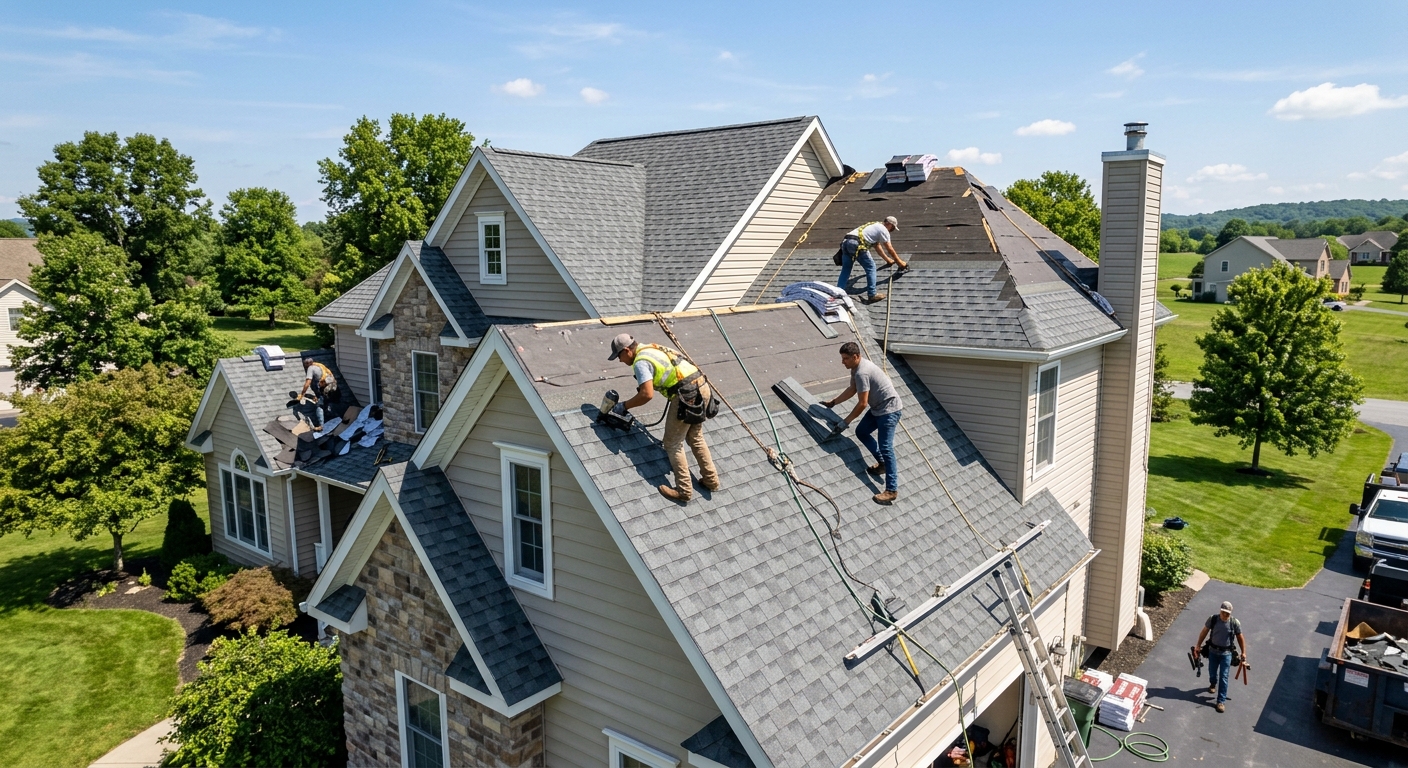
What roof replacement costs in Cheltenham in 2026
Homeowners in Cheltenham face roof replacement costs shaped by our local housing stock and climate. With a population nearing 38,000 and over 84% of homes built before 1980 (U.S. Census Bureau, ACS 2024), most Cheltenham roofs are past their first lifecycle. That age, combined with high homeownership, means demand here is steady for total roof replacement—especially asphalt shingle systems.
Post‑World War II tract housing in Abington and Cheltenham set the mold: most detached homes have roofs large enough to drive material and labor costs well above the state average. These houses typically use architectural asphalt shingles, which are favored for both affordability and to comply with HOA preferences common in the area.
For a Cheltenham home, replacing an asphalt shingle roof lands in the $10,500–$21,500 range, with metal roofing options climbing much higher. Many houses also have flat or low-slope sections on additions and porches, which require membrane roofing, further affecting scope and cost.
| Material / Scope |
Lifespan |
Best for |
Price range (installed) |
| Asphalt shingles — architectural (30-yr) |
25–30 yrs |
Most Cheltenham post‑war homes |
$10,500–$21,500 |
| Asphalt shingles — impact-resistant (Class 4) |
30+ yrs |
Storm- and hail-prone corners of Cheltenham |
$17,000–$21,500 |
| Metal standing seam |
40–70 yrs |
High-end homes or long-term owners |
$25,000–$44,500 |
| Flat roof — TPO or EPDM |
15–25 yrs |
Porches, additions, rowhouse rears |
$13,000–$26,000 |
| Roof repair — leak or isolated section |
n/a |
Spot repairs or emergency fixes |
$550–$2,100 |
Prices are estimates for a typical Cheltenham home and vary with roof size, pitch, decking condition and material selection.
Choosing a roofing material for Cheltenham's climate
Montgomery County’s ground snow load of 30 psf and winter design temperature of 14 °F make cold-weather durability a significant issue in Cheltenham. Architectural asphalt shingles remain the dominant roof material here not just by inertia—they combine cost control with reliable performance for our freeze-thaw cycles. These shingles resist cupping and cracking better than the old 3-tab kind, and their price point fits most Cheltenham budgets.
Metal standing seam roofs excel at snow-shedding, which matters after a nor’easter. But metal’s upfront cost ($25,000–$44,500) is usually too steep unless you plan to stay for decades. TPO and EPDM membranes are not meant for main pitched roofs, but they’re essential for flat or low-pitch sections where shingles fail from ponding and ice. Class 4 impact-resistant asphalt shingles offer extra storm resistance for certain exposed corners of Cheltenham, but if your house is sheltered and your insurance offers no discount, it’s rarely a cost-effective upgrade.
| Material |
Installed cost |
Lifespan |
Cold-climate performance |
Maintenance |
| Asphalt architectural |
$10,500–$21,500 |
25–30 yrs |
Handles freeze-thaw, moderate ice dam risk |
Annual inspection recommended |
| Asphalt Class 4 impact-resistant |
$17,000–$21,500 |
30+ yrs |
Strong against hail and wind |
Minimal added maintenance |
| Metal standing seam |
$25,000–$44,500 |
40–70 yrs |
Superior snow and ice shed |
Clear valleys and gutters annually |
| TPO / EPDM membrane |
$13,000–$26,000 |
15–25 yrs |
No shingle blow-off; resists ponding if installed right |
Monitor for seams and punctures |
Checking out a roofer in Cheltenham: what to verify
With Cheltenham part of the dense Philadelphia metro roofing market, low-barrier contractor entry means you’ll encounter a wide range of roofers. A legitimate contractor must hold a Pennsylvania Home Improvement Contractor (HIC) registration for any roof job over $500. Always verify this at hic.attorneygeneral.gov. Insurance is just as critical: ask for a current workers’ compensation certificate, which you can confirm yourself at WCAIS. For homes built pre-1978, make sure the contractor is EPA Lead RRP certified—check at certifiedrenovatorsearch.epa.gov.
- HIC registration number (verify at hic.attorneygeneral.gov)
- Written contract for jobs over $500 (as required by law)
- Clear, local business address (not just a PO box)
- Separate certificate of general liability insurance
- Workers’ compensation coverage, not just a certificate—check via WCAIS
- Detailed scope of work with materials and brands spelled out
- EPA Lead RRP certification for pre-1978 homes
- Payment schedule (avoid heavy upfront deposits)
- References from recent local jobs in Cheltenham or Abington
- No offer to “cover your insurance deductible” (illegal per state law)
- Photos of completed local work
- Jobsite protection and cleanup plan
Red flags in this market: contractors who show up immediately after storms (“storm chasers”), out-of-area trucks with no local address, those willing to start work “today” without paperwork, or anyone pushing a full replacement for minor repairs. Door-knocking outfits often appear in a saturated market like ours—be wary if they can’t offer recent Cheltenham references.
Roofing permits in Cheltenham: what you need before work starts
Montgomery County follows the Pennsylvania Uniform Construction Code (UCC), based on the IRC and enforced by individual municipalities. In Cheltenham, replacing more than 25% of your existing roof surface typically triggers a building permit requirement. Minor shingle repairs—such as patching under one roofing square—generally do not require a permit, but always check with your township office to confirm, especially if your project borders that threshold.
The code authority for the UCC is the Pennsylvania Department of Labor & Industry, but enforcement and permitting are handled by local township offices unless a municipality has opted out, in which case L&I steps in. Before hiring a roofer, verify their Home Improvement Contractor (HIC) registration at hic.attorneygeneral.gov and confirm current workers’ compensation insurance at wcais.pa.gov.
Written contracts are required by the Home Improvement Consumer Protection Act (HICPA) for all jobs over $500. You also have the right to cancel within three business days of signing. Whether you’re planning a complete tear-off or a membrane system for a flat roof, make sure the contractor’s paperwork is in order before any work or material delivery happens.
TPO and EPDM on Cheltenham homes
Flat roof sections are common in Cheltenham—often over porches, rear additions, or even the back half of a rowhouse. These areas cannot use regular shingles because the pitch is too shallow for water to reliably drain; shingles on anything below a 3/12 pitch will lead to leaks, rot, and expensive repairs. A flat section is always prone to slow drainage and ponding. TPO and EPDM membranes were created for these conditions: they form a watertight surface where standing water is a threat. Properly installed, they’ll last 15–25 years on a Cheltenham home, which is shorter than the 25–30 years you can get from architectural shingles on an adequate slope, but much longer than the 3–7 years you might see if someone shingled a flat area.
For most Cheltenham flat roofs, a replacement will come in at $13,000–$26,000 as of 2026, based on the size and material chosen. If a roofer quotes shingle replacement for a roof with a 2/12 pitch or less, they are signaling that long-term performance is not their first concern—walk away, because the system will almost certainly fail well before its time.
Filing a roof claim after a Pennsylvania storm
If a thunderstorm or hailstorm has damaged your Cheltenham roof, take clear photos of everything before you begin any cleanup—shingles on the ground, visible dents, leaks inside, and damage to gutters. Notify your insurer right away and request a written scope of loss from the adjuster. Insurance claims can be paid on an actual cash value (ACV) or replacement cost value (RCV) basis; ACV pays depreciated value, while RCV pays what it costs to fully restore your roof after subtracting your deductible.
The Pennsylvania Home Improvement Consumer Protection Act (HICPA) requires a written contract for any repair or replacement above $500, and you have a three-business-day window to cancel without penalty. Never agree to let a roofer “waive” or “cover” your deductible—state law prohibits this, and any contractor making that offer is exposing you to legal and insurance trouble. If your roofer pressures you to sign before an adjuster visits, or if they want to start work before the claim is settled in writing, that’s your cue to look elsewhere.
Especially after a significant storm, Cheltenham sees an influx of door-knocking crews and aggressive advertising from contractors out of the area. Stick with local references, verify their HIC registration on hic.attorneygeneral.gov, and do not pay any deposit until your scope of loss is in hand and the contract is clear.
The cost drivers behind a Cheltenham roof replacement
Roof replacement quotes in Cheltenham can swing by thousands of dollars, even between reputable contractors. The biggest drivers are roof size and complexity, but older housing stock in Cheltenham introduces unique wrinkles. Most post‑war homes here have substantial roof acreage, with multiple valleys, dormers, or additions, which means more labor and materials. The ground snow load rating of 30 psf shapes how your roof is layered and may require built-in ice barriers, adding close to $300–$800 to the tab.
Decking condition is rarely visible until the old roof comes off. With so many local homes built before 1980, it’s not unusual to uncover rotten or undersized boards needing replacement—each sheet of decking usually runs $75–$150. If you have more than one layer of old shingles, state code requires a full tear-off, which adds another $500–$1,500 or more per layer for labor and disposal. The steepness of your roof forces contractors to use harnesses and staging, driving up labor by 20–30% on tricky pitches.
| Factor |
Why it matters here |
Cost impact |
| Roof size in squares |
Each square is 100 sq ft of roof surface |
Primary multiplier |
| Pitch and access |
Steep pitches need harnesses and slow the crew |
+20–30% labour |
| Existing layers to tear off |
Two or more layers means full tear-off and disposal |
$500–$1,500 per layer |
| Decking condition |
Rot is found during tear-off, not before |
$75–$150 per sheet |
| Ice barrier at eaves |
Required where ice damming has a history |
$300–$800 |
| Material grade |
3-tab vs architectural vs Class 4 impact-resistant |
$500–$2,500 |
Frequently asked questions — roofing in Cheltenham
Does homeowner's insurance cover roof replacement in Cheltenham?
Insurance in Cheltenham usually covers roof replacement when the damage is sudden and accidental—things like windstorms, hail, or a tree falling during a thunderstorm. Insurers here will not pay for old age or wear and tear, which is common with our aging local housing stock. Before touching anything, document all storm damage: take photos inside and out, and keep every receipt. The claim process will go smoother if you have a written scope of loss from the insurance adjuster. Remember, in Pennsylvania, your roofer must provide a written contract for any job above $500, and you cannot lawfully have your deductible waived or covered—if a contractor offers to “eat” your deductible, that’s a red flag. A typical full architectural shingle replacement on a Cheltenham home runs $10,500–$21,500, but what’s covered comes down to your policy and the adjuster's findings.
Can I install new shingles over old ones in Pennsylvania?
In many Pennsylvania jurisdictions, including Cheltenham, code allows a second layer of shingles if the deck is sound and there is only one existing roof layer. However, this often isn’t advised for older Cheltenham homes, where decking may be soft or may hide rot. In Montgomery County, a full tear-off is typically required if there are two or more layers or if you’re switching materials. Adding a new layer saves on labor, but you miss the chance to address leaks, rot, or code-required ice barriers. Instead of over-layering, most homes in Cheltenham opt for a full replacement, priced at $10,500–$21,500 for architectural shingles. Always ask your contractor to inspect the deck before making the call.
Do I need to leave my house during a roof replacement?
Most Cheltenham homeowners stay in their houses while a new roof is installed. A complete tear-off and replacement is noisy and disruptive, especially in homes built before 1980 where nail pops and debris in attics are common. Plan ahead—move cars out of the driveway, protect attic contents, and expect several days of hammering. Contractors must keep sites safe and clean per state consumer protection law, and reputable companies in Cheltenham take care to protect landscaping and daily access. For a typical asphalt roof job here ($10,500–$21,500), the project usually lasts two to four days unless weather intervenes or structural repairs are discovered.
What's the cheapest way to replace a roof in Cheltenham?
Cheltenham’s most budget-friendly roof replacement is usually a basic architectural asphalt shingle system—nothing fancy, but it works with the majority of our roofs from the 1950s and 1960s. Cutting corners with the cheapest crew, skipping code-required underlayment, or overlaying new shingles on unknown layers is a gamble for older homes here. A no-frills architectural replacement starts around $10,500 for smaller ranches. If a quote is far below that, be skeptical—bargain pricing often means lack of insurance, using leftover materials, or omitting ice barriers that are needed for our winters.
How much deposit should I pay a roofer upfront?
Pennsylvania law limits home improvement deposits to no more than one-third of the contract price for jobs over $500. Many Cheltenham contractors ask for 10–20% up front to cover materials with the rest due at substantial completion. For a typical architectural shingle job at $17,000, expect a fair deposit to land between $1,700 and $5,600. If a contractor wants full—or even half—payment before starting, look elsewhere. Always get a written contract, as required by the Home Improvement Consumer Protection Act, and document each payment made.
Why do roofs fail faster in southeastern Pennsylvania?
In Cheltenham and the rest of southeastern Pennsylvania, roofs cycle between humid, hot summers and freeze-thaw winters. The 30 psf ground snow load and the moderate but regular winter temperature dips to 14 °F cause shingle materials to expand, contract, and eventually crack. Many local homes have ventilation issues in attic spaces, compounding the problem and causing shingles to age prematurely. Most national warranties say 30 years, but it’s not unusual to see replacement needed after 18–22 years here. That’s why our most common replacements, at $10,500–$21,500 for architectural shingles, are often done sooner than homeowners expect.
What are the signs of hail damage on a roof?
In Cheltenham, after a hailstorm, you might see impact marks on shingles—think random, circular pockmarks where granules are knocked off, exposing darker asphalt below. Gutters and soft metals (like vent caps) will also show dings and dents. Hail won’t always cause immediate leaks, but it opens the roof to accelerated wear. Insurance adjusters will document these impacts and may approve a full or partial replacement, which for architectural shingles here is $10,500–$21,500. It’s wise to get a professional inspection, as some hail damage can go unnoticed from ground level yet still qualify for a claim.
How much does it cost to repair a roof leak in Cheltenham?
A typical leak repair in Cheltenham falls between $550–$2,100, depending on access, roof height, and extent of the damage. If caught early, fixing a flashing or valley leak may be quick and inexpensive, but neglect can turn a $550 patch into a several-thousand-dollar replacement. Local contractors see a lot of leak calls right after summer storms or during winter thaws, especially on older, patched roofs. Always document the problem area with photos for your own reference, in case the damage escalates or you need to involve insurance.
What underlayment should be used on a Cheltenham roof?
A Cheltenham roof needs underlayment that stands up to our region’s mix of snow and humidity. For nearly every pitched shingle roof here, a synthetic roofing underlayment is the new standard, with an ice and water shield required at all eaves—especially given the 30 psf snow load and risk of ice dams. For code compliance and insurance purposes, don’t skip this step. While felt is legal, it’s mostly reserved for budget replacements. Full-layer ice barrier runs about $300–$800 extra, but is well worth it for homes with a history of winter leaks or for those with longer eave runs.