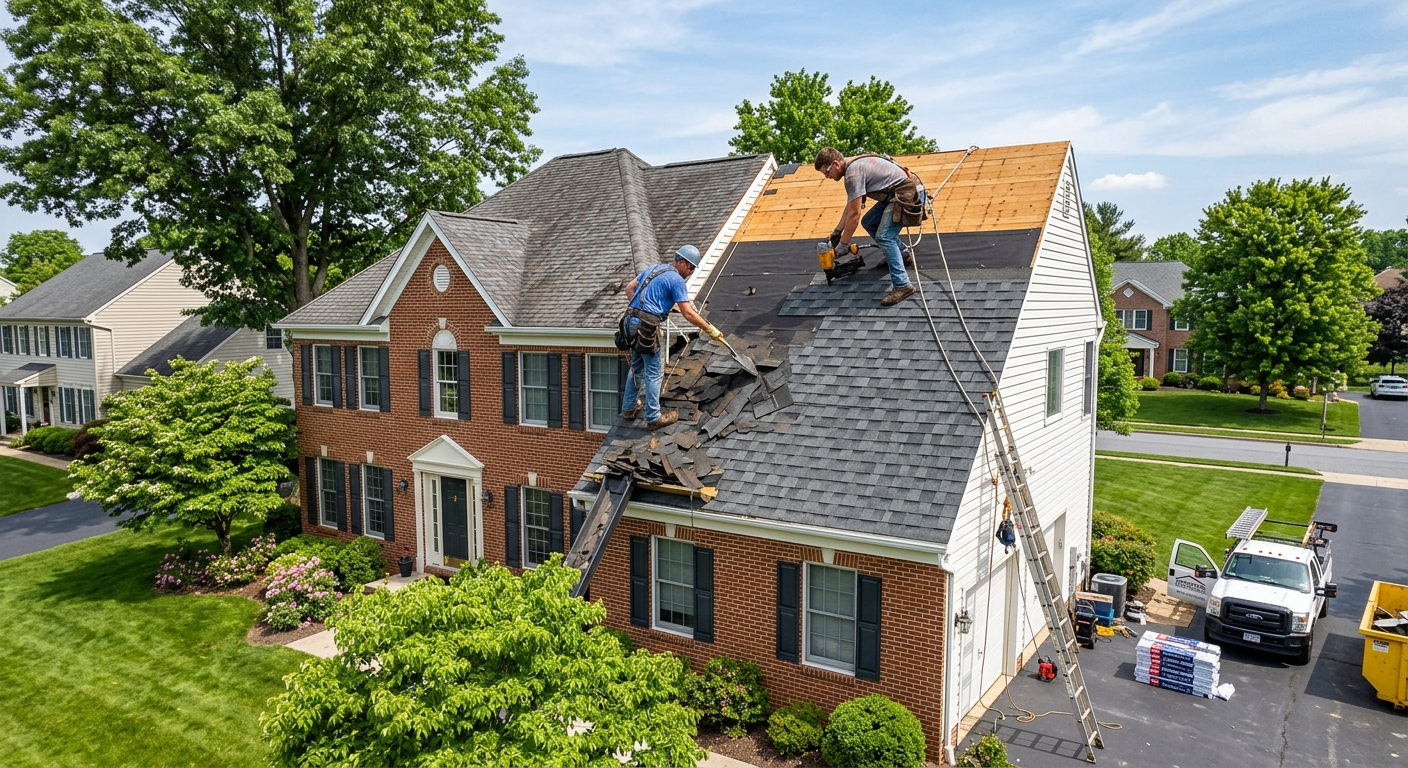
Cecil roofing prices by material and scope — 2026
Cecil’s roofing market is shaped by its suburban growth and a high homeownership rate. Nearly three out of every four homes here are owner-occupied, and with over 35% built before 1980, many roofs are reaching replacement age (U.S. Census Bureau, ACS 2024). In particular, the post‑1960 boom in Peters and neighboring North Strabane Townships led to a landscape of split-levels and ranch houses, most built with architectural asphalt shingles. These houses typically require full tear-off replacements, often involving large uninterrupted roof areas that drive up both material and disposal costs.
Cecil homeowners should know—most replacement jobs involve not just shingle installation but also addressing older plywood decking and worn ventilation components, especially on 60s–70s era homes. Because the Pittsburgh area’s contractors are concentrated along the I-79 corridor, competitive pricing keeps scam bids in check, but also means project standards are visible and replicable. Below is what you can expect to pay for different roofing material choices or repair scopes in Cecil.
| Material / Scope |
Lifespan |
Best for |
Price range (installed) |
| Asphalt shingles — architectural (30-yr) |
25–30 yrs |
Most Cecil homes |
$10,000–$21,000 |
| Asphalt shingles — impact-resistant (Class 4) |
30+ yrs |
Storm-prone areas, insurance incentives |
$16,500–$21,000 |
| Metal standing seam |
40–70 yrs |
Long-term value, snow shedding |
$24,500–$43,500 |
| Flat roof — TPO or EPDM |
15–25 yrs |
Porches, additions, low-slope sections |
$12,500–$25,500 |
| Roof repair — leak or isolated section |
n/a |
Local leaks, urgent patches |
$550–$2,000 |
Prices are estimates for a typical Cecil home and vary with roof size, pitch, decking condition and material selection.
Checking out a roofer in Cecil: what to verify
When hiring a roofer in Cecil, protect yourself by verifying credentials—not just taking a business card at face value. Pennsylvania requires all contractors with contracts over $500 to have Home Improvement Contractor (HIC) registration, which you can confirm at hic.attorneygeneral.gov. Written contracts are mandatory under the Home Improvement Consumer Protection Act, and you have a legal right to cancel within three business days. For workers’ compensation, all employers must carry coverage—look it up via WCAIS at wcais.pa.gov before work begins. If your home was built before 1978, also check for EPA Lead RRP certification at certifiedrenovatorsearch.epa.gov.
- Is HIC registration current? (hic.attorneygeneral.gov)
- Written contract provided, no handshake deals
- 3-day right of cancellation spelled out
- EPA Lead RRP certificate for pre-1978 homes
- Workers’ compensation coverage verified (wcais.pa.gov)
- Physical address in Washington County or the Pittsburgh metro
- Job references in Peters, Cecil, or North Strabane
- Insurance certificate—liability, not just comp
- Full start-to-finish timeline in writing
- Warranty terms for labor and materials
- No offer to “waive your deductible” (illegal under HICPA)
Red flags specific to Cecil’s saturated roofing market: out-of-state license plates trolling storms, high-pressure sales tactics right after a hail or wind event, refusing to list a local physical address, or skipping registration under the state’s HIC law. Door-knocking crews are common after summer storms due to the dense contractor presence along the I-79 corridor.
Roofing permits in Cecil: what you need before work starts
In Cecil Township, as in much of Washington County, a building permit is typically required for full roof replacements that involve a tear-off. Minor shingle repairs or patching on a single-family home usually don't trigger permitting in boroughs around Washington, but a full re-roof or structural change does. Permit enforcement and inspection fall to each township’s building code department—this authority is spelled out by the Pennsylvania Uniform Construction Code (UCC), which is based on the IRC and enforced locally or, if a township opts out, by the PA Department of Labor & Industry.
Before you sign a contract, verify your roofer’s Home Improvement Contractor (HIC) registration at hic.attorneygeneral.gov. Written contracts (not verbal agreements) are required by state law for work exceeding $500, and you’ll want to confirm your roofer carries valid workers’ compensation for all employees, not just for “office staff”—check this yourself at wcais.pa.gov. These checks are not optional: working with an unregistered or uninsured contractor puts your finances and home at real risk should an accident or code violation occur.
What a proper Cecil roofing quote contains
A legitimate roofing estimate in Cecil should spell out every detail you’re paying for, starting with the roof area measured in squares (one square equals 100 square feet), the pitch, and specific line items for tear-off, disposal, and decking. Ask for the underlayment and ice barrier products by brand and type; vague terms like “felt” or “ice guard” are signs the contractor wants you to guess at the quality. Decking replacement—often required on homes from Cecil’s suburban expansion era—should be priced per sheet as a contingency, not lumped in or skipped. Flashing, vent boots, and ridge vents must be listed. Finally, the quote should separate manufacturer and workmanship warranties and break down the payment schedule; any demand for a large upfront deposit is a red flag.
| Line item |
What to look for |
Red flag if… |
| Roof area |
stated in squares, with pitch |
no measurement given |
| Tear-off and disposal |
number of layers, dumpster included |
bundled into one figure |
| Underlayment |
product type and coverage |
listed only as 'felt' |
| Ice and water shield |
coverage height at eaves |
omitted entirely |
| Decking |
per-sheet contingency price |
no allowance at all |
| Warranty |
workmanship years stated separately |
only the shingle warranty |
| Payment |
deposit under 15%, balance on completion |
large upfront cash |
Low-slope and flat roofs in Cecil
Many Cecil homes have at least one low-slope section—maybe a rear addition, covered porch, or a section over a garage. These aren’t candidates for regular shingles, no matter what a fast-talking roofer claims. Western Pennsylvania’s heavy freeze-thaw cycles mean water will work its way under standard shingles at any pitch below 3/12. On a 2/12 or lower slope, shingles simply fail: they can’t shed ponding water, which results in leaks and rotted decking.
A flat or low-slope section needs a true membrane—usually TPO or EPDM single-ply. These membranes are heat-welded or glued in place and can handle ponding. Lifespan is typically 15–25 years, shorter than the pitched roof, but far better than premature failure if you try to cheat. Flat roof replacement on a porch, addition, or low-slope room in Cecil generally falls in the $12,500–$25,500 range, depending on size and complexity. If a roofer quotes shingles for anything flatter than a 3/12 pitch, that’s a warning—they're either uninformed or cutting corners at your expense.
Why gutters get replaced with the roof
In Cecil, roof replacement frequently includes the gutters, because water management is one system—roof, drip edge, gutters, downspouts, and how water leaves your foundation all need to work together. Older gutters often get damaged during tear-off or have outlived their function (especially on 1960s–70s era homes). Replacing just the roof but leaving old gutters is leaving half the job unfinished: if discharge spills too close to your foundation, you risk basement seepage and even structural damage over time.
Most roofing manufacturer warranties actually require functioning gutters and proper drainage—that’s not just fine print, it’s protection for both you and the installer. Seamless aluminum gutter replacement (installed with the roof) for a Cecil home typically runs $2,400–$5,200 depending on house footprint and number of downspouts. Gutter guards, if needed, add another $900–$2,100.
The scope items Cecil homeowners don't budget for
The most common surprises on a Cecil roofing job are those hidden scope items that surface only once the old shingles come off. First is rotted or delaminated decking—especially on homes built before 1980 and those with past ice damming—requiring sheeting at $90–$140 per 4x8 sheet installed. Inadequate attic ventilation is another silent budget buster: without continuous ridge and soffit venting, heavy winter freezes can create ice dams that force water under shingles, leading to leak damage. Fixing inadequate attic vents typically costs $350–$1,100.
Other unbudgeted repairs include replacing chimney or wall flashing ($350–$850 per area), pipe boots ($85–$200 each), and installing new drip edge and ridge vent ($450–$1,000 for a typical roof). In our southwestern Pennsylvania climate, failing to address attic ventilation or flashing isn’t just an energy issue—it sets up a roof for repeated leaks, wood rot, and shingle warranty denial.
Experienced Cecil contractors spell out these potential costs in the initial quote, usually with line-item contingencies. If you don’t see them listed, be wary—either the roofer hasn’t done enough local work or intends to pass along “extra” charges after your roof is already in pieces.
Frequently asked questions — roofing in Cecil
Should I use a local roofer or a national company?
In Cecil and the greater Washington County area, hiring a local roofer almost always delivers better value and accountability. Local contractors know the quirks of split-level and ranch roofs built during Cecil’s suburban expansion, the freeze-thaw demands for attic ventilation, and the typical patterns of storm damage we see in the Ohio Valley corridor. A roofer anchored in this market is easier to reach if there’s a warranty issue down the line—meanwhile, national chains or out-of-town crews sometimes disappear after a hail event. Local companies also price competitive with market norms: a quality asphalt shingle replacement runs $10,000–$21,000 in Cecil, and local references in nearby Peters or North Strabane should be easy to check. Use a national company only if they have a permanent presence and physical address here—not just a short-term office.
How much does a flat roof replacement cost in Cecil?
Flat roof replacement—whether TPO or EPDM—in Cecil generally falls between $12,500–$25,500, depending on the square footage and any special details like integrated gutters or parapet walls. Most houses that need flat roof work in this area have it on a rear addition, porch, or garage section built with a low slope. The price reflects prep, insulation if needed, single-ply membrane, and custom flashing. Because our freeze-thaw climate stresses seams and ponding spots, a proper flat roof quote should include drainage correction to prevent water from standing after storms. Don’t let anyone sell you shingles on a pitch under 3/12 here—it’s not code, and your money will be wasted long before the warranty is up.
How long does a roof replacement take in Cecil?
For a typical Cecil ranch or split-level home, most asphalt shingle replacements are completed in 1–3 days—sometimes four if weather delays or rot repair crops up. Metal roofing projects tend to run 3–5 days due to custom fabrication and detail work. If you have decking replacement or new ventilation added, expect the schedule to extend by a day. There’s a dense roofing contractor presence here, so crews are experienced and move quickly, but always check that your written contract spells out both start and completion dates. Rushed national outfits may promise “one day” turnarounds, but quality installs—especially in winter, or on 1960s–70s era homes—aren’t worth shortcuts. Full roof replacements in Cecil run $10,000–$21,000, so make sure the job isn’t just fast, but also thorough.
Does roof pitch affect the price in Cecil?
Yes, pitch makes a noticeable difference in project cost in Cecil. On a walkable 4/12 or 5/12 pitch, labor proceeds faster and fewer safety measures are required, which is reflected in the lower end of the price band ($10,000–$13,500) for asphalt shingle replacements. Steeper roofs, like 10/12 or 12/12, increase both labor time and crew risk, pushing projects to the upper end—often $18,000–$21,000 with scaffolding, harnesses, or extra crew members. Flat or low-slope roofs can cost less in materials but require specialty membrane systems—no one-size-fits-all price applies, so always get a quote with pitch specifically stated. In short: the steeper or trickier your roof, the more you can expect to pay in Cecil.
What are the signs of hail damage on a roof?
Hail storms do track through Washington County from the Ohio Valley corridor, and shingles here can show bruising, loss of granules, cracking, and pock marks after even a moderate hail event. On architectural asphalt roofs, look for bare fiberglass spots, random circular marks, or little piles of granules by the downspouts—the latter means shingles are breaking down. You might also see dented metal vent caps or soft spots underfoot on older decking. If you suspect hail damage in Cecil, don’t just take a door-to-door contractor’s word for it—get a photo inspection and written findings. Insurance will often cover leaks or replacement if a genuine hail event is documented, but claims are scrutinized. A repair here costs $550–$2,000, while full replacement is $10,000–$21,000 if damage is severe.
What is the best roofing material for Cecil's climate?
The best balance of cost, durability, and code compliance in Cecil is still the architectural asphalt shingle—what most post‑1960 homes were built with and what local suppliers stock year-round. They reliably last 25–30 years if installed with proper ventilation and ice barrier. Metal (standing seam) is the long-life option—great for snow shedding and hail, but comes at a premium: $24,500–$43,500 installed. Flat roof sections must use TPO or EPDM membrane; never shingles. Given the heavy freeze-thaw cycles and storm exposure specific to this Ohio Valley market, what matters most is the quality of materials and following manufacturer specs specific to our 8 °F winter design temperate and 30 psf ground snow load.
Will filing a roof claim raise my premium?
In Pennsylvania—including Cecil—filing a hail or wind claim may affect your future premiums, especially if it becomes a trend in your ZIP code. Insurers spread risk across regions, so one isolated claim for a $1,200 repair ($550–$2,000 band) will have less impact than repeated claims in the neighborhood. However, you’re not punished for using your insurance after genuine storm loss. Where you do get into trouble is with repeated small claims or fraudulent “hail damage” claims pushed by aggressive door-knocking crews (a known problem in Washington County post-storm events). Always document with photos and get an adjuster involved early, and know that your right to a claim is protected—but exercise it judiciously.
Does Cecil get enough hail to justify Class 4 shingles?
Cecil sits in the path of the Ohio Valley hail and wind corridor, so Class 4 impact-rated shingles are worth considering if you plan to keep the house long-term or want insurance discounts. These shingles cost more up front—roofing a typical home with Class 4s falls between $16,500–$21,000—but they stand up better to sporadic hail events, which Washington County gets more than neighboring Appalachian counties. Some insurers offer premium breaks for Class 4 roofs, but you’ll want to check if that applies in your ZIP code. For most homes here, architectural-grade regular shingles are sufficient, but if you’ve had repeat hail, the extra investment is justified. A good local roofer can show sample hail marks and performance differences right on-site.
How do I confirm a roofer carries workers' compensation?
In Pennsylvania—Cecil included—every roofing contractor with employees is required to carry active workers’ compensation insurance. Don’t settle for a photocopy: you can check real-time coverage status at the official WCAIS database (wcais.pa.gov) with the contractor’s name and business address. This coverage protects you from liability if a worker gets injured on your property—a special concern for roof work, which carries high accident risk. Some outfits try to skirt the law by claiming “all 1099 labor” or “family only”—don’t buy it. Also remember, the state Home Improvement Contractor (HIC) registry at hic.attorneygeneral.gov is a separate check for registration, not the same as proof of insurance. Verifying both before starting your $10,000–$21,000 roofing project is your best line of defense as a homeowner.